

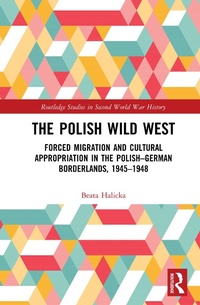
The Polish Wild West
Forced Migration and Cultural Appropriation in the Polish-German Borderlands, 1945-1948
1st Edition
Published on 12. May 2020
412 pages
978-1-000-06003-4 (ISBN)
Description

The incorporation of German territories east of the Oder and Western Neisse rivers into Poland in 1945 was linked with the difficult process of an almost total exchange of population and involved the taking over of a region in which the Second World War had effected an enormous level of destruction. The contemporary term 'Polish Wild West' not only alluded to the reigning atmosphere of chaos and 'survival of the fittest' in the Polish-German borderland but was also associated with a new kind of freedom and the opportunity to start everything anew. The arrival in this region of Polish settlers from different parts of Poland led to Poles, Germans and Soviet soldiers temporarily coming into contact with one another. Living together in this war-damaged space was far from easy.
On the basis of ego-documents, the author recreates the beginnings of the shaping of this new society, one affected by a repressive political system, internal conflicts and human tragedy. In distancing oneself from the until-recently dominant narratives concerning expellees in Germany or pioneers of the 'Recovered Territories' in Poland, Beata Halicka tells the story of the disintegration of a previous cultural landscape and the establishment of one which was new, in a colourful and vivid manner and encompassing different points of view.
On the basis of ego-documents, the author recreates the beginnings of the shaping of this new society, one affected by a repressive political system, internal conflicts and human tragedy. In distancing oneself from the until-recently dominant narratives concerning expellees in Germany or pioneers of the 'Recovered Territories' in Poland, Beata Halicka tells the story of the disintegration of a previous cultural landscape and the establishment of one which was new, in a colourful and vivid manner and encompassing different points of view.
Reviews / Votes
"It is marvelous that Halicka's rich source base is finally accessible to English-language specialists and classrooms, for it conveys many complexities of the grass roots human experience of forced migration." - Andrew Demshuk, American UniversityMore details
Series
Edition
1. Auflage
Language
English
Place of publication
London
United Kingdom
Publishing group
Taylor & Francis Ltd
Target group
College/higher education
Illustrations
20 Halftones, black and white; 20 Illustrations, black and white
ISBN-13
978-1-000-06003-4 (9781000060034)
Copyright in bibliographic data and cover images is held by Nielsen Book Services Limited or by the publishers or by their respective licensors: all rights reserved.
Schweitzer Classification
Other editions
Additional editions
Beata Halicka
The Polish Wild West
Forced Migration and Cultural Appropriation in the Polish-German Borderlands, 1945-1948
Book
12/2021
1st Edition
Routledge
€68.50
Shipment within 10-20 days
Beata Halicka
The Polish Wild West
Forced Migration and Cultural Appropriation in the Polish-German Borderlands, 1945-1948
Book
05/2020
1st Edition
Routledge
€179.51
Shipment within 15-20 days
Beata Halicka
The Polish Wild West
Forced Migration and Cultural Appropriation in the Polish-German Borderlands, 1945-1948
Book
05/2020
Routledge
Unfortunately, price unknown
Available (delivery time upon request)
Person
Beata Halicka is Professor of history of Central and Eastern Europe at the Adam Mickiewicz University in Poznan, Poland. Her book, Poland's Wild West, was published in Polish and German and received the Identities Prize 2016 for the best historical book in Poland. For more on this, please visit: http://beatahalicka.pl/
Content
1. Introduction
1.1 State of research
1.2 Conceptual basis
1.3 Sources and methods
2. The Oder Region and the Polish 'Wild West'
3. 'The most difficult language in the world' - a literary introduction to the subject
4. The Deconstruction of the Oder Region
4.1 'We had no idea about anything that went on in the East'
4.2 'The Master Race' and Polish forced labourers in the Oder Region
4.3 The flight of Germans as seen through the eyes of Polish forced labourers
4.4 'When the Russians arrived ...'
5. Dealing with Obstacles
5.1 The Oder Region's Road to the new Polish state
5.2 Soviet headquarters and the first Polish settlers
5.3 'Treat the Germans as they treated us'
6. Poland on the Move - the Migration of People
6.1 The so-called repatriation of Poles from the East - in cattle cars to the bosom of the nation?
6.2 Internal resettlement - in search of better living conditions
6.3 From forced labour to the 'Recovered Territories'
7. Arrival in the Oder Region
7.1 In a strange, desolate world
7.2 Any old roof over one's head at the beginning or a hunt for the most beautiful home?
7.3 A period of transition - Germans and Poles living together
8. A successful takeover? A typology of the New Settlers
8.1 Victims of war sitting on suitcases and tired of life
8.2 Looters - the post-war migration of people on business?
8.3 Zealous pioneers of the 'Recovered Territories'
9. The Appropriation of One's Space
9.1 The post-war clean-up
9.2 New schools, institutions, associations - society organises itself
9.3 Religious life and the appropriation of German churches
9.4 The beginnings of agriculture and the consequences of incomplete agricultural reforms
9.5 The pioneering spirit of small businesspeople and government mismanagement
9.6 The German labour force and the resettlement of the Germans
9.7 The new balance of power and the 1946 referendum - what did people really vote for?
10. A New Society - A Cultural and Ethnic Mix
10.1 Poznanians, Poles from central Poland and the eastern borderlands, indigenous inhabitants, Jews, Ukrainians, Germans, Gypsies, Greeks, repatriates from Western and Southern Europe, as well as late expellees from the Soviet Union
10.2 The loss of cultural diversity and the concept of an ethnically homogenous state
10.3 The building of a new society - a short summary
11. The Myth of the 'Polish Wild West' a Decade Later
Outline of Primary and Secondary Sources
Index
1.1 State of research
1.2 Conceptual basis
1.3 Sources and methods
2. The Oder Region and the Polish 'Wild West'
3. 'The most difficult language in the world' - a literary introduction to the subject
4. The Deconstruction of the Oder Region
4.1 'We had no idea about anything that went on in the East'
4.2 'The Master Race' and Polish forced labourers in the Oder Region
4.3 The flight of Germans as seen through the eyes of Polish forced labourers
4.4 'When the Russians arrived ...'
5. Dealing with Obstacles
5.1 The Oder Region's Road to the new Polish state
5.2 Soviet headquarters and the first Polish settlers
5.3 'Treat the Germans as they treated us'
6. Poland on the Move - the Migration of People
6.1 The so-called repatriation of Poles from the East - in cattle cars to the bosom of the nation?
6.2 Internal resettlement - in search of better living conditions
6.3 From forced labour to the 'Recovered Territories'
7. Arrival in the Oder Region
7.1 In a strange, desolate world
7.2 Any old roof over one's head at the beginning or a hunt for the most beautiful home?
7.3 A period of transition - Germans and Poles living together
8. A successful takeover? A typology of the New Settlers
8.1 Victims of war sitting on suitcases and tired of life
8.2 Looters - the post-war migration of people on business?
8.3 Zealous pioneers of the 'Recovered Territories'
9. The Appropriation of One's Space
9.1 The post-war clean-up
9.2 New schools, institutions, associations - society organises itself
9.3 Religious life and the appropriation of German churches
9.4 The beginnings of agriculture and the consequences of incomplete agricultural reforms
9.5 The pioneering spirit of small businesspeople and government mismanagement
9.6 The German labour force and the resettlement of the Germans
9.7 The new balance of power and the 1946 referendum - what did people really vote for?
10. A New Society - A Cultural and Ethnic Mix
10.1 Poznanians, Poles from central Poland and the eastern borderlands, indigenous inhabitants, Jews, Ukrainians, Germans, Gypsies, Greeks, repatriates from Western and Southern Europe, as well as late expellees from the Soviet Union
10.2 The loss of cultural diversity and the concept of an ethnically homogenous state
10.3 The building of a new society - a short summary
11. The Myth of the 'Polish Wild West' a Decade Later
Outline of Primary and Secondary Sources
Index
