

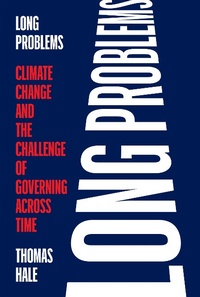
Long Problems
Climate Change and the Challenge of Governing Across Time
1st Edition
Published on 12. June 2024
256 pages
978-0-691-23813-5 (ISBN)
Description

Political strategies for tackling climate change and other "long problems" that span generations
Climate change and its consequences unfold over many generations. Past emissions affect our climate today, just as our actions shape the climate of tomorrow, while the effects of global warming will last thousands of years. Yet the priorities of the present dominate our climate policy and the politics surrounding it. Even the social science that attempts to frame the problem does not theorize time effectively. In this pathbreaking book, Thomas Hale examines the politics of climate change and other "long problems." He shows why we find it hard to act before a problem's effects are felt, why our future interests carry little weight in current debates, and why our institutions struggle to balance durability and adaptability. With long-term goals in mind, he outlines strategies for tilting the politics and policies of climate change toward better outcomes.
Globalization "widened" political problems across national boundaries and changed our understanding of politics and governance. Hale argues that we must make a similar shift to understand the "lengthening" of problems across time. He describes tools and strategies that can, under certain conditions, allow policymakers to anticipate future needs and risks, make interventions that get ahead of problems, shift time horizons, adapt to changing circumstances, and set forward-looking goals that endure. As the climate changes, politics must, too. Efforts to solve long-term problems-not only climate change but other issues as well, including technology governance and demographic shifts-can also be a catalyst for a broader institutional transformation oriented toward the long term. With Long Problems, Hale offers an essential guide to governing across time.
Climate change and its consequences unfold over many generations. Past emissions affect our climate today, just as our actions shape the climate of tomorrow, while the effects of global warming will last thousands of years. Yet the priorities of the present dominate our climate policy and the politics surrounding it. Even the social science that attempts to frame the problem does not theorize time effectively. In this pathbreaking book, Thomas Hale examines the politics of climate change and other "long problems." He shows why we find it hard to act before a problem's effects are felt, why our future interests carry little weight in current debates, and why our institutions struggle to balance durability and adaptability. With long-term goals in mind, he outlines strategies for tilting the politics and policies of climate change toward better outcomes.
Globalization "widened" political problems across national boundaries and changed our understanding of politics and governance. Hale argues that we must make a similar shift to understand the "lengthening" of problems across time. He describes tools and strategies that can, under certain conditions, allow policymakers to anticipate future needs and risks, make interventions that get ahead of problems, shift time horizons, adapt to changing circumstances, and set forward-looking goals that endure. As the climate changes, politics must, too. Efforts to solve long-term problems-not only climate change but other issues as well, including technology governance and demographic shifts-can also be a catalyst for a broader institutional transformation oriented toward the long term. With Long Problems, Hale offers an essential guide to governing across time.
More details
Other editions
Additional editions
Book
02/2026
Princeton University Press
€24.00
Shipment within 10-20 days
Book
04/2024
Princeton University Press
€31.50
Shipment within 10-20 days
Person
Thomas Hale is professor of global public policy at the Blavatnik School of Government, University of Oxford. His previous books include Beyond Gridlock, Between Interests and Law: The Politics of Transnational Commercial Disputes, Transnational Climate Change Governance, and Gridlock: Why Global Cooperation Is Failing When We Need It Most.
Content
- Cover
- Contents
- Acknowledgments
- 1. Long Problems
- A Carbon View of Politics
- The Argument in Brief
- Defining Problems and Their Length
- Why We Need to Govern Long Problems
- About This Book
- 2. Why Long Problems Are Hard to Govern
- Short-Termism: The Tyranny of the Present
- Shadow Interests: Decision-Takers Have No Power over Decision-Makers
- Institutional Lag: Dynamic Problem Structures
- The Early Action Paradox: Uncertainty, Salience, Obstructionism, and Muddling Through
- 3. Forward Action: Addressing the Early Action Paradox
- Information and Foresight: Making the Future Known and Salient
- Experimentalism: Overcoming Uncertainty
- Catalysts: Eroding Obstructionism
- 4. The Long View: Addressing Shadow Interests
- Representation: Voices for Future Generations
- Trusteeship: Insulation and Tying Our Hands
- Horizon-Shifting: Changing Preferences
- 5. Endurance and Adaptability: Addressing Institutional Lag
- Endurance: Goal-Setting
- Reflexive Governance: Updating Institutions
- Triggers and Reserves: Combining Durability and Adaptability
- 6. Studying Long Problems
- Taking the Period of Analysis Seriously
- Existing Tools
- Rates of Change
- Dynamic Problem Structure Chains
- Empirical Analysis of the Future
- 7. Governing Time
- An Institutional Agenda on Climate Change
- How Do We Get There: Climate Change and Institutional Change
- Learning to Fly
- Appendix 1: Why We Face More Long Problems Now
- The Collision of Human and Planetary Timescales
- Science and Technology Allow Us to See the Future More Clearly and to Affect It More Decisively
- A Changing Normative Frame? The Growing Moral Shadow of the Future
- Appendix 2: The Role of Acceleration
- Notes
- References
- Index
