

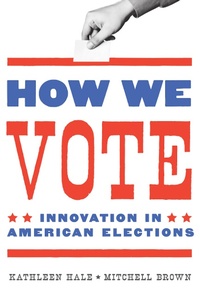
How We Vote
Description

Public Administration / Politics
"Through this book, readers will not only gain a better understanding about how voting has evolved in America over the past two decades, but will gain a greater understanding of the plethora of factors that have gotten us to where we are today. A must-read."
- Charles Stewart III, Kenan Sahin Distinguished Professor of Political Science, Massachusetts Institute of Technology
If recent US elections have taught us anything, it's that the administration of free and fair elections is anything but simple. Election officials work in an intergovernmental environment of constant change and intense partisanship. Voting practices and funding vary from state to state. Multiple government agencies, the judicial system, voting equipment vendors, nonprofit groups, and citizen activists influence practices and impact change. Meanwhile, pessimistic media assessments abound.
Yet, despite these real challenges, Kathleen Hale and Mitchell Brown make the case that election officials are largely successful in their work to facilitate, protect, and evolve the voting process. In How We Vote, Hale and Brown explore how election officials work, how ballots are cast and counted, and how jurisdictions seek to innovate and improve the voting process while also guaranteeing its security.
Using original data gathered from state and local election officials and policymakers across the United States, Hale and Brown analyze innovations in voter registration, voting options, and voter convenience, and they examine support for voting in multiple languages, the integrity of the voting process, and voting system technology. The result is a fascinating picture of how we vote now and how we will vote in the future.
Kathleen Hale is a professor in the Department of Political Science at Auburn University, where she directs the graduate program in election administration. She is the author of the award-winning How Information Matters: Networks and Public Policy Innovation (Georgetown University Press, 2011).
Mitchell Brown is a professor in the Department of Political Science at Auburn University and associate editor of the Journal of Political Science Education.
More details
Other editions
Additional editions

Persons
Kathleen Hale is a professor in the Department of Political Science at Auburn University, where she directs its graduate program in election administration. She is the author of the award-winning How Information Matters: Networks and Public Policy Innovation (Georgetown University Press, 2011).
Mitchell Brown is a professor in the Department of Political Science at Auburn University and associate editor of the Journal of Political Science Education.
Together, Hale and Brown direct the Election Administration Initiative at Auburn University. They are the coauthors of Applied Research Methods in Public and Nonprofit Organizations and Administering Elections: How American Elections Work with Robert Montjoy. They are coeditors of The Future of Election Administration as well as The Future of Election Administration: Cases and Conversations with Bridgett King.
Content
Introduction
1. The Federal System and the Politics of Election Administration
2. Innovation in Complex Systems
3. Innovations in Administering Voter Registration
4. Catalysts for Convenience Voting
5. Collaboration on Language Assistance
6. Administrative Innovations in Counting Ballots
7. Technology and Security in Election Administration
8. Measurement, Innovation, and Election Administration
Conclusion
Appendix A: List of US Supreme Court and Federal Court Cases
Appendix B: List of Major Federal Laws
Appendix C: Methodology
References
About the Authors
Index
