

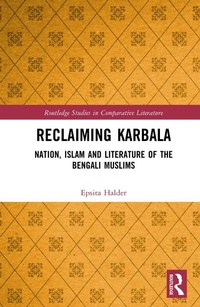
Reclaiming Karbala
Nation, Islam and Literature of the Bengali Muslims
1st Edition
Published on 18. May 2023
346 pages
978-1-000-53167-1 (ISBN)
Description

Analysing an extensive range of texts and publications across multiple genres, formats and literary lineages, Reclaiming Karbala studies the emergence and formation of a viable Muslim identity in Bengal over the late-19th century through the 1940s. Beginning with an explanation of the tenets of the battle of Karbala, this multi-layered study explores what it means to be Muslim, as well as the nuanced relationship between religion, linguistic identity and literary modernity that marks both Bengaliness and Muslimness in the region.This book is an intervention into the literature on regional Islam in Bengal, offering a complex perspective on the polemic on religion and language in the formation of a jatiya Bengali Muslim identity in a multilingual context. This book, by placing this polemic in the context of intra-Islamic reformist conflict, shows how all these rival reformist groups unanimously negated the Karbala-centric commemorative ritual of Muharram and Shi'i intercessory piety to secure a pro-Caliphate sensibility as the core value of the Bengali Muslim public sphere.
Reviews / Votes
This magnificent book sheds completely new light on the literary production and language choices of Bengal Muslims over three centuries, considering a vast array of texts in manuscript and printed form against the backdrop of successive waves of religious reform. Reclaiming Karbala shows how shifts in vocabulary, register and narrative focus need to be understood in the light of theological, political and aesthetic positions and debates. The book greatly adds to our understanding of the articulations of Muslim modernity, but also of Bengali literary modernity. The Bengal Renaissance will never look the same again.-Prof Francesca Orsini, Professor emerita of Hindi and South Asian Literature, SOAS, University of London, UK
The struggle of Muslims in Bengal to create an identity-based literature is generally lost in nationalist historiography of the nineteenth and twentieth centuries; here Epsita Halder has painstakingly peeled away the complex layers of this engagement by focusing on the central role of the Karbala narrative. The Shi'i insistence on martyrdom and Muharram ritual enactments faced a Sunni reaction that sought to suppress practice while appropriating the trope, emphasizing the place of Hasan and Husayn in Muhammad's family, ahl al-Bayt. Identity mediated through story ignited vigorous debates over the role of Urdu, and the utility of Persian- and Urdu-inflected dobha?i Bangla versus the formal standards of Sanskritic sadhu bha?a, including for the translation of the Qur'an. This is a must read to understand the spirited literary legacy that still shapes contemporary sensibilities of what it means to be both Bengali and Muslim.
-Prof Tony K. Stewart, Gertrude Conaway Vanderbilt Chair in Humanities, Emeritus, Vanderbilt University, USA
More details
Series
Edition
1. Auflage
Language
English
Place of publication
London
United Kingdom
Publishing group
Taylor & Francis Ltd
Target group
College/higher education
Professional and scholarly
Product notice
Reflowable
Illustrations
8 Halftones, black and white; 8 Illustrations, black and white
ISBN-13
978-1-000-53167-1 (9781000531671)
Copyright in bibliographic data and cover images is held by Nielsen Book Services Limited or by the publishers or by their respective licensors: all rights reserved.
Schweitzer Classification
Other editions
Additional editions
Book
10/2024
1st Edition
Routledge
€68.10
Shipment within 10-20 days
Book
05/2023
1st Edition
Routledge
€232.40
Shipment within 15-20 days
Person
Epsita Halder is Associate Professor of Comparative Literature, Jadavpur University, India. She was Visiting Fellow at Max-Weber Kollege, University of Erfurt, Germany, and at the School of Oriental and African Studies, University of London, UK.
Content
List of Figures
Acknowledgements
A Note on Transliteration and Other Conventions
List of Abbreviations
Introduction: Situating Karbala in Bengal
Chapter 1: Mapping Karbala from orality to print
Prologue
1.1 Creative application of Islamic ideas in early modern Bengal
1.1.1 Karbala in the Bengal region
1.1.2 Translation/rewriting as intertextuality, narrative as speech act
1.2 Dobhashi: The language of the popular
1.2.1 From recitation to reading: At the threshold
1.2.2 How cheap, how scriptural: The internal ambivalence of Dobhashi
1.3 Oral forms, scripted format: Whatever happened to the performative?
1.4 Writing as sacred ritual: Turning pain from body to book
Conclusion
Chapter 2: Print and Husayn-Centric Piety
Prologue
2.1 New sober Islam and the new authors
2.1.1 Sunna and ma?hab: Two elements of reformist sensibilities
2.1.2 From pir-centric piety to Prophet-centric piety: Muhammad as the moral template
2.2 The Caliphate and the ahl ul-bayt: Two legacies of Muhammad and his intercession
2.2.3 Namaz and the ahl ul-bayt: Muhammad's twin treasures
2.3 Fatima, the mother of the martyrs: The template of Sabr
Conclusion
Chapter 3: The Rhetoric of Loss and Recovery: The Moment of Muslim jatiyata
Prologue
3.1 The beginning of jati?ata: Bengaliness and Muslimness
3.1.1 The jati?a between Syed Ameer Ali and Jamaluddin al-Afghani
3.1.2 Anjumans, periodicals and the new print network: Affiliation, alliance and antagonism
3.2 Talking back to the Evangelists and Orientalists: Jesus versus Muhammad
3.3 The Bangla-Urdu divide: Bengali Muslims between region and nation
3.4 Literariness of jati?a sahitya
Conclusion
Chapter 4: The Recovery of the Past: History and Biography
Prologue
4.1 A Hindu nationalist script and the Muslim jati?a
4.1.1 The search for jati?a: Territorial expansion and authentication
4.1.2 Writing the history of the sacred: Between Medina and Mymensingh
4.2 Jibani/Carit as a modern genre: The contributions of Girishchandra Sen
4.3 Writing jati?a Itihas and jibani as modern literature: Between the rational and the miraculous
4.4 Other histories and other biographies: Between the pan-Islamic and the province
4.5 Ummah, succession and the Karbala in jati?a sahitya
Conclusion
Chapter 5: Literature, Modernity, Multilinguality
Prologue
5.1 Misra Bangla: Linguistic identity-in-difference
5.1.1 Reformist Islam and the claims over Bangla language: Ahle Hadis, Islam Darsan, Ba?gi?a Mussalman Sahitya Patrika
5.1.2 Bangla as misra bhasha in Muslim multilingualism
5.1.3 Redefining literary modernity: Recovery of puthis, discovery of folk
5.2 Karbala: Intra-literary reception and rejection
5.2.1 Narrative as argumentative discourse: Moharram Kanda
5.2.2 From Mahasmasan Kabya to Maharam Sariph ba Atma-bisarjan Kabya: Kaykobad and Karbala
5.3 Poetry as Kaiphi?at: Karbala Kabya and Maharam Sariph
Conclusion
Afterword: 300 Karbalas and Beyond
Bibliography
Index
Acknowledgements
A Note on Transliteration and Other Conventions
List of Abbreviations
Introduction: Situating Karbala in Bengal
Chapter 1: Mapping Karbala from orality to print
Prologue
1.1 Creative application of Islamic ideas in early modern Bengal
1.1.1 Karbala in the Bengal region
1.1.2 Translation/rewriting as intertextuality, narrative as speech act
1.2 Dobhashi: The language of the popular
1.2.1 From recitation to reading: At the threshold
1.2.2 How cheap, how scriptural: The internal ambivalence of Dobhashi
1.3 Oral forms, scripted format: Whatever happened to the performative?
1.4 Writing as sacred ritual: Turning pain from body to book
Conclusion
Chapter 2: Print and Husayn-Centric Piety
Prologue
2.1 New sober Islam and the new authors
2.1.1 Sunna and ma?hab: Two elements of reformist sensibilities
2.1.2 From pir-centric piety to Prophet-centric piety: Muhammad as the moral template
2.2 The Caliphate and the ahl ul-bayt: Two legacies of Muhammad and his intercession
2.2.3 Namaz and the ahl ul-bayt: Muhammad's twin treasures
2.3 Fatima, the mother of the martyrs: The template of Sabr
Conclusion
Chapter 3: The Rhetoric of Loss and Recovery: The Moment of Muslim jatiyata
Prologue
3.1 The beginning of jati?ata: Bengaliness and Muslimness
3.1.1 The jati?a between Syed Ameer Ali and Jamaluddin al-Afghani
3.1.2 Anjumans, periodicals and the new print network: Affiliation, alliance and antagonism
3.2 Talking back to the Evangelists and Orientalists: Jesus versus Muhammad
3.3 The Bangla-Urdu divide: Bengali Muslims between region and nation
3.4 Literariness of jati?a sahitya
Conclusion
Chapter 4: The Recovery of the Past: History and Biography
Prologue
4.1 A Hindu nationalist script and the Muslim jati?a
4.1.1 The search for jati?a: Territorial expansion and authentication
4.1.2 Writing the history of the sacred: Between Medina and Mymensingh
4.2 Jibani/Carit as a modern genre: The contributions of Girishchandra Sen
4.3 Writing jati?a Itihas and jibani as modern literature: Between the rational and the miraculous
4.4 Other histories and other biographies: Between the pan-Islamic and the province
4.5 Ummah, succession and the Karbala in jati?a sahitya
Conclusion
Chapter 5: Literature, Modernity, Multilinguality
Prologue
5.1 Misra Bangla: Linguistic identity-in-difference
5.1.1 Reformist Islam and the claims over Bangla language: Ahle Hadis, Islam Darsan, Ba?gi?a Mussalman Sahitya Patrika
5.1.2 Bangla as misra bhasha in Muslim multilingualism
5.1.3 Redefining literary modernity: Recovery of puthis, discovery of folk
5.2 Karbala: Intra-literary reception and rejection
5.2.1 Narrative as argumentative discourse: Moharram Kanda
5.2.2 From Mahasmasan Kabya to Maharam Sariph ba Atma-bisarjan Kabya: Kaykobad and Karbala
5.3 Poetry as Kaiphi?at: Karbala Kabya and Maharam Sariph
Conclusion
Afterword: 300 Karbalas and Beyond
Bibliography
Index
