

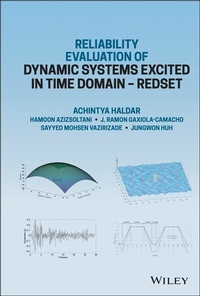
Reliability Evaluation of Dynamic Systems Excited in Time Domain - Redset
Description

Multi-disciplinary approach to structural reliability analysis for dynamic loadings offering a practical alternative to the random vibration theory and simulation
Reliability Evaluation of Dynamic Systems Excited in Time Domain - REDSET is a multidisciplinary concept that enables readers to estimate the underlying risk that could not be solved in the past. The major hurdle was that the required limit state functions (LSFs) are implicit in nature and the lack of progress in the reliability evaluation methods for this class of problems. The most sophisticated deterministic analysis requires that the dynamic loadings must be applied in the time domain. To satisfy these requirements, REDSET is developed. Different types and forms of dynamic loadings including seismic, wind-induced wave, and thermomechanical loading in the form of heating and cooling of solder balls used in computer chips are considered to validate REDSET. Time domain representations and the uncertainty quantification procedures including the use of multiple time histories are proposed and demonstrated for all these dynamic loadings. Both onshore and offshore structures are used for validation. The potential of REDSET is demonstrated for implementing the Performance Based Seismic Design (PBSD) concept now under development in the United States. For wider multidisciplinary applications, structures are represented by finite elements to capture different types of nonlinearity more appropriately. Any computer program capable of conducting nonlinear time domain dynamic analysis can be used, and the underlying risk can be estimated with the help of several dozens or hundreds of deterministic finite element analyses, providing an alternative to the simulation approach. To aid comprehension of REDSET, numerous illustrative examples and solution strategies are presented in each chapter. Written by award-winning thought leaders from academia and professional practice, the following sample topics are included:
* Fundamentals of reliability assessment including set theory, modeling of uncertainty, the risk-based engineering design concept, and the evolution of reliability assessment methods
* Implicit performance or limit state functions are expressed explicitly by the extensively modified response surface method with several new experimental designs
* Uncertainty quantification procedures with multiple time histories for different dynamic loadings, illustrated with examples
* The underlying risk can be estimated using any computer program representing structures by finite elements with only few deterministic analyses
* REDSET is demonstrated to be an alternative to the classical random vibration concept and the basic simulation procedure for risk estimation purposes
* REDSET changes the current engineering design paradigm. Instead of conducting one deterministic analysis, a design can be made more dynamic load tolerant, resilient, and sustainable with the help of a few additional deterministic analyses
This book describing REDSET is expected to complement two other books published by Wiley and authored by Haldar and Mahadevan: Probability, Reliability and Statistical Methods in Engineering Design and Reliability Assessment Using Stochastic Finite Element Analysis. The book is perfect to use as a supplementary resource for upper-level undergraduate and graduate level courses on reliability and risk-based design.
More details
Other editions
Additional editions
Persons
Achintya Haldar - University of Arizona, Tucson, Arizona, USA
Hamoon Azizsoltani - North Carolina State University, Raleigh, North Carolina, USA
J. Ramon Gaxiola-Camacho - Autonomous University of Sinaloa, Culiacan, Mexico
Sayyed Mohsen Vazirizade - Vanderbilt University, Nashville, Tennessee, USA
Jungwon Huh - Chonnam National University, Gwangju, Korea
Content
1 REDSET and Its Necessity 1
1.1 Introductory Comments 1
1.2 Reliability Evaluation Procedures Existed Around 2000 2
1.3 Improvements or Alternative to Stochastic Finite Element Method (SFEM) 2
1.4 Other Alternatives Besides SFEM 4
1.4.1 Random Vibration 4
1.4.2 Alternative to Basic Monte Carlo Simulation 5
1.4.3 Alternatives to Random Vibration Approach for Large Problems 5
1.4.4 Physics-Based Deterministic FEM Formulation 5
1.4.5 Multidisciplinary Activities to Study the Presence of Uncertainty in Large Engineering Systems 6
1.4.6 Laboratory Testing 7
1.5 Justification of a Novel Risk Estimation Concept REDSET Replacing SFEM 7
1.6 Notes for Instructors 8
1.7 Notes to Students 9
Acknowledgments 9
2 Fundamentals of Reliability Assessment 11
2.1 Introductory Comments 11
2.2 Set Theory 12
2.3 Modeling of Uncertainty 14
2.3.1 Continuous Random Variables 15
2.3.2 Discrete Random Variables 16
2.3.3 Probability Distribution of a Random Variable 16
2.3.4 Modeling of Uncertainty for Multiple Random Variables 17
2.4 Commonly Used Probability Distributions 19
2.4.1 Commonly Used Continuous and Discrete Random Variables 19
2.4.2 Combination of Discrete and Continuous Random Variables 20
2.5 Extreme Value Distributions 20
2.6 Other Useful Distributions 21
2.7 Risk-Based Engineering Design Concept 21
2.8 Evolution of Reliability Estimation Methods 25
2.8.1 First-Order Second-Moment Method 25
2.8.2 Advanced First-Order Reliability Method (AFOSM) 26
2.8.3 Hasofer-Lind Method 26
2.9 AFOSM for Non-Normal Variables 31
2.9.1 Two-Parameter Equivalent Normal Transformation 31
2.9.2 Three-Parameter Equivalent Normal Transformation 33
2.10 Reliability Analysis with Correlated Random Variables 33
2.11 First-Order Reliability Method (FORM) 35
2.11.1 FORM Method 1 35
2.11.2 Correlated Non-Normal Variables 37
2.12 Probabilistic Sensitivity Indices 39
2.13 FORM Method 2 40
2.14 System Reliability Evaluation 40
2.15 Fundamentals of Monte Carlo Simulation Technique 41
2.15.1 Steps in Numerical Experimentations Using Simulation 42
2.15.2 Extracting Probabilistic Information from N Data Points 43
2.15.3 Accuracy and Efficiency of Simulation 43
2.16 Concluding Remarks 44
3 Implicit Performance or Limit State Functions 47
3.1 Introductory Comments 47
3.2 Implicit Limit State Functions - Alternatives 48
3.3 Response Surface Method 49
3.4 Limitations of Using the Original RSM Concept for the Structural Reliability Estimation 50
3.5 Generation of Improved Response Surfaces 51
3.5.1 Polynomial Representation of an Improved Response Surface 52
3.6 Experimental Region, Coded Variables, and Center Point 54
3.6.1 Experimental Region and Coded Variables 54
3.6.2 Experimental Design 55
3.6.3 Saturated Design 56
3.6.4 Central Composite Design 56
3.7 Analysis of Variance 56
3.8 Experimental Design for Second-Order Polynomial 58
3.8.1 Experimental Design - Model 1: SD with Second-Order Polynomial without Cross Terms 58
3.8.2 Experimental Design - Model 2: SD with Second-Order Polynomial with Cross Terms 59
3.8.3 Experimental Design - Model 3: CCD with Second-Order Polynomial with Cross Terms 61
3.9 Comparisons of the Three Basic Factorial Designs 61
3.10 Experimental Designs for Nonlinear Dynamic Problems Excited in the Time Domain 64
3.11 Selection of the Most Appropriate Experimental Design 64
3.12 Selection of Center Point 65
3.13 Generation of Limit State Functions for Routine Design 66
3.13.1 Serviceability Limit State 66
3.13.2 Strength Limit State Functions 67
3.13.3 Interaction Equations for the Strength Limit State Functions 67
3.13.4 Dynamic Effect in Interaction Equations 68
3.14 Concluding Remarks 69
4 Uncertainty Quantification of Dynamic Loadings Applied in the Time Domain 71
4.1 Introductory Comments 71
4.2 Uncertainty Quantification in Seismic Loadings Applied in the Time Domain 73
4.2.1 Background Information 74
4.3 Selection of a Suite of Acceleration Time Histories Using PEER Database - Alternative 1 75
4.3.1 Earthquake Time History Selection Methodology 78
4.4 Demonstration of the Selection of a Suite of Ground Motion Time Histories - Alternative 1 79
4.5 Simulated Ground Motions Using the Broadband Platform (BBP) - Alternative 2 84
4.5.1 Broadband Platform Developed by SCEC 84
4.6 Demonstration of Selection and Validation of a Suite of Ground Motion Time Histories Using BPP 86
4.7 Applications of BBP in Selecting Multiple Earthquake Acceleration Time Histories 88
4.8 Summary of Generating Multiple Earthquake Time Histories Using BPP 91
4.9 Uncertainty Quantification of Wind-Induced Wave Loadings Applied in the Time Domain 91
4.9.1 Introductory Comments 91
4.9.2 Fundamentals of Wave Loading 94
4.9.3 Morison Equation 95
4.10 Modeling of Wave Loading 96
4.10.1 Wave Modeling Using the New Wave Theory 97
4.10.2 Wheeler Stretching Effect 98
4.10.3 Three-Dimensional Directionality 98
4.10.4 Summary of Deterministic Modeling of Wave Loading 100
4.11 Uncertainty Quantifications in Wave Loading Applied in the Time Domain 100
4.11.1 Uncertainty Quantification in Wave Loading - Three-Dimensional Constrained New Wave (3D CNW) Concept 100
4.11.2 Three-Dimensional Constrained New Wave (3D CNW) Concept 102
4.11.3 Uncertainty in the Wave Height Estimation 104
4.11.4 Uncertainty Quantification of Wave Loading 105
4.11.5 Quantification of Uncertainty in Wave Loading 106
4.12 Wave and Seismic Loadings - Comparisons 107
4.13 Concluding Remarks 108
5 Reliability Assessment of Dynamic Systems Excited in Time Domain - REDSET 111
5.1 Introductory Comments 111
5.2 A Novel Reliability Estimation Concept - REDSET 113
5.2.1 Integration of Finite Element Method, Improved Response Surface Method, and FORM 113
5.2.2 Increase Efficiency in Generating an IRS 114
5.2.3 OptimumNumber of NDFEA Required for the Generation of an IRS 115
5.2.4 Reduction of Random Variables 115
5.3 Advanced Sampling Design Schemes 116
5.4 Advanced Factorial Design Schemes 116
5.5 Modified Advanced Factorial Design Schemes 119
5.5.1 Modified Advanced Factorial Design Scheme 2 (MS2) 119
5.5.2 Modified Advanced Factorial Design Scheme 3 121
5.6 Optimum Number of TNDFEA Required to Implement REDSET 122
5.7 Improve Accuracy of Scheme MS3 Further - Alternative to the Regression Analysis 122
5.7.1 Moving Least Squares Method 122
5.7.2 Concept of Moving Least Squares Method 123
5.7.3 Improve Efficiency Further to the Moving Least Squares Method 124
5.8 Generation of an IRS Using Kriging Method 126
5.8.1 Simple Kriging 127
5.8.2 Ordinary Kriging 128
5.8.3 Universal Kriging 128
5.8.4 Variogram Function 131
5.8.5 Scheme S3 with Universal Kriging Method 133
5.8.6 Scheme MS3 with Modified Universal Kriging Method 133
5.9 Comparisons of All Proposed Schemes 133
5.10 Development of Reliability Evaluation of Dynamical Engineering Systems Excited in Time Domain (REDSET) 135
5.10.1 Required Steps in the Implementation of REDSET 136
5.11 Concluding Remarks 138
6 Verification of REDET for Earthquake Loading Applied in the Time Domain 139
6.1 Introductory Comments 139
6.2 Verification - Example 1: 3-Story Steel Moment Frame with W24 Columns 140
6.2.1 Example 1: Accuracy Study of All 9 Schemes 140
6.2.2 Verification - Example 2: 3-Story Steel Moment Frame with W14 Columns 147
6.3 Case Study: 13-Story Steel Moment Frame 151
6.4 Example 4: Site-Specific Seismic Safety Assessment of CDNES 160
6.4.1 Location, Soil Condition, and Structures 161
6.4.2 Uncertainty Quantifications 162
6.4.3 Uncertainty Quantifications in Resistance-Related Design Variables 162
6.4.3.1 Uncertainty Quantifications in Gravity Load-related Design Variables 165
6.4.3.2 Selection of a Suite of Site-Specific Acceleration Time Histories 165
6.5 Risk Evaluation of Three Structures using REDSET 166
6.5.1 Selection of Limit State Functions 166
6.5.2 Estimations of the Underlying Risk for the Three Structures 166
6.6 Concluding Remarks 172
7 Reliability Assessment of Jacket-Type Offshore Platforms Using REDSET for Wave and Seismic Loadings 175
7.1 Introductory Comments 175
7.2 Reliability Estimation of a Typical Jacket-Type Offshore Platform 176
7.3 Uncertainty Quantifications of a Jacket-Type Offshore Platform 177
7.3.1 Uncertainty in Structures 178
7.3.2 Uncertainty in Wave Loadings in the Time Domain 179
7.4 Performance Functions 180
7.4.1 LSF of Total Drift at the Top of the Platform 180
7.4.2 Strength Performance Functions 180
7.5 Reliability Evaluation of JTPs 181
7.6 Risk Estimations of JTPs Excited by the Wave and Seismic Loadings - Comparison 183
7.7 Comparison of Results for the Wave and Earthquake Loadings 190
7.8 Concluding Remarks 193
8 Reliability Assessment of Engineering Systems Using REDSET for Seismic Excitations and Implementation of PBSD 195
8.1 Introductory Comments 195
8.2 Assumed Stress-Based Finite Element Method for Nonlinear Dynamic Problems 196
8.2.1 Nonlinear Deterministic Seismic Analysis of Structures 196
8.2.2 Seismic Analysis of Steel Structures 196
8.2.3 Dynamic Governing Equation and Solution Strategy 197
8.2.4 Flexibility of Beam-to-Column Connection Models by Satisfying Underlying Physics - Partially Restrained Connections for Steel Structures 200
8.2.5 Incorporation of Connection Rigidities in the FE Formulation Using Richard Four-Parameter Model 202
8.3 Pre- and Post-Northridge Steel Connections 204
8.4 Performance-Based Seismic Design 207
8.4.1 Background Information and Motivation 207
8.4.2 Professional Perception of PBSD 208
8.4.3 Building Codes, Recommendations, and Guidelines 210
8.4.4 Performance Levels 210
8.4.5 Target Reliability Requirements to Satisfy Different Performance Levels 211
8.4.6 Elements of PBSD and Their Sequences 212
8.4.7 Explore Suitability of REDSET in Implementing PBSD 212
8.5 Showcasing the Implementation of PBSD 213
8.5.1 Verification of REDSET - Reliability Estimation of a 2-Story Steel Frame 214
8.6 Implementation Potential of PBSD - 3-, 9-, and 20-Story Steel Buildings 219
8.6.1 Description of the Three Buildings 219
8.6.2 Post-Northridge PR Connections 219
8.6.3 Quantification of Uncertainties in Resistance-Related Variables 219
8.6.4 Uncertainties in Gravity Loads 219
8.6.5 Uncertainties in PR Beam-to-Column Connections 220
8.6.6 Uncertainties in Seismic Loading 225
8.6.7 Serviceability Performance Functions - Overall and Inter-Story Drifts 226
8.7 Structural Reliability Evaluations of the Three Buildings for the Performance Levels of CP, LS, and IO Using REDSET 227
8.7.1 Observations for the Three Performance Levels 228
8.8 Implementation of PBSD for Different Soil Conditions 237
8.9 Illustrative Example of Reliability Estimation for Different Soil Conditions 239
8.9.1 Quantifications of Uncertainties for Resistance-Related Variables and Gravity Loads 240
8.9.2 Generation of Multiple Design Earthquake Time Histories for Different Soil Conditions 240
8.9.3 Implementation of PBSD for Different Soil Conditions 240
8.10 Concluding Remarks 244
9 Reliability Assessment of Lead-Free Solders in Electronic Packaging Using REDSET for Thermomechanical Loadings 247
9.1 Introductory Comments 247
9.2 Background Information 249
9.3 Deterministic Modelling of a Solder Ball 251
9.3.1 Solder Ball Represented by Finite Elements 251
9.3.2 Material Modeling of SAC Alloy 251
9.3.2.1 HISS Plasticity Model 252
9.3.2.2 Disturbed State Concept 254
9.3.2.3 Creep Modeling 254
9.3.2.4 Rate-Dependent Elasto-Viscoplastic Model 255
9.3.3 Temperature-Dependent Modeling 255
9.3.4 Constitutive Modeling Calibration 255
9.3.5 Thermomechanical Loading Experienced by Solder Balls 256
9.4 Uncertainty Quantification 257
9.4.1 Uncertainty in all the Parameters in a Solder Ball 258
9.4.2 Uncertainty Associated with Thermomechanical Loading 260
9.5 The Limit State Function for the Reliability Estimation 260
9.6 Reliability Assessment of Lead-Free Solders in Electronic Packaging 261
9.7 Numerical Verification Using Monte Carlo Simulation 262
9.8 Verification Using Laboratory Test Results 263
9.9 Concluding Remarks 264
Concluding Remarks for the Book - REDSET 266
References 267
Index 281
1
REDSET and Its Necessity
1.1 Introductory Comments
A novel reliability evaluation method, denoted hereafter as REDSET (Reliability Evaluation of Dynamic Systems Excited in Time Domain) is proposed. As the secondary heading of the book suggests, REDSET will be an alternative to the classical random vibration and simulation techniques. REDSET is expected to address a knowledge gap that will be discussed later in this chapter to help us better meet current professional needs and/or requirements.
Pierre Simon Marquis de Laplace (1749-1827) wrote a commentary on general intelligence published as "A Philosophical Essay on Probabilities." He wrote It is seen in this essay that the theory of probabilities is at bottom only common sense reduced to calculus; it makes us appreciate with exactitude that which exact minds feel by a sort of instinct without being able ofttimes to give a reason for it. It leaves no arbitrariness in the choice of opinions and sides to be taken; and by its use can always be determined the most advantageous choice. Thereby it supplements most happily the ignorance and weakness of the human mind. (Laplace 1951). These timeless comments have a significant influence on every aspect of human activities. However, the concept of risk or reliability-based engineering analysis, design, and planning was initiated recently, most likely by Freudenthal (1956). As a result of comprehensive efforts by different engineering disciplines, design guidelines and codes have already been modified or are in the process of being modified. The Accreditation Board of Engineering and Technology (ABET) in the United States now requires that all undergraduate students in civil engineering demonstrate the necessary knowledge to follow or interpret the requirements outlined in design guidelines and apply them in everyday practices.
1.2 Reliability Evaluation Procedures Existed Around 2000
After Freudenthal's initiative and the necessity of acquiring the required mathematical knowledge, a considerable amount of development in the reliability evaluation area was reported in the literature. The team members of the authors wrote two books earlier, published by John Wiley, titled "Probability, Reliability and Statistical Methods in Engineering Design" and "Reliability Assessment Using Stochastic Finite Element Analysis" (Haldar and Mahadevan 2000a, 2000b). The first book is now being used as a textbook all over the world. It covers basic reliability concepts for estimating the risk of structures that existed around 2000.
The reliability or risk of an engineering system is always estimated with respect to a performance requirement or limit state function (LSF). The first book presented various risk estimation methods with various levels of sophistication when LSFs are explicit and readily available that existed around 2000. However, when a structure is represented by finite elements (FEs), as in the second book, LSFs are expected to be implicit in most applications to appropriately incorporate information on different sources of nonlinearities satisfying the physics-based formulation to accurately estimate the required structural responses. The stochastic finite element method (SFEM) concept presented in the second book is capable of estimating reliability for implicit LSFs, but the required derivatives of LFSs with respect to the design variables to estimate risk are evaluated numerically. The basic SFEM concept cannot be used to estimate the risk of complex nonlinear dynamic engineering systems (CNDES) and an alternative is urgently needed. This book will fill the vacuum.
1.3 Improvements or Alternative to Stochastic Finite Element Method (SFEM)
One of the major impacts of the SFEM concept was that it helped reliability analysis of structures represented by FEs commonly used in many engineering disciplines. The basic finite element method (FEM)-based representation helps estimate the deterministic behavior of structures considering complicated geometric arrangements of elements made with different materials, realistic connections and support conditions, various sources of nonlinearity, and numerous sophisticated and complicated features a structure experiences from the initial to the failure state following different load paths in a very comprehensive way. However, the deterministic FEM formulation fails to incorporate the presence of uncertainty in the design variables and thus cannot estimate the underlying risk. The SFEM concept was proposed to capture the desirable features of the deterministic FEM formulation integrated with probabilistic or stochastic information on design variables. However, it was primarily developed for the static application of loadings. For ease of discussion, it can be denoted as SFEM-static. It was a significant improvement over other available methods around the mid-nineties.
The SFEM-static concept or its extension cannot be used to estimate the reliability of CNDES. It can be a building block for the reliability analysis of CNDES by representing structures using FEs with improved physics-based modeling techniques, incorporating recently introduced several advanced energy dissipation features, and exciting them in the time domain resulting in the SFEM-dynamic algorithm. However, it should be noted that SFEM-static was developed about three decades ago using outdated computational platforms not available at present. A considerable amount of time, money, and effort will be needed to modify it for current needs, and it may not be the best option. An improved version of SFEM-static is needed.
The risk evaluation capability of a procedure representing structures by FEs will depend on the efficiency of the deterministic FEM formulation used. The FEM representation should also be similar to the procedures used by the deterministic community in routine applications. To estimate nonlinear responses of frame structures, the displacement-based FEM is very commonly used. Almost all current commercially available computer programs are based on this concept. In this approach, shape functions are used to describe the displacements at the nodes of the elements. This will require a large number of elements to model members with large deformation expected just before failure, making it computationally very inefficient. It will be more efficient if the realistic structural behavior can be estimated using fewer elements and expressing the tangent stiffness matrix explicitly without updating it at every step of the nonlinear analysis. To address these issues, the assumed stress-based FEM can be used as an alternative, especially for frame-type structures.
The assumed stress-based FEM formulation, although mathematically more demanding, has many advantages over the displacement-based approach. In this approach, the tangent stiffness can be expressed in explicit form, the stresses of an element can be expressed and obtained directly, fewer elements are required in describing a large deformation configuration, and integration is not required to obtain the tangent stiffness. It is found to be accurate and very efficient in analyzing frame-type structures just before failure.
The probability of failure of a frame needs to be estimated using two iterative schemes, one to capture the nonlinear behavior and the other for the reliability estimation to consider uncertainty in the design variables. In developing SFEM-static, the displacement-based FEM approach was initially used. Subsequent studies indicated that it would be practically impossible to use this approach to extract reliability information for realistic large nonlinear structural systems. Although the stress-based FEM concept was at the early stage of development in the early eighties, it was incorporated in the subsequent developments of SFEM-static. The book on SFEM is essentially based on the stress-based FEM approach. The modified concept was extensively verified using available information.
Sophisticated computer programs were developed to implement the concept. They were written in the FORTRAN language available in the early eighties and no users' manual was developed. Most importantly, there is no other program using the concept readily available even today for commercial or academic research. Related subjects are not taught in most universities, and the basic concept is not fully developed to analyze complicated structural systems. The book by Haldar and Mahadevan (2000b) can be used. However, it will not satisfy the current professional needs.
In summary, it will take a considerable amount of time and effort to modify the SFEM-static programs suitable for different computer platforms widely used at present. The most attractive option will be if users can use any computer program capable of conducting nonlinear time domain dynamic analyses using any type of FEM to estimate structural responses.
1.4 Other Alternatives Besides SFEM
Several reliability-evaluation techniques for CNDES available at present will be briefly discussed next. Considering their deficiencies and current needs, a new concept is preferable.
1.4.1 Random Vibration
To study the stochastic behavior of dynamic systems, the classical random vibration approach (Lin 1967; Lin and Cai 2004) is expected to be the obvious choice. It is an extremely sophisticated but complicated mathematical concept. The basic random vibration concept...
