

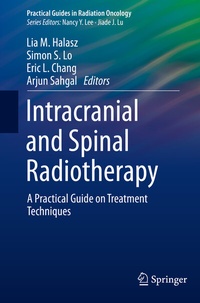
Intracranial and Spinal Radiotherapy
Description

This book is a practical, up-to-date guide to the treatment of patients with brain and spinal tumors. Leading experts in the field explain treatment techniques in detail, highlighting key considerations in the use of external beam radiation therapy, intensity-modulated radiation therapy, particle therapy, radiosurgery, and stereotactic body radiation therapy. Specific recommendations are described for different tumor types, and helpful information provided on other important issues, such as the interaction of radiotherapy and systemic therapy and the avoidance of treatment complications.
With the development of modern technology, highly conformal radiotherapy techniques have become more complicated, yet also more widely employed. This book will equip readers with the knowledge required to set up practices to deliver quality brain and spinal radiation therapy appropriate to each patient. It will be of benefit to radiation oncologists, clinical oncologists, medical physicists, medical dosimetrists, radiation therapists, and senior nurses as well as medical oncologists and surgical oncologists with an interest in radiotherapy.More details
Other editions
Additional editions
Persons
Lia M. Halasz, MD , is Associate Professor of Radiation Oncology and Neurological Surgery at the University of Washington and Seattle Cancer Care Alliance, where she is Co-Director for the Alvord Brain Tumor Center. She completed her medical degree and residency in Radiation Oncology at Harvard Medical School. Her clinical interests include primary brain tumors, brain metastases, stereotactic radiosurgery, and proton therapy. She is Program Director for the University of Washington Radiation Oncology Residency and Fellowship. She has previously served as Associate Editor for the CNS track of the International Journal of Radiation Oncology Biology and Physics and currently serves as Vice Chair for the ASTRO task force developing guidelines on radiation therapy for patients with lower grade gliomas.
Simon S, Lo, MB, ChB, FACR, FASTRO , is Professor of Radiation Oncology, Vice Chair for Strategic Planning and Director of Stereotactic Body Radiotherapy at Department of Radiation Oncology and Professor of Neurological Surgery at University of Washington School of Medicine. He is the President of the Council of Affiliated Regional Radiation Oncology Societies of American College of Radiology and a member of the Board of Directors of Radiosurgery Surgery. He has edited or co-edited six textbooks on stereotactic radiosurgery, stereotactic body radiotherapy, CNS radiation oncology, or general radiation oncology. He has lectured at many major national and international meetings (USA, Canada, Australia, Europe, Singapore and Hong Kong) and has been a visiting professor at numerous prestigious academic institutions in the USA, Canada, Europe, Singapore, and Hong Kong. He has led or participated in several practice guidelines in brain, spine and bone metastases, SRS and SBRT and has published 220 peer-reviewed papers. Dr. Lo is also an Associate Editor for Radiation Oncology Section of Neurosurgery and Advances in Radiation Oncology.
Eric L. Chang, MD, FASTRO , is Professor and Chair of Radiation Oncology at the Keck School of Medicine of the University of Southern California (USC). Prior to joining USC, he was Professor of Radiation Oncology at The University of Texas M.D. Anderson Cancer Center. He established the first Gamma Knife radiosurgery program at M.D. Anderson, which treats over 450 patients a year, and served as the Director of the CNS Stereotactic Radiation Program. He was the 2011 CNS track leader for the ASTRO Scientific Program Committee and is a member of the ACR Appropriateness Criteria Expert Panel on bone metastases. He led a phase III randomized controlled trial on brain metastasis, published in Lancet Oncology (2009), which is starting to change the practice patterns for metastatic brain disease. He has authored or co-authored over 180 peer-reviewed papers and abstracts. He is currently chair of the American RadiumSociety Brain Appropriate Use Criteria Committee.
Arjun Sahgal, MD, FRCPC , is Deputy Chief of the Department of Radiation Oncology at the University of Toronto affiliated Sunnybrook Odette Cancer Center and an international clinical and research leader in the field of high-precision stereotactic radiation to the brain and spine for both metastases and primary tumors. He is a professor of radiation oncology at the University of Toronto. He is also currently directing the Sunnybrook Cancer Ablation Therapy program, which involves the installation and integration of MR brachytherapy, MR linac, and Gamma Knife ICON technology. He has published over 500 peer-reviewed papers and has been the recipient of various awards and distinguished visiting professorships. He is a past meeting chairman and current board member for the International Stereotactic Radiosurgery Society, and a current co-chair of the AOSpine Tumor Knowledge Forum.
