

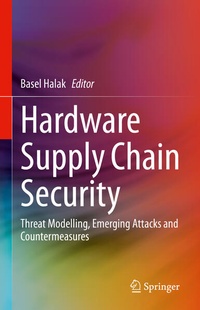
Hardware Supply Chain Security
Description

This book presents a new threat modelling approach that specifically targets the hardware supply chain, covering security risks throughout the lifecycle of an electronic system. The authors present a case study on a new type of security attack, which combines two forms of attack mechanisms from two different stages of the IC supply chain. More specifically, this attack targets the newly developed, light cipher (Ascon) and demonstrates how it can be broken easily, when its implementation is compromised with a hardware Trojan. This book also discusses emerging countermeasures, including anti-counterfeit design techniques for resources constrained devices and anomaly detection methods for embedded systems.
More details
Other editions
Additional editions
Person
Dr Basel Halak is the director of the embedded systems and IoT program at the University of Southampton, a visiting scholar at the Technical University of Kaiserslautern, a visiting professor at the Kazakh-British Technical University, a fellow of the royal academy of engineering, a national teaching fellow of Advance HE in the UK, and a senior fellow of the higher education academy. He has written over 80-refereed conference and journal papers, and authored two books, including the first textbook on Physically Unclonable Functions. His research expertise include evaluation of security of hardware devices, development of appropriate countermeasures, the development of mathematical formalisms of reliability issues in CMOS circuits (e.g. crosstalk, radiation, ageing), and the use of fault tolerance techniques to improve the robustness of electronics systems against such issues.. Dr Halak lectures on digital design, Secure Hardware and Cryptography. He is also leading European Masters in Embedded Computing Systems (EMECS) , a two year course run in collaboration with Kaiserslautern University in Germany and the Norwegian University of Science and Technology in Trondheim (electronics and communication). Dr Halak serves on several technical program committees such as HOST, IEEE DATE, IVSW, ICCCA, ICCCS, MTV and EWME. He is an associate editor of IEEE access and an editor of the IET circuit devices and system journal. He is also a member of the hardware security-working group of the World Wide Web Consortium (W3C).
Content
Part I. Threat Modelling of Hardware Supply Chain.- Chapter 1. CIST: A Threat Modelling Approach for Hardware Supply Chain Security.- Part II. Emerging Hardware-based Security Attacks and Countermeasures.- Chapter 2. A Cube Attack on a Trojan-Compromised Hardware Implementation of Ascon.- Chapter 3. Anti-counterfeiting Techniques for Resources-Constrained Devices.- Part III. Anomaly Detection in Embedded Systems.- Chapter 4. Anomalous Behaviour in Embedded Systems.- Chapter 5. Hardware Performance Counters (HPCs) for Anomaly Detection.- Chapter 6. Anomaly Detection in an Embedded System.
