

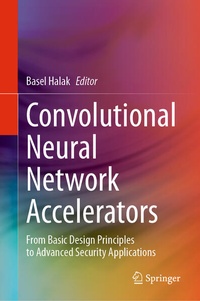
Convolutional Neural Network Accelerators
Description

This book provides comprehensive coverage of the state-of-the-art in Convolutional Neural Network (CNN) hardware accelerator design, security, and its applications in hardware security. The first part gives a foundational understanding of CNN architectures, emphasizing their computational demands and the necessity for specialized hardware solutions. It also proposes an emulation method with open-source code to mimic CNN hardware accelerator behavior. The second part presents security applications of CNN models, featuring a case study in Network-on-Chip security. It covers threat modeling, countermeasures, and the use of alternative machine learning models to CNNs. The third part explains security threats throughout the AI model production lifecycle, including software vulnerabilities and hardware risks, and explores techniques to enhance the robustness of CNN hardware accelerators, focusing on preventing hardware Trojan and backdoor attacks and analyzing the vulnerability levels of different CNN layers.
More details
Other editions
Additional editions
Person
Dr Basel Halak is an Associate Professor of Secure Electronics and the Director of the Cyber Security Academy with the University of Southampton. He is also a leading European Masters in Embedded Computing Systems (EMECS). Dr. Halak is a visiting scholar at the Technical University of Kaiserslautern, the Norwegian University of Science and Technology, and the Polytechnic di Torino. He previously served as a visiting professor at the Kazakh-British Technical University 2017. Dr. Halak's expertise spans Digital Systems Design, Hardware Security, and Applied Cryptography. and he has authored over 120 refereed conference and journal papers and seven books, including the first textbook on Physically Unclonable Functions and the first book on Hardware Supply Chain Security. Beyond academia, Dr. Halak has collaborated extensively with industry such as ARM, Arqit, Schneider Electric, and Ericsson. Dr. Halak is the recipient of the Industrial Fellowship from the Royal Academy of Engineering and the National Teaching Fellowship awarded by the Advance Higher Education (HE) Academy. He actively contributes to the global research community as a member of technical program committees for leading conferences such as HOST, IEEE DATE, IEEE DAC, IVSW, ICCCA, ICCCS, MTV and EWME. He is an Associate Editor of IEEE access and a Guest Editor of the IET circuit devices and system journal. As of July 2025, he supervised to completion of 18 PhD students and 7 postdoctoral scholars.
Content
Introduction.- Hardware implementation of CNN hardware accelerator.- A tutorial on the design and hardware implementation of a CNN-based machine learning model.- Performance Optimization of CNN Hardware.- Security Optimization of a CNN-based machine learning model.- Application of CNN Accelerators in Hardware Security - Security Issues in Networks-on-Chip.- Application of CNN Accelerators in Hardware Security - Countermeasures for Security Issues in Networks-on-Chip.- Application of CNN Accelerators in Hardware Security - Other Machine Learning Models for Networks-on-Chip Security.- Conclusions and Future Opportunities.
