

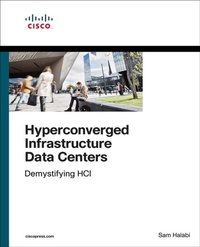
Hyperconverged Infrastructure Data Centers
Demystifying HCI
1st Edition
Published on 18. January 2019
400 pages
978-0-13-499792-6 (ISBN)
Description

Improve Manageability, Flexibility, Scalability, and Control with Hyperconverged Infrastructure
Hyperconverged infrastructure (HCI) combines storage, compute, and networking in one unified system, managed locally or from the cloud. With HCI, you can leverage the cloud's simplicity, flexibility, and scalability without losing control or compromising your ability to scale.
In Hyperconverged Infrastructure Data Centers, best-selling author Sam Halabi demystifies HCI technology, outlines its use cases, and compares solutions from a vendor-neutral perspective. He guides you through evaluation, planning, implementation, and management, helping you decide where HCI makes sense, and how to migrate legacy data centers without disrupting production systems.
The author brings together all the HCI knowledge technical professionals and IT managers need, whether their background is in storage, compute, virtualization, switching/routing, automation, or public cloud platforms. He explores leading solutions including the Cisco HyperFlex platform, VMware vSAN, Nutanix Enterprise Cloud, Cisco Application-Centric Infrastructure (ACI), VMware's NSX, the open source OpenStack and Open vSwitch (OVS) / Open Virtual Network (OVN), and Cisco CloudCenter for multicloud management.
As you explore discussions of automation, policy management, and other key HCI capabilities, you'll discover powerful new opportunities to improve control, security, agility, and performance.
Understand and overcome key limits of traditional data center designs
Discover improvements made possible by advances in compute, bus interconnect, virtualization, and software-defined storage
Simplify rollouts, management, and integration with converged infrastructure (CI) based on the Cisco Unified Computing System (UCS)
Explore HCI functionality, advanced capabilities, and benefits
Evaluate key HCI applications, including DevOps, virtual desktops, ROBO, edge computing, Tier 1 enterprise applications, backup, and disaster recovery
Simplify application deployment and policy setting by implementing a new model for provisioning, deployment, and management
Plan, integrate, deploy, provision, manage, and optimize the Cisco HyperFlex hyperconverged infrastructure platform
Assess alternatives such as VMware vSAN, Nutanix, open source OpenStack, and OVS/OVN, and compare architectural differences with HyperFlex
Compare Cisco ACI (Application- Centric Infrastructure) and VMware NSX approaches to network automation, policies, and security
This book is part of the Networking Technology Series from Cisco Press, which offers networking professionals valuable information for constructing efficient networks, understanding new technologies, and building successful careers.
Hyperconverged infrastructure (HCI) combines storage, compute, and networking in one unified system, managed locally or from the cloud. With HCI, you can leverage the cloud's simplicity, flexibility, and scalability without losing control or compromising your ability to scale.
In Hyperconverged Infrastructure Data Centers, best-selling author Sam Halabi demystifies HCI technology, outlines its use cases, and compares solutions from a vendor-neutral perspective. He guides you through evaluation, planning, implementation, and management, helping you decide where HCI makes sense, and how to migrate legacy data centers without disrupting production systems.
The author brings together all the HCI knowledge technical professionals and IT managers need, whether their background is in storage, compute, virtualization, switching/routing, automation, or public cloud platforms. He explores leading solutions including the Cisco HyperFlex platform, VMware vSAN, Nutanix Enterprise Cloud, Cisco Application-Centric Infrastructure (ACI), VMware's NSX, the open source OpenStack and Open vSwitch (OVS) / Open Virtual Network (OVN), and Cisco CloudCenter for multicloud management.
As you explore discussions of automation, policy management, and other key HCI capabilities, you'll discover powerful new opportunities to improve control, security, agility, and performance.
Understand and overcome key limits of traditional data center designs
Discover improvements made possible by advances in compute, bus interconnect, virtualization, and software-defined storage
Simplify rollouts, management, and integration with converged infrastructure (CI) based on the Cisco Unified Computing System (UCS)
Explore HCI functionality, advanced capabilities, and benefits
Evaluate key HCI applications, including DevOps, virtual desktops, ROBO, edge computing, Tier 1 enterprise applications, backup, and disaster recovery
Simplify application deployment and policy setting by implementing a new model for provisioning, deployment, and management
Plan, integrate, deploy, provision, manage, and optimize the Cisco HyperFlex hyperconverged infrastructure platform
Assess alternatives such as VMware vSAN, Nutanix, open source OpenStack, and OVS/OVN, and compare architectural differences with HyperFlex
Compare Cisco ACI (Application- Centric Infrastructure) and VMware NSX approaches to network automation, policies, and security
This book is part of the Networking Technology Series from Cisco Press, which offers networking professionals valuable information for constructing efficient networks, understanding new technologies, and building successful careers.
All prices
More details
Series
Edition
1. Auflage
Language
English
Place of publication
Indianapolis
United States
Publishing group
Pearson Education (US)
Target group
College/higher education
File size
17,27 MB
ISBN-13
978-0-13-499792-6 (9780134997926)
Copyright in bibliographic data and cover images is held by Nielsen Book Services Limited or by the publishers or by their respective licensors: all rights reserved.
Schweitzer Classification
Other editions
Additional editions
Book
02/2019
Cisco Press
€56.00
Shipment within 3-4 weeks
Person
Sam Halabi is a well-known industry figure with many years of experience in the field of information technology, multicloud, hyperconvergence, enterprise software, and data networking. Sam is a trusted advisor, capable of establishing close relationships with customers at the executive level, linking complex technologies with business benefits. Sam has worked at major companies in the U.S. and international markets, where he led sales, presales, consulting, marketing, and business development efforts targeting enterprises building scalable data centers. Sam is the founder of VirtuService (www.virtuservice.com), a provider of customer service and IT consulting in the areas of private, hybrid, public cloud, and multicloud. Sam has authored many Cisco Press books, including the bestseller Internet Routing Architectures and Metro Ethernet. Follow Sam Halabi on Twitter @VirtuService.
Content
PART I: Basics of Data Center Networking and Storage
Chapter 1 Data Networks: Existing Designs
Chapter 2 Storage Networks: Existing Designs
PART II: Evolution in Host Hardware and Software
Chapter 3 Host Hardware Evolution
Chapter 4 Server Virtualization
Chapter 5 Software Defined Storage
PART III: Hyperconverged Infrastructure
Chapter 6 Converged Infrastructure
Chapter 7 HCI Functionality
Chapter 8 HCI Benefits and Use Cases
PART IV: Cisco HyperFlex
Chapter 9 Cisco HyperFlex
Chapter 10 Deploying, Provisioning, and Managing the HyperFlex Platform
Chapter 11 HyperFlex Workload Optimization and Efficiency
PART V: Alternative HCI Implementations
Chapter 12 VMware vSAN
Chapter 13 Nutanix Enterprise Cloud Platform
Chapter 14 Open Source Compute and Storage
Part VI: Hyperconverged Networking
Chapter 15 Software-Defined Networking and Open Source
Chapter 16 VMware NSX
Chapter 17 Cisco Application Centric Infrastructure
Part VII: Public, Private, Hybrid, and Multicloud
Chapter 18 The Public Cloud
Chapter 19 The Private Cloud
Chapter 20 The Hybrid Cloud and Multicloud
Glossary
Index
Chapter 1 Data Networks: Existing Designs
Chapter 2 Storage Networks: Existing Designs
PART II: Evolution in Host Hardware and Software
Chapter 3 Host Hardware Evolution
Chapter 4 Server Virtualization
Chapter 5 Software Defined Storage
PART III: Hyperconverged Infrastructure
Chapter 6 Converged Infrastructure
Chapter 7 HCI Functionality
Chapter 8 HCI Benefits and Use Cases
PART IV: Cisco HyperFlex
Chapter 9 Cisco HyperFlex
Chapter 10 Deploying, Provisioning, and Managing the HyperFlex Platform
Chapter 11 HyperFlex Workload Optimization and Efficiency
PART V: Alternative HCI Implementations
Chapter 12 VMware vSAN
Chapter 13 Nutanix Enterprise Cloud Platform
Chapter 14 Open Source Compute and Storage
Part VI: Hyperconverged Networking
Chapter 15 Software-Defined Networking and Open Source
Chapter 16 VMware NSX
Chapter 17 Cisco Application Centric Infrastructure
Part VII: Public, Private, Hybrid, and Multicloud
Chapter 18 The Public Cloud
Chapter 19 The Private Cloud
Chapter 20 The Hybrid Cloud and Multicloud
Glossary
Index
