


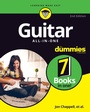
Guitar All-in-One For Dummies
Description

If you've just bought a guitar, or you've had one for a while, you probably know it takes some time and effort to learn how to play the popular instrument. There's so much to know about owning, maintaining, and playing a guitar. Where do you even begin?
In Guitar All-in-One For Dummies, a team of expert guitarists and music teachers shows you the essentials you need to know about owning and playing a guitar. From picking your first notes to exploring music theory and composition, maintaining your gear, and diving into the specifics of genres like blues and rock, this book is a comprehensive and practical goldmine of indispensable info.
Created for the budding guitarist who wants all their lessons and advice in one place, the book will show you how to:
* Maintain, tune, and string your guitar, as well as decipher music notation and guitar tablature
* Understand guitar theory, sounds and techniques to help you learn new songs and add your style to classic tunes
* Practice several popular genres of guitar music, including blues, rock, and classical
* Access accompanying online video and audio instructional resources that demonstrate the lessons you find in the book
Perfect for guitar players at any skill level, Guitar All-in-One For Dummies is a must-have resource for anyone who wants to get the most out of their own guitar and make great music.
More details
Other editions
Additional editions
Persons
DesiSerna, a guitar guru and music theory expert; and
Hal Leonard Corporation, a renowned U.S. music publishing company.
Content
Book 1: Guitar 101 5
Chapter 1: Guitar Anatomy and Tuning 7
Chapter 2: Getting Ready to Play 21
Chapter 3: Buying and Stringing a Guitar 33
Chapter 4: Deciphering Music Notation and Tablature 61
Book 2: Sounds and Techniques 75
Chapter 1: Basic Major and Minor Chords 77
Chapter 2: Adding Spice: Basic 7th Chords 95
Chapter 3: Power Chords and Barre Chords 109
Chapter 4: Right-Hand Rhythm Guitar Techniques 123
Chapter 5: Playing Melodies in Position and in Double-Stops 145
Book 3: Getting to Know Guitar Theory 161
Chapter 1: Navigating the Fretboard and Building Triads 163
Chapter 2: Getting to Know the CAGED System 187
Chapter 3: Playing Snazzier Chords with Chord Tones and Extensions 209
Chapter 4: Playing Chord Progressions by Numbers 227
Chapter 5: Identifying Tonics, Keys, and Modes 239
Chapter 6: Dominant Function and Voice Leading 271
Book 4: Rock Guitar 283
Chapter 1: I Know, It's Only Rock Guitar, but I Like It 285
Chapter 2: Playing Lead 301
Chapter 3: Groovin' on Riffs 323
Chapter 4: Going Up the Neck and Playing the Fancy Stuff 333
Chapter 5: The Care and Feeding of Your Electric Guitar 355
Book 5: Blues Guitar 377
Chapter 1: Introducing the Blues and Playing Blues Rhythm 379
Chapter 2: Blues Progressions, Song Forms, and Moves 405
Chapter 3: Musical Riffs: Bedrock of the Blues 427
Book 6: Classical Guitar 443
Chapter 1: Introducing the Classical Guitar 445
Chapter 2: Playing Easy Pieces in Open Position 467
Chapter 3: Combining Arpeggios and Melody 481
Book 7: Exercises: Practice, Practice, Practice 501
Chapter 1: Putting the Major Scales to Use in Your Playing 503
Chapter 2: Adding Major Scale Sequences to Your Repertoire 515
Chapter 3: Tackling the Three Minor Scales 529
Chapter 4: Building Finger Independence with Chord Exercises 557
Appendix A: 96 Common Chords 581
Appendix B: Accessing the Video Clips and Audio Tracks 585
Index 593
Introduction
So, you want to play guitar, eh? No one can blame you. The guitar isn't just a beautiful, soulful, and versatile instrument. For about 80 years now, it has also set the standard for coolness in the music world. Not a bad combination.
Though the guitar as we know it is only about a century and a half old, its roots as a plucked stringed instrument go back deep into history. Many ancient folk instruments have followed the basic strings-stretched-over-fretboard-and-played-with-fingers design for thousands of years, and the guitar is in some ways the culmination of that legacy. It seems humans have always had something like the guitar in mind.
After the guitar was electrified in the 1930s - that is, when it went from soft backup instrument to a forceful and expressive vehicle for soloing - its popularity skyrocketed, and its intrinsic qualities and sound changed popular music forever. But its softer side didn't go away. When Bob Dylan famously "plugged in" at the 1965 Newport Folk Festival and was booed by outraged folk fans, it became clear that the electric guitar had entered its own universe.
Guitar All-in-One For Dummies, 2nd Edition covers both the acoustic and the electric universes - as well as the older classical guitar one, which has its own language, techniques, and musical pedigree.
About This Book
First, here's what this book is not: It's not a textbook, nor a long-winded history, nor a rote learning tool. Lots of those kinds of books are on the market, if that's what you're looking for - but beware, they're often dry and assume underlying knowledge.
Guitar All-in-One For Dummies, 2nd Edition is a generous conglomeration of material from several For Dummies guitar and music books. It aims to cover the guitar gamut, from what those thingies are called that wind the strings (tuning machines) to how Stevie Ray Vaughan got his incredible sound (by tuning lower, among other tricks) to how to employ the insights of guitar theory in your playing.
Much of the material is relevant to any style of guitar playing. But three popular guitar genres each get their own sections, called books: rock guitar, blues guitar, and classical guitar. You'll also find chapters on learning to read music, on building your chord repertoire, on practicing, scales, riffs, and how to play the fancy stuff . let's just say there's a lot here. And don't forget, the book is accompanied by 30 video clips and more than 120 audio tracks that can help you on your way to sounding just like the pros.
In this book, important words are defined in italics. Key words in lists that bring important ideas to your attention are in bold. And Web addresses are in monofont to set them apart.
Here are a few other conventions to help you navigate this book:
- Right hand and left hand: Instead of using "strumming hand" and "fretting hand," this book uses "right hand" for the hand that picks or strums the strings and "left hand" for the hand that frets the strings (it's easier and shorter that way). Sincere apologies to those left-handed readers who are using this book; you folks should read "right hand" to mean "left hand" and vice versa. You're probably used to stuff like that.
- Up and down, higher and lower, and so on: If you're asked to move a note or chord up the guitar neck or to play it higher on the neck, it means higher in pitch, or toward the body of the guitar. If you're asked to go down or lower on the neck, it means toward the headstock, or lower in pitch. (Those who hold a guitar with the headstock tilted upward may need to do a bit of mental adjustment whenever you see these terms. Just remember that these terms are about pitch, not position, and you'll do just fine.)
- Dual music notation: Some songs and exercises are arranged with the standard music staff and guitar tablature. You can use either of these methods, but you don't need to look at both at the same time. In many cases, the music under scrutiny also is on the free audio files for the book, so look for the Play This! icon that points you to specific tracks.
Foolish Assumptions
This book doesn't assume you know anything about playing guitar or reading music. It starts from zero and builds from the ground up - and then keeps going and going. It contains straightforward, informal explanations of how guitars work, what the different kinds are, how to get started playing, and how to form chords and strum and fingerpick. It then proceeds to help deepen your knowledge in several directions.
This book is designed for just about anyone who loves guitar. It's as useful for people who have barely touched a guitar as it is for those who have fiddled around with one for years but would like to get more serious. Even advanced players - those who would like to try a different genre than they're used to, or who specifically need to work on, say, their outside chord inversion patterns - will find plenty of valuable information in these pages.
No matter your situation, experience, or motives, this book's goal is to give you enough information so that ultimately you can explore the guitar on your own. Many of the best guitar players describe themselves as "self-taught." You can use this book to teach yourself. Discovering what the instrument can do, finding ways to make new sounds, suddenly grasping a better way to fret notes or chords that just minutes ago seemed impossible - these are tremendously exciting and satisfying experiences. Such magic awaits you if you're willing to put in some time and effort. That's a big if, though. It really is up to you.
Icons Used in This Book
As you go through the chapters of this book, you'll find friendly icons scattered here and there. They're designed to draw your attention to different kinds of information, from helpful guidance to pleasant diversions.
Be sure to pay attention to anything that has this icon attached. As you may guess, it's something important that you shouldn't forget. Tuck this info in the back of your mind.
When you see this icon, you know that some handy-dandy information follows that can save you time, trouble, money, energy, and more.
There's an occasional step into the swamp of technical jargon or complex discussion, and this icon gives you fair warning. It's not essential stuff. Feel free to flip past it if you just don't care.
Pay attention to text featuring this icon. It can help you avoid mistakes and problems.
This means there's an audio track or video clip that relates to what you're reading. The video and audio examples that appear throughout the text bring a lot of the music in this book to life. You can find these tracks and clips at www.dummies.com/go/guitaraio.
Beyond the Book
In addition to the book content, you can find a free online Cheat Sheet that includes handy info on fingerboard diagrams and tablature, 24 common guitar chords, and all the notes on the first nine frets. Go to www.dummies.com/cheatsheet/guitaraio to access this handy reference material, and then print it out and keep it handy.
This book comes with additional free articles that cover information that simply couldn't fit into the book. Check them out at www.dummies.com/extras/guitaraio.
Finally, remember that www.dummies.com/go/guitaraio is home to the video clips and audio tracks that accompany this book. Head there for demonstrations of notes, riffs, scales, chords, songs, exercises, the sounds of instruments, and various guitar features - and much more.
Where to Go from Here
The book is organized into parts (called books) with chapters grouped according to broad, related topics. But you sure don't have to read it from front to back - or in any particular order. The idea is that you can skim through the table of contents and pick and choose whatever's interesting to you, based on where you are currently in your musical journey. Then go directly to that section and get cracking.
Still, if you really want some tips about where to begin, here are a few:
- If you've never touched a guitar before, definitely start with Book 1 (and if looking at printed music gives you heart palpitations, you really should think about heading to Chapter 4 in Book 1).
- If you're okay on the very basics, try Book 2, which covers chord and note fundamentals and basic techniques.
- If you're okay strumming along by a campfire, but get wobbly in the knees whenever you think of playing anything higher than the 5th fret, check out the chapters in Book 3.
- If you're already not bad at playing but would like to dig deeper into some particular styles, such as rock, blues, or classical guitar, head to Books 4-6.
- And if you're actually pretty good but could use some terrific warmups to get your fingers even more limber (limberer?), head for Book 7 for lots (and lots) of practice material.
Bottom line: Every person's musical journey is unique. Don't feel like you have...
