

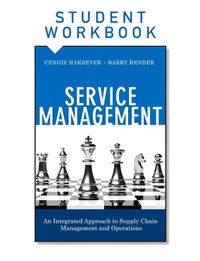
Service Management, Student Workbook
An Integrated Approach to Supply Chain Management and Operations
1st Edition
Published on 31. May 2013
99998 pages
978-0-13-308890-8 (ISBN)
Description

With this hands-on study guide to accompany the reference on integrating the many disciplines that comprise service operations management, authors Haksever and Render help students master all aspects of the field. Fully aligned with Service Management, this workbook-style book includes chapter learning objectives, chapter summaries, chapter questions, reviews of key terms and concepts, additional cases and examples, discussion questions, and more.
More details
Edition
1. Auflage
Language
English
Place of publication
Boston
United States
Publishing group
Pearson Education (US)
Target group
Professional and scholarly
ISBN-13
978-0-13-308890-8 (9780133088908)
Copyright in bibliographic data and cover images is held by Nielsen Book Services Limited or by the publishers or by their respective licensors: all rights reserved.
Schweitzer Classification
Other editions
Additional editions
Cengiz Haksever | Barry Render
Service Management, Student Workbook
An Integrated Approach to Supply Chain Management and Operations
Book
07/2013
Financial TImes Prentice Hall
€34.65
Article exhausted; check different version
Persons
Cengiz Haksever is a Professor of Management Sciences at the College of Business Administration of Rider University. He received his B.S. and M.S. degrees in Industrial Engineering from Middle East Technical University in Ankara, Turkey, his M.B.A. from Texas A & M University in College Station, Texas, and his Ph.D. in Operations Research from the University of Texas in Austin.
His research interests include service management, supply chain management, operations research, operations management, quality and continuous improvement, and data envelopment analysis. Dr. Haksever's work appeared in European Journal of Operational Research, Journal of the Operational Research Society, Computers & Operations Research, Computers & Industrial Engineering, Journal of Construction Engineering and Management, International Journal of Production Economics, Journal of Small Business Strategy, Journal of Business Ethics, Education Economics, International Journal of Production Economics, International Journal of Information and Management Sciences, and Business Horizons.
He has taught courses in operations management, supply chain management, service operations management, management science, quality assurance, statistics, and regression in undergraduate and M.B.A. programs. He served as examiner and senior examiner for the New Jersey Governor's Award for Performance Excellence. During the 1993-1994 academic year, he was a Fulbright Senior Lecturer at Marmara University in Istanbul, Turkey. At Rider University, he was awarded the Jessie H. Harper Professorship for the academic year of 2000-2001. Dr. Haksever served on the Editorial Advisory Board of Computers & Operations Research and was a guest editor of a special issue of the journal Data Envelopment Analysis.
Barry Render is Professor Emeritus, the Charles Harwood Professor of Operations Management, Crummer Graduate School of Business, Rollins College, Winter Park, Florida. He received his B.S. in Mathematics and Physics at Roosevelt University and his M.S. in Operations Research and Ph.D. in Quantitative Analysis at the University of Cincinnati. He previously taught at George Washington University, University of New Orleans, Boston University, and George Mason University, where he held the Mason Foundation Professorship in Decision Sciences and was Chair of the Decision Sciences Department. Dr. Render has also worked in the aerospace industry for General Electric, McDonnell Douglas, and NASA.
Professor Render has coauthored 10 textbooks for Prentice Hall, including Managerial Decision Modeling with Spreadsheets, Quantitative Analysis for Management, Service Management, Introduction to Management Science, and Cases and Readings in Management Science. Quantitative Analysis for Management, now in its eleventh edition, is a leading text in that discipline in the United States and globally. Dr. Render's more than 100 articles on a variety of management topics have appeared in Decision Sciences, Production and Operations Management, Interfaces, Information and Management, Journal of Management Information Systems, Socio-Economic Planning Sciences, IIE Solutions, and Operations Management Review, among others.
Dr. Render has been honored as an AACSB Fellow and was twice named a Senior Fulbright Scholar. He was Vice President of the Decision Science Institute Southeast Region and served as Software Review Editor for Decision Line for six years and as Editor of The New York Times Operations Management special issues for five years. From 1984 to 1993, Dr. Render was President of Management Service Associates of Virginia, Inc., whose technology clients included the FBI, the U.S. Navy, Fairfax County, Virginia, and C&P Telephone. He is currently Consulting Editor to Financial Times Press.
Dr. Render has taught operations management courses in Rollins College's M.B.A. and Executive M.B.A. programs. He has received that school's Welsh Award as leading professor and was selected by Roosevelt University as the 1996 recipient of the St. Claire Drake Award for Outstanding Scholarship. In 2005, Dr. Render received the Rollins College M.B.A. Student Award for Best Overall Course and in 2009 was named Professor of the Year by full-time M.B.A. students.
His research interests include service management, supply chain management, operations research, operations management, quality and continuous improvement, and data envelopment analysis. Dr. Haksever's work appeared in European Journal of Operational Research, Journal of the Operational Research Society, Computers & Operations Research, Computers & Industrial Engineering, Journal of Construction Engineering and Management, International Journal of Production Economics, Journal of Small Business Strategy, Journal of Business Ethics, Education Economics, International Journal of Production Economics, International Journal of Information and Management Sciences, and Business Horizons.
He has taught courses in operations management, supply chain management, service operations management, management science, quality assurance, statistics, and regression in undergraduate and M.B.A. programs. He served as examiner and senior examiner for the New Jersey Governor's Award for Performance Excellence. During the 1993-1994 academic year, he was a Fulbright Senior Lecturer at Marmara University in Istanbul, Turkey. At Rider University, he was awarded the Jessie H. Harper Professorship for the academic year of 2000-2001. Dr. Haksever served on the Editorial Advisory Board of Computers & Operations Research and was a guest editor of a special issue of the journal Data Envelopment Analysis.
Barry Render is Professor Emeritus, the Charles Harwood Professor of Operations Management, Crummer Graduate School of Business, Rollins College, Winter Park, Florida. He received his B.S. in Mathematics and Physics at Roosevelt University and his M.S. in Operations Research and Ph.D. in Quantitative Analysis at the University of Cincinnati. He previously taught at George Washington University, University of New Orleans, Boston University, and George Mason University, where he held the Mason Foundation Professorship in Decision Sciences and was Chair of the Decision Sciences Department. Dr. Render has also worked in the aerospace industry for General Electric, McDonnell Douglas, and NASA.
Professor Render has coauthored 10 textbooks for Prentice Hall, including Managerial Decision Modeling with Spreadsheets, Quantitative Analysis for Management, Service Management, Introduction to Management Science, and Cases and Readings in Management Science. Quantitative Analysis for Management, now in its eleventh edition, is a leading text in that discipline in the United States and globally. Dr. Render's more than 100 articles on a variety of management topics have appeared in Decision Sciences, Production and Operations Management, Interfaces, Information and Management, Journal of Management Information Systems, Socio-Economic Planning Sciences, IIE Solutions, and Operations Management Review, among others.
Dr. Render has been honored as an AACSB Fellow and was twice named a Senior Fulbright Scholar. He was Vice President of the Decision Science Institute Southeast Region and served as Software Review Editor for Decision Line for six years and as Editor of The New York Times Operations Management special issues for five years. From 1984 to 1993, Dr. Render was President of Management Service Associates of Virginia, Inc., whose technology clients included the FBI, the U.S. Navy, Fairfax County, Virginia, and C&P Telephone. He is currently Consulting Editor to Financial Times Press.
Dr. Render has taught operations management courses in Rollins College's M.B.A. and Executive M.B.A. programs. He has received that school's Welsh Award as leading professor and was selected by Roosevelt University as the 1996 recipient of the St. Claire Drake Award for Outstanding Scholarship. In 2005, Dr. Render received the Rollins College M.B.A. Student Award for Best Overall Course and in 2009 was named Professor of the Year by full-time M.B.A. students.
Content
PART I: UNDERSTANDING SERVICES
Chapter 1: The Important Role Services Play in an Economy 1
Chapter 2: The Nature of Services and Service Encounters 5
Chapter 3: Customers: The Focus of Service Management 9
Chapter 4: Globalization of Services 13
Chapter 5: Service Strategy and Competitiveness 15
Chapter 6: Ethical Challenges in Service Management 19
PART II: BUILDING THE SERVICE SYSTEM
Chapter 7: Technology and Its Impact on Services and Their Management 23
Chapter 8: Design and Development of Services and Service Delivery Systems 27
Chapter 9: Supply Chains in Services and Their Management 31
Chapter 10: Locating Facilities and Designing Their Layout 33
PART III: OPERATING THE SERVICE SYSTEM
Chapter 11: Managing Demand and Supply in Services 43
Chapter 11 Supplement: Queuing and Simulation 47
Chapter 12: Service Quality and Continuous Improvement 55
Chapter 12 Supplement: Tools and Techniques of Total Quality Management 57
Chapter 13: Service Productivity and Measurement of Performance 61
Chapter 14: Management of Public and Private Nonprofit Service Organizations 67
PART IV: TOOLS AND TECHNIQUES FOR MANAGING SERVICE OPERATIONS
Chapter 15: Forecasting Demand for Services 71
Chapter 16: Vehicle Routing and Scheduling 81
Chapter 17: Project Management 87
Chapter 18: Linear and Goal Programming Applications for Services 95
Chapter 19: Service Inventory Systems 105
Appendix A: Areas Under the Standard Normal Curve 109
Appendix B: Answers to Selected Problems 113
Chapter 1: The Important Role Services Play in an Economy 1
Chapter 2: The Nature of Services and Service Encounters 5
Chapter 3: Customers: The Focus of Service Management 9
Chapter 4: Globalization of Services 13
Chapter 5: Service Strategy and Competitiveness 15
Chapter 6: Ethical Challenges in Service Management 19
PART II: BUILDING THE SERVICE SYSTEM
Chapter 7: Technology and Its Impact on Services and Their Management 23
Chapter 8: Design and Development of Services and Service Delivery Systems 27
Chapter 9: Supply Chains in Services and Their Management 31
Chapter 10: Locating Facilities and Designing Their Layout 33
PART III: OPERATING THE SERVICE SYSTEM
Chapter 11: Managing Demand and Supply in Services 43
Chapter 11 Supplement: Queuing and Simulation 47
Chapter 12: Service Quality and Continuous Improvement 55
Chapter 12 Supplement: Tools and Techniques of Total Quality Management 57
Chapter 13: Service Productivity and Measurement of Performance 61
Chapter 14: Management of Public and Private Nonprofit Service Organizations 67
PART IV: TOOLS AND TECHNIQUES FOR MANAGING SERVICE OPERATIONS
Chapter 15: Forecasting Demand for Services 71
Chapter 16: Vehicle Routing and Scheduling 81
Chapter 17: Project Management 87
Chapter 18: Linear and Goal Programming Applications for Services 95
Chapter 19: Service Inventory Systems 105
Appendix A: Areas Under the Standard Normal Curve 109
Appendix B: Answers to Selected Problems 113
