

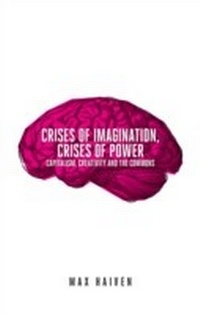
Crises of Imagination, Crises of Power
Capitalism, Creativity and the Commons
1st Edition
Published on 13. March 2014
322 pages
978-1-78032-954-3 (ISBN)
Description

Today, when it seems like everything has been privatized, when austerity is too often seen as an economic or political problem that can be solved through better policy, and when the idea of moral values has been commandeered by the right, how can we re-imagine the forces used as weapons against community, solidarity, ecology and life itself?
In this stirring call to arms, Max Haiven argues that capitalism has colonized how we all imagine and express what is valuable. Looking at the decline of the public sphere, the corporatization of education, the privatization of creativity, and the power of finance capital in opposition to the power of the imagination and the growth of contemporary social movements, Haiven provides a powerful argument for creating an anti-capitalist commons. Capitalism is not in crisis, it is the crisis, and moving beyond it is the only key to survival.
Crucial reading for all those questioning the imposition of austerity and hoping for a fairer future beyond it.
In this stirring call to arms, Max Haiven argues that capitalism has colonized how we all imagine and express what is valuable. Looking at the decline of the public sphere, the corporatization of education, the privatization of creativity, and the power of finance capital in opposition to the power of the imagination and the growth of contemporary social movements, Haiven provides a powerful argument for creating an anti-capitalist commons. Capitalism is not in crisis, it is the crisis, and moving beyond it is the only key to survival.
Crucial reading for all those questioning the imposition of austerity and hoping for a fairer future beyond it.
Reviews / Votes
Haiven's provocative book does justice to a topic that has been too long neglected. He not only explains the constraints that are everywhere placed on our political imagination, but also makes a strong case for transcending them. * Andrew Ross, author of Creditocracy and the Case for Debt Refusal * The right has taken possession of the field of values with a politics that is inadequate to deal with the crises therein, whereas the left has the concepts needed to deal with the crises but has all but abandoned the field. This is a conundrum that must be explored and solved. Haiven is to be thanked for formulating this problem so precisely. * George Caffentzis, author of In Letters of Blood and Fire * Fatalism and futility beware! We now have a handbook for the invention of a new commons. In Crises of Imagination, Crises of Power, Max Haiven explains how and why we need to struggle to take back creativity, imagination and our sense of collective purpose from those forces that seek to use it to their own ends. With the help of this book, another world really is possible. * Imre Szeman, Canada Research Chair in Cultural Studies, University of Alberta * In this inspired and engaged book, Max Haiven provides us with what he calls a series of exercises of the imagination. Readers will emerge from these invigorating sessions, which rework the machineries of finance, labor and activism, equipped with a contemporary radicalism to face the demands of a full immersion in the possibilities and complexities of our moment. * Randy Martin, New York University * Against the bankruptcy of liberal politics, Max Haiven puts forward a renewed called for the elaboration of others values, lives, and ways of being together. This is a radicalism based not upon pie-in-the-sky ideas, but on expanding the commons of a social reproduction not premised on capital's measure but its own, extending and learning from practices already in motion. Crises of Imagination, Crises of Power helps bring us closer to the utopia that is within our grasp. * Stevphen Shukaitis, author of Imaginal Machines: Autonomy and Self-Organization in the Revolutions of Everyday Life * [Haiven's] consideration of the potential cracks in the status quo, and how these might provide spaces for the collective work of imagining alternatives, demonstrates the ways in which global activist networks have already started transforming our world. * TOPIA: Canadian Journal of Cultural Studies *More details
Edition
1. Auflage
Language
English
Place of publication
United Kingdom
Publishing group
Bloomsbury Publishing PLC
Target group
College/higher education
ISBN-13
978-1-78032-954-3 (9781780329543)
Copyright in bibliographic data and cover images is held by Nielsen Book Services Limited or by the publishers or by their respective licensors: all rights reserved.
Schweitzer Classification
Other editions
Additional editions
Book
03/2014
Zed Books Ltd
€30.50
Shipment within 3-4 weeks
Book
03/2014
Zed Books Ltd
€106.80
Article exhausted; check different version
Person
Max Haiven is an assistant professor in the division of Art History and Critical Studies at the Nova Scotia College of Art and Design in Halifax, Canada. He is the author of many academic articles on themes including the financialization of society and culture, contemporary social movements, the radical imagination, and cultural and social theory.
He is the co-author of The Radical Imagination: Social Movement Research in the Age of Austerity (Zed 2014) and author of Cultures of Financialization: Fictitious Capital in Popular Culture and Everyday Life (2014). More information can be found at maxhaiven.com.
He is the co-author of The Radical Imagination: Social Movement Research in the Age of Austerity (Zed 2014) and author of Cultures of Financialization: Fictitious Capital in Popular Culture and Everyday Life (2014). More information can be found at maxhaiven.com.
Content
Introduction: Crises of the Imagination
1. Reimagining Value
2. Publics, Commons, Occupations
3. The Crisis of the Financialized Imagination
4. Within and Beyond the Edu-factory
5. The Enclosure of History, the Debt of the Past, the Commons of Memory
6. The Enclosure of Creativity
7. What is the Radical Imagination?
Conclusion: Fatalism and its Discontents
1. Reimagining Value
2. Publics, Commons, Occupations
3. The Crisis of the Financialized Imagination
4. Within and Beyond the Edu-factory
5. The Enclosure of History, the Debt of the Past, the Commons of Memory
6. The Enclosure of Creativity
7. What is the Radical Imagination?
Conclusion: Fatalism and its Discontents
