

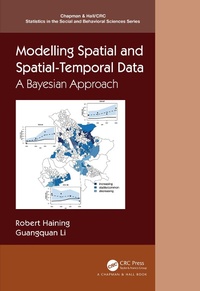
Modelling Spatial and Spatial-Temporal Data
A Bayesian Approach
1st Edition
Published on 27. January 2020
400 pages
978-1-4822-3743-6 (ISBN)
Description

Modelling Spatial and Spatial-Temporal Data: A Bayesian Approach is aimed at statisticians and quantitative social, economic and public health students and researchers who work with spatial and spatial-temporal data. It assumes a grounding in statistical theory up to the standard linear regression model. The book compares both hierarchical and spatial econometric modelling, providing both a reference and a teaching text with exercises in each chapter. The book provides a fully Bayesian, self-contained, treatment of the underlying statistical theory, with chapters dedicated to substantive applications. The book includes WinBUGS code and R code and all datasets are available online.
Part I covers fundamental issues arising when modelling spatial and spatial-temporal data. Part II focuses on modelling cross-sectional spatial data and begins by describing exploratory methods that help guide the modelling process. There are then two theoretical chapters on Bayesian models and a chapter of applications. Two chapters follow on spatial econometric modelling, one describing different models, the other substantive applications. Part III discusses modelling spatial-temporal data, first introducing models for time series data. Exploratory methods for detecting different types of space-time interaction are presented followed by two chapters on the theory of space-time separable (without space-time interaction) and inseparable (with space-time interaction) models. An applications chapter includes: the evaluation of a policy intervention; analysing the temporal dynamics of crime hotspots; chronic disease surveillance; and testing for evidence of spatial spillovers in the spread of an infectious disease. A final chapter suggests some future directions and challenges.
Part I covers fundamental issues arising when modelling spatial and spatial-temporal data. Part II focuses on modelling cross-sectional spatial data and begins by describing exploratory methods that help guide the modelling process. There are then two theoretical chapters on Bayesian models and a chapter of applications. Two chapters follow on spatial econometric modelling, one describing different models, the other substantive applications. Part III discusses modelling spatial-temporal data, first introducing models for time series data. Exploratory methods for detecting different types of space-time interaction are presented followed by two chapters on the theory of space-time separable (without space-time interaction) and inseparable (with space-time interaction) models. An applications chapter includes: the evaluation of a policy intervention; analysing the temporal dynamics of crime hotspots; chronic disease surveillance; and testing for evidence of spatial spillovers in the spread of an infectious disease. A final chapter suggests some future directions and challenges.
Reviews / Votes
"Knowledge on statistical theory and regression concepts are essential to read, comprehend, appreciate, and use the rich contents of this fascinating book. This well-written book is a good source for the Bayesian concepts and methods to practice the spatial-temporal analysis using R and WinBugs codes . . . I recommend this book to economics, health, statistics and computing professionals and researchers."~ Ramalingam Shanmugam, Texas State University
More details
Series
Edition
1. Auflage
Language
English
Place of publication
Philadelphia, PA
United States
Publishing group
Taylor & Francis Inc
Target group
College/higher education
Illustrations
20 b/w images
ISBN-13
978-1-4822-3743-6 (9781482237436)
Copyright in bibliographic data and cover images is held by Nielsen Book Services Limited or by the publishers or by their respective licensors: all rights reserved.
Schweitzer Classification
Other editions
Additional editions
Book
09/2021
1st Edition
Chapman & Hall/CRC
€72.00
Shipment within 10-20 days
Book
02/2020
1st Edition
Chapman & Hall/CRC
€185.87
Article not available for order
Persons
Robert Haining is Emeritus Professor in Human Geography, University of Cambridge, England. He is the author of Spatial Data Analysis in the Social and Environmental Sciences (1990) and Spatial Data Analysis: Theory and Practice (2003). He is a Fellow of the RGS-IBG and of the Academy of Social Sciences.
Guangquan Li is Senior Lecturer in Statistics in Department of Mathematics, Physics and Electrical Engineering, Northumbria University, Newcastle, England. His research includes the development and application of Bayesian methods in the social and health sciences. He is a Fellow of the Royal Statistical Society.
Guangquan Li is Senior Lecturer in Statistics in Department of Mathematics, Physics and Electrical Engineering, Northumbria University, Newcastle, England. His research includes the development and application of Bayesian methods in the social and health sciences. He is a Fellow of the Royal Statistical Society.
Content
Introduction. Thinking spatially, thinking statistically in the social and economic sciences. The nature of spatial data and the implications for statistical analysis. Exploratory analysis of spatial and spatial-temporal data. Bayesian regression modeling with spatial data. Introduction to the Bayesian approach to regression modeling with spatial data. Topics in spatial modeling. Further topics in spatial modeling. Bayesian regression modeling with spatial-temporal data. Generic issues in spatial-temporal modeling. Topics in spatial-temporal modeling. Appendices.
