

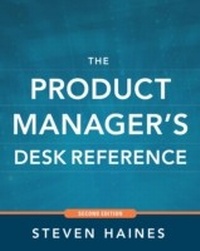
Product Manager's Desk Reference 2E
1st Edition
Published on 6. June 2014
819 pages
978-0-07-182581-8 (ISBN)
Available for download
Description

Whatever your business sells, product management is one of the most important functions in the organization's pursuit of profits. With everexpanding globalization and increasingly fierce competition, the stakes are higher than ever--and the room for error narrower than ever. Introducing a brand-new Product Management Life Cycle (PMLC) model, The Product Manager's Desk Reference, Second Edition, provides the knowledge, tools, and insight you need to establish yourself as a cutting-edge product manager who contributes measurably to your company's success. In this fully revised edition of the definitive product management guide, veteran product management thought leader and practitioner Steven Haines clearly illustrates the entire product life cycle, from beginning to end. The Product Manager's Desk Reference is packed with an array of best practices and helpful hints that are critical to the efficient management of products. Written for practitioners by a practitioner, The Product Manager's Desk Reference explains how to: Choose and justify which products to build Plan for their profitable creation and deployment Develop and launch them Manage them once they enter the market Gracefully retire them and replace them with new products Efficiently allocate investments across all of the products in an organization The Product Manager's Desk Reference embodies everything ",product management.", It is a comprehensive, versatile, must-have resource for anyone who works in any company, in any industry, who seeks to successfully and profitably market and manage products and services. PRAISE FOR The Product Manager's Desk Reference: ",There are some books that are destined to become classics in their field. The Product Manager's Desk Reference by Steven Haines is one of those books. Anyone working not just in product management but also marketing and business development should take the time to read and absorb the comprehensive body of knowledge that Steven has organized around product management.", -- AMANDA NOZ, Head of Positioning and Messaging, Alcatel-Lucent ",Steven has done an excellent job of bringing a standard definition of the roles and responsibilities of this 'accidental profession' to the industry, and has provided a path along with tools to improve your skills within the product management profession.", -- BRIAN WEBER, Manager of Product Management, Thomson Reuters ",Steven Haines covers this multifaceted topic in a systematic manner that makes the book easy to navigate. His groundbreaking proposal that product management become a formal discipline is an accurate reflection of the acute need for these skills in the business community.", -- DAN O'DAY, Senior Director, Product Management, Thomson Reuters ",From now on, this book will stand as an important reference point for all product management teams.", -- MARK ELLIOTT, Vice President, Product Management, Smiths Detection ",The Product Manager's Desk Reference is a practicial guide to the activities fi rms need to engage in to build the discipline of product management. When actively utilized, the Desk Reference promotes consistency and standardization of methodology, which in turn leads to repeatable process, good decision making, and positive outcomes. This is an incredibly valuable resource.", -- DEBORAH LORENZEN, Chief Operating Officer, BNY Mellon University
More details
Other editions
Additional editions
Steven Haines
The Product Manager's Desk Reference 2E
Book
08/2014
2nd Edition
McGraw-Hill Professional
€96.71
Article exhausted; check for reprint
Content
- Cover
- Title Page
- Copyright Page
- Dedication
- Contents
- List of Illustrations
- List of Templates
- Foreword Practice What You Preach: A Case Study on Steven Haines . Bob Caporale
- Preface
- Introduction The Accidental Profession
- MODULE 1 FOUNDATIONS OF PRODUCT MANAGEMENT
- Introduction to Module 1
- Chapter 1 What Is Product Management?
- Question 1: What Is a Product?
- Product Lines
- Product Portfolios
- Solutions, Bundles, and Systems
- Product Elements and Modules
- Platforms
- Question 2: What Is Management?
- What Is a Product Manager?
- What Does a Product Manager Really Do?
- Question 3: What Is Product Management?
- Question 4: How Does Product Management Transform a Business?
- Discovery and Innovation
- New Product Planning Phases
- New Product Introduction Phases (Execution)
- Post-Launch Product Management
- Product Management: A Holistic Activity
- Summary: Why Product Management Matters
- Raising Your Product Management Experience Quotient (PMEQ)
- Chapter 2 The Product Master Plan
- The Purpose of a Master Plan
- Plans Change
- The Format of the Product Master Plan
- The Value of a Product Master Plan
- An Insurance Policy for Consistent Communication
- The Basic Construction of the Product Master Plan
- Product and Product Line Business Documents
- Cross-Functional Product Team and Other Organizational Information
- Product Performance and Other Business Information
- Market Data
- Resources and Tools
- A Personal Library
- A Product Management Library
- Summary
- Raising Your Product Management Experience Quotient (PMEQ)
- Chapter 3 Leadership: Creating Influence
- You Are Always on Stage
- Stay Calm, Even when Your Hair's on Fire
- Transformation
- The Most Important Values
- Leadership Behaviors and Mindset
- Additional Skills and Subject Matter Expertise
- Experiential Development
- How Do You Improve Your Skills and Experiences?
- Summary
- Raising Your Product Management Experience Quotient (PMEQ)
- Chapter 4 Cross-Functional Product Teams: Getting Things Done
- Cross-Functional Team Definitions
- Definition: A Culture of Discipline
- Team Membership
- Teaming Is Not Always Easy
- Curing the Dysfunctional Team
- Building Blocks of a Cross-Functional Product Team
- Team Membership
- Multicultural Product Team Issues
- Product Team Responsibilities
- Cross-Functional Product Team Membership
- Clarifying Roles and Responsibilities
- The Functional Support Plan
- Team Membership Across the Life Cycle
- Cross-Functional Teams in the Global Arena
- Cross-Functional Team Leadership
- Summary
- Raising Your Product Management Experience Quotient (PMEQ)
- Chapter 5 Problem Solving and Decision Making: What's Next?
- The Importance of Decision Making
- Decision Making and Problem Solving
- Saving Grace: A Case Study about Decision Making
- Decision-Making Techniques
- Combining Options
- The Morphologic Box
- The Decision Matrix
- The Decision Tree
- Analysis Paralysis and Rational Ignorance
- Gut-Feel Decision Making
- Business Intelligence
- Summary
- Raising Your Product Management Experience Quotient (PMEQ)
- Chapter 6 Finance for the Product Manager: Keeping Score
- The Language of Business
- The Basic Financial Statements
- The Income Statement
- The Balance Sheet
- Cash Flow
- Demystifying Discounted Cash Flow
- Financial Planning for Product Managers
- Creating Business Cases for Product Investments
- Assembling Forecasts
- Testing Planning Assumptions Using Sensitivity Analysis
- Deriving Product Cost Models
- Establishing Pricing Models
- Preparing Product Budgets
- Managing the Business
- Making Sure the Product Is Achieving Its Financial Goals
- Financial Ratios
- Last Words on Ratios
- Maturity Assessment: Placing the Product on the Life Cycle Curve
- Using Scorecards
- Summary
- Raising Your Product Management Experience Quotient (PMEQ)
- MODULE 2 BUILDING INSIGHTS AND DRIVING STRATEGIES BY MAKING THE MARKET YOUR PRIMARY FOCUS
- Introduction to Module 2
- Why Insights Matter
- Chapter 7 The Playing Field and the Players: Analyzing the Industry and Competition
- Becoming the Expert
- What Is an Industry?
- Industry Classifications
- Putting Industry Evolution into Perspective
- Carrying out Industry Research
- Securing Additional Data
- Processing the Signals
- Competitive Environment
- Competitive Positioning
- Gaining an Edge: Performance Counts
- Competitive Intelligence in Your Company
- Competitive Intelligence in Your World
- Ethics in Competitive Intelligence
- With Whom Do You Compete?
- Competitor SWOT
- How Do They Do What They Do?
- The Final Analysis
- Summary
- Raising Your Product Management Experience Quotient (PMEQ)
- Chapter 8 Finding Markets to Conquer by Understanding Customer Needs and Market Segments
- The Common Denominator in Segmentation: Customer Needs
- How Markets Are Segmented
- Market Segmentation and the Marketing Mix
- Describing the Target Market
- They Don't Know What They Don't Know
- Planning and Carrying out Customer Visits
- The Voice of the Customer
- Using Personas (Or Customer Characterizations) as a Way to Capture Needs
- Your Research Strategy
- Summary
- Raising Your Product Management Experience Quotient (PMEQ)
- Chapter 9 Preparing to Set Your Mileposts: Forecasting for the Product Manager
- Forecasting Basics
- Forecasting Is a Cross-Functional Exercise
- Validating Market and Demand Potential
- Forecasts Are Built on Beliefs about the Future
- Validating Assumptions and Applying Customer Preferences
- How Much Can We Really Make? Deriving Market Share Estimates
- Case Study: Forecasting
- Sales Forecasting
- Making the Sales Forecast Useful
- Demand Planning
- Concluding the Case
- Summary
- Raising Your Product Management Experience Quotient (PMEQ)
- Chapter 10 Strategic Product Planning: The Inflection Point
- Strategy Is a Dynamic Continuum
- Using a Generic Strategy
- Strategizing Is Like Solving a Puzzle
- The Waterfall Effect
- Dynamic Strategy for the Product Manager
- Strategy in Your World
- The Product as a Business: A Strategic Planning Model
- An Overview of the Model
- The Model in Detail
- Step A. Baseline the Business of the Product
- Organizing the Data
- External Data: Industry and Competition
- Customer Activity
- Organizational Capabilities and Financial Health
- Capturing Product Performance Data
- Synthesizing Data and Creating Useful Information
- Prepare to Tell a Story about the Product
- The State-of-the-Business Product Strategy Review
- Step B: Recast the Vision for the Product
- Step C: Identify Strategic Options
- A Note on Product Roadmaps
- Summary
- Raising Your Product Management Experience Quotient (PMEQ)
- MODULE 3 THE START OF THE PRODUCT'S JOURNEY: THE NEW PRODUCT DEVELOPMENT PROCESS
- Introduction to Module 3
- Limits and Benefits of Processes
- A Generic Phase Gate Model
- Processes Are Linear, Markets Are Not
- Importance of the Right Pace for New Product Planning
- Faster is Not Always Better, But It Can't Hurt
- The Value of Flawless Execution
- Organization of the Chapters in This Module
- Chapter 11 Making a Molehill Out of a Mountain: The Concept Phase
- The Basic Process
- Ideation: What's the Big Idea?
- Experimentation and Discovery
- Categorization of Product "Projects"
- Sorting out Opportunities
- Looking Down the Product Pipeline
- Product Enhancements as a Grouped Opportunity
- "So What?": The Value Proposition for the Opportunity
- Clarifying Your Identity with a Positioning Statement
- Positioning Means Making a Difference
- Narrowing the Field: Choosing Among Opportunities
- Managing Rejected Opportunities
- Securing Approval to Move to the Next Phase: The Concept Review
- Summary
- Raising Your Product Management Experience Quotient (PMEQ)
- Chapter 12 Is There Really a Business Here? Assessing Feasibility
- Using Functional Support Plans to Clarify Roles, Responsibilities, and Deliverables
- The Marketing Functional Support Plan (The Marketing Plan for the Product)
- Product Development/IT/Systems Functional Support Plan
- Finance Functional Support Plan
- Customer Service Functional Support Plan
- Sales Functional Support Plan
- Operations Functional Support Plan
- Supply Chain Functional Support Plan
- Legal/Regulatory/Compliance Functional Support Plan
- Manufacturing Functional Support Plan
- International (or Global) Functional Support Plan
- Resource Planning and Summarization
- Document Evolution During Feasibility
- Planning to Monitor the Future Performance of The Product
- The Power of the Prototype
- The Decision Matrix for the Feasibility Phase
- Phase Review: Feasibility
- Summary
- Raising Your Product Management Experience Quotient (PMEQ)
- Chapter 13 Appearances Are Everything: Defining and Designing the Product
- Product Definition Documents
- The PRD Outline and Template
- Managing Requirements
- Eliciting Requirements
- Defining Requirements
- Organizing Documents
- Managing Requirements from Beginning to End
- Prioritizing Requirements
- Inspections and Peer Reviews
- Requirements Management and the Product Life Cycle
- The Evolving Product Design
- Linking the Product Definition to "Building" the Product
- Make Versus Buy
- Carrying out a Make Versus Buy Analysis: An Example
- The Countdown Starts Now: Launch Planning
- Counting Back: How to Meet the Launch Goal
- Other Parameters for Successful Launch Planning
- Setting the Conditions to Recognize Future Life Cycle States
- The Exit Plan
- The Product Definition Phase Review
- Summary
- Raising Your Product Management Experience Quotient (PMEQ)
- Chapter 14 Justifying Product Investments: The Business Case
- The Purpose of the Business Case
- Characteristics of Good Business Cases
- Activities and Sequencing
- Orchestration of the Case
- Business Case Structure
- Cover Page
- Executive Summary
- Framing
- Business Need and/or Strategic Fit
- Market Assessment
- Product Description
- Project Proposal
- Assumptions, Forecasts, and Financials
- Operations and Implementation
- Risk Analysis and Contingency Plans
- Recommendation
- Appendices
- Kick Start the Business Case
- Case Study: Creating a Business Case
- The Sample Business Case
- Concluding Comments
- Summary
- Raising Your Product Management Experience Quotient (PMEQ)
- Chapter 15 Synchronizing the Gears: The Marketing Plan for the Product
- The Marketing Plan for the Product Is a Functional Support Plan
- Getting Organized
- Marketing Plans Always Begin with Strategy
- Building a Historical Marketing Profile
- Historical Inbound Programs
- Competitor Research
- Field Research Data
- Market Segmentation and/or Customer Research
- Industry Research Reports
- Checking for Inbound Data Sufficiency
- Historical Outbound Programs
- Advertising, Promotion, and Customer Education Program Information
- Sales Information
- Marketing and Selling Collateral
- Using the Historical Profile
- Putting the Marketing Mix in Perspective
- Outline for the Marketing Plan
- Setting the Team Up with a Realistic Marketing Plan
- Essential Sections of the Marketing Plan
- Executive Summary
- Strategic Context for the Marketing Plan
- The Market Environment for the Product
- The Marketing Mix: Strategies and Tactics
- Product
- Value-Oriented Pricing
- Advertising, Promotion, and Customer Education
- Place: Sales and Distribution Channels
- Marketing Alliances
- International Marketing Activities
- Product Launches Being Planned or Being Carried Out
- Sales Support and Training Programs
- Customer Service Training
- Additional Research Programs Needed
- Cross-Functional Deliverables and Dependencies
- Integrated Budgets
- Measurements and Metrics
- Risks
- Appendices and Supporting Material
- Summary
- Raising Your Product Management Experience Quotient (PMEQ)
- Chapter 16 Execution and Oversight During Product Development
- The Product Manager's Role During the Development Phase
- The Product Manager as Facilitator, Partner, and Orchestrator
- Truth Mixed with Compassion
- Product Managers Must Understand Execution and Mitigate Conflicts
- Surfacing Conflicts and Realities with "How" Questions
- Rapid Product Development
- Progress Tracking
- Frequent Status Updates Are Essential
- Managing Project Plans Helps Manage Risk
- Additional Project Management Tools
- Progress Validation Is Essential
- Product Testing
- The Beta Test
- Product Documentation
- Managing Scope and Budget Creep
- Managing Change: Trade-Offs and Prioritization Decisions
- The Development Phase Review and Checklist
- Summary
- Raising Your Product Management Experience Quotient (PMEQ)
- Chapter 17 Introducing the Product and Orchestrating the Launch
- Launch Benchmarking Outcomes
- The Product Launch Phase Workflow
- Executive Champions Need to Lead Important Product Launches
- Confirm the Market Window
- Synchronize Your Documentation (The Business Case, Marketing Plan, and Launch Plan)
- Review Market and Beta Tests-or Conduct Them If Necessary
- Product Availability Ratings
- Provide Adequate Sales Training
- Sales Goals and Compensation
- Ensure Readiness of Marketing Collateral, Website, and Integrated Promotional Programs
- Arrange Coverage by Industry or Market Analysts
- Make Sure Distribution Channels Are Able to Sell and Deliver the Product
- Ensure Readiness of Operational Systems
- Preparing for the Internal Launch
- Launch Metrics Must Be Assembled and Ready to Track
- Risk Management
- Be Willing to Recommend Go or No-Go for Launch
- The Announcement
- The Launch Checklist
- Summary
- Raising Your Product Management Experience Quotient (PMEQ)
- MODULE 4 CONTINUING THE JOURNEY: POST-LAUNCH PRODUCT MANAGEMENT
- Introduction to Module 4
- Chapter 18 Auditing Results After the Launch
- Afterward
- Using an Impartial Auditor
- Market Window Compliance
- Executive Sponsorship
- Business Case Synchronization
- Adequacy and Timing of Collateral
- Adequacy of Sales Training
- Reviewing Operational Readiness
- Conformance to Launch Metrics
- Make Sure to Capture Lessons Learned
- Win-Loss Audits
- Internal Win-Loss Auditing
- External Win-Loss Auditing
- Assembling a Report
- Summary
- Raising Your Product Management Experience Quotient (PMEQ)
- Chapter 19 Post-Launch Strategic Performance Analysis
- Running the Business
- The Importance of Measuring Performance
- The Product Business Strategy Model
- Collection of Data
- Sources and Types of Data
- Market Data
- Financial Data
- Sales, Service, and Operations Data
- Observational Data
- Evaluate the Data: What's Happening Now with the Product?
- Identify the In-Market Life Cycle State of the Product
- Answer the Question: "What's Happening Now with the Product?"
- Leading the Cross-Functional Product Team
- Product Team Meetings
- Summary
- Raising Your Product Management Experience Quotient (PMEQ)
- Chapter 20 Post-Launch Strategic Mix Management
- Steering the Product Using an Actionable, Integrated Roadmap
- Deriving Value-Based Pricing
- Strategic Context
- Value Orientation
- Creating Programs to Advertise, Promote, and Educate Customers
- Fundamental Advertising, Promotion, and Educational Programs
- Understand What Your Company Is Currently Promoting
- Action Plans to Promote Your Own Product and Educate Your Customers
- Improving Customer Access by Selecting the Best Path to Your Chosen Customer
- Deciding on the Best Path to Take and Creating an Action Plan
- Integrating Other Aspects of the Strategic Mix for the Product's Business
- Creating Unforgettable Customer or User Experiences
- Protecting the Brand
- Garnering Customer Loyalty
- Operating Efficiently
- Summary
- Raising Your Product Management Experience Quotient (PMEQ)
- Chapter 21 Life Cycle Product Portfolio Management
- Dispelling Some Myths about Product Portfolio Management
- What Is Life Cycle Product Portfolio Management?
- A Portfolio Reference Model
- The Ideal Work Structure for Product Portfolio Management
- The Cross-Functional Product Review Board
- A Life Cycle Product Portfolio Model
- Methodology
- Considering Existing Products
- Product Projects in New Product Introduction
- Products Being Planned
- Create Your Own Product Portfolio Model
- Portfolio Decision Making
- Availability of Data Is Critical
- Summary
- Raising Your Product Management Experience Quotient (PMEQ)
- Chapter 22 Enough's Enough! Discontinuing the Product
- Barriers to Discontinuation
- The Discontinuation Decision
- Product Discontinuation Documentation
- The Cross-Functional Team
- Other Types of "Discontinuation"
- The Discontinuation Notice
- Summary
- Raising Your Product Management Experience Quotient (PMEQ)
- MODULE 5 PROFESSIONALIZING PRODUCT MANAGEMENT
- Introduction to Module 5
- Chapter 23 Charting Your Career
- It's Up to You
- A Career Strategy
- Where Are You Now?
- Assessing Knowledge, Skills, and Experiences
- Career Action Planning
- Your Applied Learning Project
- Summary
- Chapter 24 Organizing for and Managing Product Management
- Getting Organized
- Leading Product Management
- Transforming the Organization
- Chartering and Supporting Cross-Functional Product Teams
- Empowerment
- Acting as the Product Portfolio Review Council and Directing Product Investments
- Assigning an Owner for All Product Management Processes and Documents
- Providing Data for Product Managers
- Creating a Repository of Templates and Tools
- Resolving Problems as Escalated by the Product Teams
- Staffing Strategies for Product Managers
- Ensuring Ongoing Professional Development of Product Managers
- Support the Building of a Product Management Community
- Establishing an Environment for Creating and Sustaining Customer Partnerships
- Investing in Market Research to Support the Product Teams
- Coaching Product Managers
- At the Heart of Business: Product Management Matters
- MODULE 6 THE PRODUCT MANAGER'S TOOLBOX
- Customer Visit Plan Template
- Functional Support Plan Template
- Opportunity Statement Template
- Product Positioning Statement Template
- Competitive Analysis Dossier
- Business Case Template
- Product Strategy Template
- Product Marketing Plan Template
- Product Launch Template
- Product Discontinuation Outline
- Product Master Plan Outline
- Product Requirements Document Guideline and Template
- Glossary
- References and Resources
- Index

