

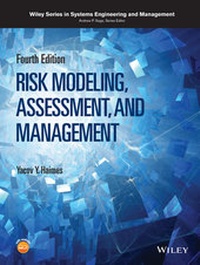
Risk Modeling, Assessment, and Management
Description

More details
Other editions
Additional editions
Persons
YACOV Y. HAIMES, PhD, is the Lawrence R. Quarles Professor at the School of Engineering and Applied Science, University of Virginia, USA, and is a member of the Systems and Information Engineering faculty and the Civil and Environmental Engineering faculty. He is the Founding Director (1987) of the university-wide Center for Risk Management of Engineering Systems. On the faculty of Case Western Reserve University, USA, for 17 years, he was the Chair of the Systems Engineering Department, and Director of the Center for Large-Scale Systems and Policy Analysis.
Content
Preface to the Fourth Edition ix
The Companion Website xv
Acknowledgments xvii
Part I Fundamentals of Risk Modeling, Assessment, and Management 1
1 The Art and Science of Systems and Risk Analysis 3
1.1 Introduction 3
1.2 Systems Engineering 4
1.3 Risk Assessment and Management 14
1.4 Concept Road Map 26
1.5 Epilogue 35
References 35
2 The Role of Modeling in the Definition and Quantification of the Risk Function 41
2.1 Introduction 41
2.2 The Risk Assessment and Management Process: Historical Perspectives 43
2.3 Information, Intelligence, and Models 45
2.4 The Building Blocks of Mathematical Models 47
2.5 On the Complex Definition of Risk, Vulnerability, and Resilience: a Systems-Based Approach 51
2.6 On the Definition of Vulnerabilities in Measuring Risks to Systems 56
2.7 On the Definition of Resilience in Measuring Risk to Systems 57
2.8 On the Complex Quantification of Risk to Systems 60
References 65
3 Identifying Risk through Hierarchical Holographic Modeling and its Derivatives 69
3.1 Hierarchical Aspects 69
3.2 Hierarchical Overlapping Coordination 70
3.3 HHM 73
3.4 HHM and the Theory of Scenario Structuring 76
3.5 Adaptive Multiplayer HHM Game 79
3.6 Water Resources System 80
3.7 Sustainable Development 83
3.8 HHM in a System Acquisition Project 86
3.9 Software Acquisition 90
3.10 Hardening the Water Supply Infrastructure 94
3.11 Risk Assessment and Management for Support of Operations other than War 98
3.12 Automated Highway System 103
3.13 Food-Poisoning Scenarios 108
References 113
4 Modeling and Decision Analysis 115
4.1 Introduction 115
4.2 Decision Rules Under Uncertainty 116
4.3 Decision Trees 118
4.4 Decision Matrix 122
4.5 The Fractile Method 124
4.6 Triangular Distribution 127
4.7 Influence Diagrams 128
4.8 Population Dynamic Models 132
4.9 PSM 139
4.10 Example Problems 144
References 152
5 Multiobjective Trade-off Analysis 155
5.1 Introduction 155
5.2 Examples of Multiple Environmental Objectives 157
5.3 The Surrogate Worth Trade-off Method 159
5.4 Characterizing a Proper Noninferior Solution 166
5.5 The SWT Method and the Utility Function Approach 168
5.6 Example Problems 172
5.7 Summary 177
References 178
6 Defining Uncertainty and Sensitivity Analysis 179
6.1 Introduction 179
6.2 Sensitivity, Responsivity, Stability, and Irreversibility 180
6.3 Uncertainties Due to Errors in Modeling 182
6.4 Characterization of Modeling Errors 183
6.5 Uncertainty Taxonomy 185
6.6 The USIM 196
6.7 Formulation of the Multiobjective Optimization Problem 199
6.8 A Robust Algorithm of the USIM 204
6.9 Integration of the USIM with Parameter Optimization at the Design Stage 207
6.10 Conclusions 209
References 209
7 Risk Filtering, Ranking, and Management 211
7.1 Introduction 211
7.2 Past Efforts in Risk Filtering and Ranking 212
7.3 RFRM: A Methodological Framework 213
7.4 Case Study: An OOTW 220
7.5 Summary 224
References 224
Part II Advances in Risk Modeling, Assessment, and Management 227
8 Risk of Extreme Events and the Fallacy of the Expected Value 229
8.1 Introduction 229
8.2 Risk of Extreme Events 230
8.3 The Fallacy of the Expected Value 232
8.4 The PMRM 233
8.5 General Formulation of the PMRM 236
8.6 Summary of the Pmrm 238
8.7 Illustrative Example 239
8.8 Analysis of Dam Failure and Extreme Flood through the PMRM 240
8.9 Example Problems 243
8.10 Summary 257
References 257
9 Multiobjective Decision-tree Analysis 259
9.1 Introduction 259
9.2 Methodological Approach 261
9.3 Differences between SODT and MODT 279
9.4 Summary 281
9.5 Example Problems 282
References 293
10 Multiobjective Risk Impact Analysis Method 295
10.1 Introduction 295
10.2 Impact Analysis 296
10.3 The Multiobjective, Multistage Impact Analysis Method: An Overview 297
10.4 Combining the PMRM and the MMIAM 298
10.5 Relating Multiobjective Decision Trees to the MRIAM 304
10.6 Example Problems 313
10.7 Epilogue 325
References 326
11 Statistics of Extremes: Extension of the PMRM 329
11.1 A Review of the Partitioned Multiobjective Risk Method 329
11.2 Statistics of Extremes 333
11.3 Incorporating the Statistics of Extremes into the PMRM 338
11.4 Sensitivity Analysis of the Approximation of f4(·) 344
11.5 Generalized Quantification of Risk of Extreme Events 350
11.6 Summary 356
11.7 Example Problems 357
References 368
12 Systems-Based Guiding Principles for Risk Modeling, Planning, Assessment, Management, and Communication 371
12.1 Introduction 371
12.2 The Journey: The Guiding Principles in the Broader Context of the Emerging Next Generation Developed by the Federal Aviation Administration 372
References 387
13 Fault Trees 389
13.1 Introduction 389
13.2 Basic Fault-Tree Analysis 391
13.3 Reliability and Fault-Tree Analysis 392
13.4 Minimal Cut Sets 397
13.5 The DARE Using Fault Trees 400
13.6 Extreme Events in Fault Tree Analysis 403
13.7 An Example Problem Based on a Case Study 405
13.8 Failure Mode and Effects Analysis and Failure Mode, Effects, and Criticality Analysis 409
13.9 Event Trees 411
13.10 Example Problems 414
References 420
14 Multiobjective Statistical Method 423
14.1 Introduction 423
14.2 Mathematical Formulation of the Interior Drainage Problem 424
14.3 Formulation of the Optimization Problem 424
14.4 The MSM: Step-by-Step 425
14.5 The SWT Method 427
14.6 Multiple Objectives 428
14.7 Applying the MSM 429
14.8 Example Problems 432
References 438
15 Principles and Guidelines for Project Risk Management 439
15.1 Introduction 439
15.2 Definitions and Principles of Project Risk Management 440
15.3 Project Risk Management Methods 443
15.4 Aircraft Development Example 450
15.5 Quantitative Risk Assessment and Management of Software Acquisition 454
15.6 Critical Factors That Affect Software Nontechnical Risk 458
15.7 Basis for Variances in Cost Estimation 460
15.8 Discrete Dynamic Modeling 461
15.9 Summary 469
References 469
16 Modeling Complex Systems of Systems with Phantom System Models 473
16.1 Introduction 473
16.2 What Have We Learned from Other Contributors? 474
16.3 The Centrality of the States of the System in Modeling and in Risk Analysis 476
16.4 The Centrality of Time in Modeling Multidimensional Risk, Uncertainty, and Benefits 477
16.5 Extension of HHM to PSM 478
16.6 PSM and Meta-modeling 480
16.7 PSM Laboratory 486
16.8 Summary 488
References 489
17 Adaptive Two-Player Hierarchical Holographic Modeling Game for Counterterrorism Intelligence Analysis 493
17.1 Introduction 493
17.2 Bayes' Theorem 494
17.3 Modeling the Multiple Perspectives of Complex Systems 495
17.4 Adaptive Two-Player Hhm Game: Terrorist Networks versus Homeland Protection 499
17.5 The Building Blocks of Mathematical Models and the Centrality of State Variables in Intelligence Analysis 502
17.6 Hierarchical Adaptive Two-Player HHM Game 504
17.7 Collaborative Computing Support for Adaptive Two-Player HHM Games 505
17.8 Summary 507
References 508
18 Inoperability Input-Output Model and Its Derivatives for Interdependent Infrastructure Sectors 511
18.1 Overview 511
18.2 Background: The Original Leontief Input-Output Model 512
18.3 Inoperability Input-Output Model 513
18.4 Regimes of Recovery 516
18.5 Supporting Databases for IIM Analysis 517
18.6 National and Regional Databases for IIM Analysis 518
18.7 RIMS II 522
18.8 Development of the IIM and its Extensions 523
18.9 The Dynamic IIM 527
18.10 Practical Uses of the IIM 530
18.11 Uncertainty IIM 533
18.12 Example Problems 536
18.13 Summary 539
References 540
19 Case Studies 543
19.1 A Risk-Based Input-Output Methodology for Measuring the Effects of the August 2003 Northeast Blackout 543
19.2 Systemic Valuation of Strategic Preparedness Through Applying the IIM with Lessons Learned from Hurricane Katrina 558
19.3 Ex Post Analysis Using the IIM of the September 11, 2001, Attack on the United States 569
19.4 Risk Modeling, Assessment, and Management of Lahar Flow Threat 575
19.5 The Statistics of Extreme Events and 6-Sigma Capability 587
19.6 Sequential Pareto-Optimal Decisions Made During Emergent Complex Systems of Systems: An Application to the Faa Nextgen 593
References 612
Appendix: Optimization Techniques 617
A.1 Introduction to Modeling and Optimization 617
A.2 Bayesian Analysis and the Prediction of Chemical Carcinogenicity 655
A.3 The Farmer's Dilemma: Linear Model and Duality 657
A.4 Standard Normal Probability Table 664
References 665
Author Index 667
Subject Index 673
Preface to the Fourth Edition
Public interest in the field of risk analysis has expanded in leaps and bounds during the recent three decades. Furthermore, risk analysis has emerged as an effective and comprehensive procedure that supplements and complements the overall management of almost all aspects of our lives. Managers of health care, the environment, and physical infrastructure systems of systems (e.g., water resources, transportation, infrastructure interdependencies, homeland and cyber security, and electric power, to cite a few) all incorporate risk analysis in their decisionmaking processes. The omnipresent adaptations of risk analysis by many disciplines, along with its deployment by industry and government agencies in decisionmaking, have led to an unprecedented development of theory, methodology, and practical tools. As a fellow of seven diverse professional societies, I find technical articles on risk analysis published in all of their journals. These articles address concepts, tools, technologies, and methodologies that have been developed and practiced in such areas as planning, design, development, system integration, prototyping, and construction of physical infrastructure; in reliability, quality control, and maintenance; and in the estimation of costs and schedules and in project management.
The challenge that faces society today is that all of this knowledge has not been fully duplicated, shared, and transferred from one field of endeavor to another. This calls for a concerted effort to improve our understanding of the commonalities and differences among diverse fields for the mutual benefit of society as a whole. Such a transfer of knowledge has always been the key to advancing the natural, social, and behavioral sciences, as well as engineering. I believe that we can start meeting this challenge through our college and university classrooms and through continuing education programs in industry and government. It is essential to build bridges among the disciplines and to facilitate the process of learning from each other.
Risk, a measure of the probability and severity of adverse effects, is a concept that many find difficult to comprehend, and its quantification has challenged and confused laypersons and professionals alike. There are myriad fundamental reasons for this state of affairs. One is that risk is a complex composition and amalgamation of two components-one real (the potential damage, or unfavorable adverse effects and consequences), the other (the likelihood of projected adverse consequences), measured or estimated through an imagined mathematical human construct termed probability. Probability per se is intangible, yet its omnipresence in risk-based decisionmaking is indisputable. Furthermore, the measure of the probability that dominates the measure of risk is itself uncertain, especially for rare and extreme events-for example, when there exists an element of surprise.
This book seeks to balance the quantitative and empirical dimensions of risk assessment and management with the more qualitative and normative aspects of decisionmaking under risk and uncertainty. In particular, select analytical methods and tools are presented without advanced mathematics or with no mathematics at all, to enable the less math-oriented reader to benefit from them. For example, hierarchical holographic modeling (HHM) is introduced and discussed in Chapter 3 for its value as a comprehensive and systemic tool for risk identification. While all mathematical details for hierarchical coordination (within the HHM philosophy) are mostly left out of the text, they are included in my earlier book, cited in Chapter 1, Hierarchical Multiobjective Analysis of Large-Scale Systems [Haimes et al., 1990]. Myriad case study applications of the HHM approach for risk identification are presented here, including studies conducted for the Presidential Commission for Critical Infrastructure Protection, the US Army, General Motors, the Federal Bureau of Investigation, Virginia Department of Transportation, VA Governor's Office, Institute for Information Infrastructure Protection (I3P), US Department of Homeland Security, and the US Department of Defense, among others. The HHM philosophy is grounded on the premise that complex systems, such as air traffic control systems, should be studied and modeled in more than one way. Because such complexities cannot be adequately modeled or represented through a planar or single model or vision, overlapping of these visions is unavoidable. This can actually be helpful in providing a holistic appreciation of the interconnectedness among the various components, aspects, objectives, and decisionmakers associated with a system.
Furthermore, this holistic approach stems from the realization that the process of risk assessment and management is a blend of art and science; and although mathematical formulation and modeling of a problem are important for sound decisionmaking, they are not by themselves sufficient for that purpose. Clearly, institutional, organizational, managerial, political, and cultural considerations, among others, can be as dominant as scientific, technological, economic, or financial aspects, and must be accounted for in the decisionmaking process.
Consider, for example, the protection and management of a major water supply system. Deploying the HHM approach discussed in Chapter 3, it is possible to address the holistic nature of the system in terms of its hierarchical decisionmaking structure, which includes various time horizons, multiple decisionmakers, stakeholders, and users of the water supply system, and a host of hydrological, technological, legal, and other socioeconomic conditions and factors that require consideration. The effective identification of the myriad sources of risk to which natural, cyber, or physical system are exposed is markedly improved by considering all real, perceived, or imaginary risks from their multiple decompositions, visions, and perspectives.
The adaptive multiplayer HHM (AMP-HHM) game, introduced in Chapter 3, is an important concept with the potential to serve as a repeatable, adaptive, and systemic process that can contribute to tracking terrorism scenarios [Haimes and Horowitz, 2004]. It builds on fundamental principles of systems engineering, systems modeling, and risk analysis. The AMP-HHM game captures multiple perspectives of a system through computer-based interactions. For example, a two-player game creates two opposing views of the opportunities for carrying out acts of terrorism: one developed by a Blue team defending against terrorism, and the other by a Red team planning to carry out a terrorist act.
This book draws on my experience in the practice of risk-based decisionmaking in government and industry, and it builds on results from numerous management-based projects. It is also based on homework and exams compiled during over 40 years of teaching graduate courses in risk analysis at Case Western Reserve University and at the University of Virginia. In addition, the text incorporates the results of close to four decades of research and consulting work with industry and government that has resulted in over 80 masters and 50 doctoral theses and numerous technical papers on risk analysis.
I have also gained experience and knowledge from organizing and chairing 12 Engineering Foundation conferences on risk-based decisionmaking since 1980. The interaction with the participants in these intensely focused meetings has markedly influenced the structure of this book. I have benefited as well from the foresight and practical orientation of hundreds of participants in numerous short courses that I taught along with colleagues from 1968 to the present. For example, for 29 consecutive years, I offered a 1-week short course titled Hierarchical-Multiobjective Approach in Water Resources Planning and Management. I have been offering a graduate course on risk analysis at the University of Virginia since 1987.
In preparing the first (1998), second (2004), third (2009), and fourth (2016) editions of this book, I have been guided by the following premises and needs:
- Increasingly, international as well as US federal and state legislators and regulatory agencies have been addressing the assessment and management of risk more explicitly, whether in environmental and health protection, human safety, manufacturing, or security.
- There is a need for a text that presents both basic and advanced methodologies in risk analysis at a sufficiently detailed level so that the reader can confidently apply specific methods to appropriate problems. To achieve this fundamental goal, risk methodologies presented in this book are supplemented with example problems and, when possible, with case study applications.
- The modeling and assessment of risk necessarily lead to noncommensurate and conflicting objectives. Invariably, the reduction or the management of risk requires the expenditure of funds and other resources. Thus, at its simplest modeling level, at least two objectives must be considered: (i) minimizing and managing risk (e.g., environmental risk, health risk, and risk of terrorism) and (ii) minimizing the cost associated with achieving these goals. Although the concept of a multiattribute utility may be grounded on a brilliant theory, it might not be practical when applied to real-world problems and human decisionmakers. Therefore, this book emphasizes multiobjective trade-off analysis, which avoids the pre-commensuration of risks, costs, and benefits through a single utopian...
