

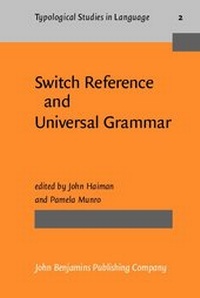
Switch Reference and Universal Grammar
Proceedings of a symposium on switch reference and universal grammar, Winnipeg, May 1981
1st Edition
Published on 1. January 1983
XV, 337 pages
978-90-272-8026-8 (ISBN)
Description

Canonical switch-reference is an inflectional category of the verb, which indicates whether or not its subject is identical with the subject of some other verb. Switch-reference may be analyzed from a structural or a functional point of view. Functionally, switch-reference is a device for referential tracking. Formally, switch-reference is almost always a verbal category, similar to the familiar category of verbal concord. In most languages switch-reference marking is indicated by a verbal affix, however in some languages it may be marked by an independent morpheme. The contributions to this volume are concerned with questions of form, function, and genesis of canonical switch-reference systems.
More details
Other editions
Additional editions
John Haiman | Pamela Munro
Switch Reference and Universal Grammar
Proceedings of a symposium on switch reference and universal grammar, Winnipeg, May 1981
Book
01/1983
John Benjamins Publishing Co
€137.80
Shipment within 10-15 days
Content
- SWITCH-REFERENCE AND UNIVERSAL GRAMMAR
- Editorial page
- Title page
- Copyright page
- Table of contents
- Acknowledgements
- INTRODUCTION
- NOTES
- SWITCH REFERENCE IN TWO QUECHUA LANGUAGES
- I. Introduction
- II. Switch Reference in Ancash Quechua
- III. Adverbial Clauses in Imbabura Quechua
- IV. Subjunctive Clauses in Imbabura Quechua
- V. The Person Hierarchy
- VI. Toward a Unification of Switch Reference and the Person Hierarchy
- VII. Conclusions
- NOTES
- SWITCH-REFERENCE IN HUICHOL A TYPOLOGICAL STUDY
- Abbreviations
- 1. Aims and data-base
- 2. The nature of switch-reference
- 3. Same-subject and different-subject
- 4. Switch-reference marking
- 5. Controlling clause and marked clause
- 6. Person and number
- 7. Coreference, disjoint reference, and overlapping reference
- 8. Grammatical relations
- 9. Residual switch-reference in Huichol
- 10. Conclusions
- NOTES
- SOME FEATURES OF INTERCLAUSAL REFERENCE IN KEWA
- Abbreviations
- 2. Temporal and Sequential Dependence of Medial Verbs
- 3. Switch-Reference Features.
- 4. Embedding and Switch-Reference.
- 5. Person Identity and Switch-Reference.
- 6. Implied Switch-Reference.
- 7. Temporal Modifications.
- 8. Interrupting Reference Chains.
- NOTES
- TOPIC CONTINUITY IN DISCOURSE: THE FUNCTIONAL DOMAIN OF SWITCH REFERENCE
- 1. Introduction
- 2. Subject and topic
- 3. Continuity in discourse
- 4. The grammar of topic/participant continuity
- 4.1. Preliminaries
- 4.2 Zero anaphora and unstressed/bound/agreement pronouns
- 4.3. Unstressed (or agreement) pronouns vs. stressed/independent pronouns
- 4.4. Pronouns vs. DEF-NP's
- 4.5 The use of R-dislocated DEF-NP's
- 4.6. The use of L-dislocated DEF-NP's
- 4.7.Y-movement Icontrastivetopicalization
- 4.8. Cleft/focus constructions
- 5. Other constructions that code points on the continuity scale
- 5.1. Restrictively-modified DEF-NP's
- 5.2. Word-order devices to code continuity/ discontinuity
- 5.3. Passivization
- 5.4. Main vs. subordinate clauses
- 5.5. Finite vs. non-finite/participial / nominalized clauses
- 5.6. Indefinite NP's and existential-presentative constructions
- 6. Topic continuity and switch-reference: A Diachronic perspective
- 6.1. The pronominal origin of switch-reference
- 6.2. The participial/non-finite origin of switch-reference
- 6.3. The use of word-order in coding the SS/DS contrast
- 6.4. The use of deictic-related morphemes in switch reference
- 6.5. The use of first-person vs. non-first-person agreement for switch reference
- 7. Closure: Reflexions on "canonical" switch-reference
- NOTES
- SWITCHREFERENCE, CLAUSE ORDER, AND INTERCLAUSAL RELATIONSHIPS IN MARICOPA1
- 1. -k and -m in Maricopa.
- NOTES
- ON SOME ORIGINS OF SWITCH REFERENCE MARKING
- Introduction
- NOTES
- REFERENTIAL TRACKING IN NUNGGUBUYU (AUSTRALIA)
- 0. General.
- 1. Bases for comparison.
- 2. Basic grammatical features of Nunggubuyu.
- 3. Functional integration.
- 4. Text.
- 5. Conclusion.
- NOTES
- TYPOLOGICAL AND GENETIC NOTES ON SWITCH-REFERENCE SYSTEMS IN NORTH AMERICAN INDIAN LANGUAGES*
- 1. Occurrence.
- 2. Purpose.
- 3. Terminology.
- 4. The Data.
- 5. Number of systems.
- 6. Analyzability.
- 7. Number of markers.
- 8. Symmetrical pairing.
- 9. Number of associated categories.
- 10. Anaphoric particles.
- 11. Clause types.
- 12. Language types.
- 13. Diffusion.
- 14. Origins
- NOTES
- SWITCHREFERENCESYSTEMSFROM TWO DISTINCT LINGUISTIC AREAS: WOJOKESO (PAPUA NEW GUINEA) AND GUANANO (NORTHERN SOUTH AMERICA)
- 1. Typological similarities.
- 2. Switch reference in Wojokeso
- 3. Switch reference in Guanano.
- NOTES
- SWITCH-REFERENCE IN LENAKEL
- 1. INTRODUCTION
- 2. LENAKEL
- 2.1. Coreferential Subjects
- 2.2. Inclusive Subjects
- 2.3. Non-coreferential Subjects
- 3. THER SOUTHERN VANUATU LANGUAGES
- 3.1. Southwest Tanna
- 3.2. Sie
- 3.3. Anejom
- 4. DISCUSSION
- 5. CONCLUSION
- NOTES
- WHEN "SAME" IS NOT "NOT DIFFERENT
- NOTES
- SWITCH REFERENCE IN THE NORTHEAST CAUCASUS
- NOTES
- INTERCLAUSAL REFERENCE IN KASHAYA1
- 1. INTRODUCTION
- 2. THE KASHAYA AGENTIAL SYSTEM
- 2:1 Pairl. Simultaneous, alternating.
- 2:2 Pair 2. Anterior
- past, present.
- 2:3 Pair3. Anterior
- future, conditional.
- 2:4 Pair 4. Counter-expectation.
- 2:5 Pair 5. Inferential.
- 2:6 Pair 6 . Inferential, counter-expectation.
- 2:7 Combinations.
- 2:8Aberrations.
- 2:9 Inclusion.
- 3. Reference Types
- 4. Sentence Connectives
- 5. Focal Nesting
- 6. Other Inter clausal Referential Devices
- 6:1 The Causative.
- 6:2 The cross-referencing pronouns.
- 7. Personality of the Verb
- NOTE
- SWITCH REFERENCE, SYNTACTIC ORGANIZATION, AND RHETORICAL STRUCTURE IN CENTRAL YUP'IK ESKIMO*
- 0. Introduction.
- 1. Switch reference in the system of inflection.
- 1.1. The system of inflection.
- 1.2. Switch reference devices: the "ideal" version.
- 2. Switch reference and rhetorical structure.
- 2.1. The system of rhetorical structure.
- 2.2. Bounding of switch reference devices by units of rhetorical structure.
- 3. Conclusions.
- NOTES
- APPENDIX
- REFERENCES
- INDEX OF LANGUAGES, LANGUAGE FAMILIES, AND LANGUAGE AREAS
