

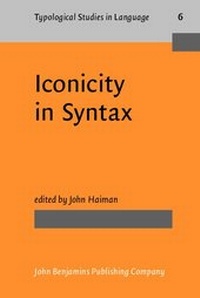
Iconicity in Syntax
Proceedings of a symposium on iconicity in syntax, Stanford, June 24-26, 1983
1st Edition
Published on 1. January 1985
VI, 402 pages
978-90-272-8639-0 (ISBN)
Description

The papers in this volume all explore one kind of functional explanation for various aspects of linguistic form - iconicity: linguistic forms are frequently the way they are because they resemble the conceptual structures they are used to convey, or, linguistic structures resemble each other because the different conceptual domains they represent are thought of in the same way. The papers in Part I of this volume deal with aspects of motivation, the ways in which the linguistic form is a diagram of conceptual structure, and homologous with it in interesting ways. Most of the papers in Part II focus on isomorphism, the tendency to associate a single invariant meaning with each single invariant form. The papers in Part III deal with the apparent arbitrariness that arises from competing motivations.
More details
Other editions
Additional editions
John Haiman
Iconicity in Syntax
Proceedings of a symposium on iconicity in syntax, Stanford, June 24-26, 1983
Book
01/1985
John Benjamins Publishing Co
€143.10
Shipment within 10-15 days
Content
- ICONICITY IN SYNTAX
- Editorial page
- Title page
- Copyright page
- Table of contents
- INTRODUCTION
- REFERENCES
- PART I: MOTIVATION
- DIAGRAMMATIC ICONICITY IN STEM-INFLECTION RELATIONS
- 1. The relevance of morphological categories
- 2. Cross-linguistic data
- 3. The order of morphemes
- 4. Degree of fusion with the stem
- 5. Explaining the correlations
- 6. Apparent problems - number, negation and object agreement
- 7. Conclusions
- NOTES
- REFERENCES
- LANGUAGE REFERENCES
- TEMPORAL SEQUENCE AND CHINESE WORD ORDER
- 1. Introduction
- 2. The Principle of Temporal Sequence as Independently Motivated
- 3. PTS and Adverbial Placement
- 4. The Principle of Temporal Scope
- 5. PTS and Noun Phrases
- 6. Conclusion
- NOTES
- REFERENCES
- Appendix: Glosses of Chinese sentences.
- SYMMETRY
- 1. Overcoming temporal asymmetry
- 1.1. Reciprocity in Kate
- 1.2. Simultaneity in Kewa
- 1.3. Simultaneity, balance, and alternation Tauya
- 1.4. Symmetrical relationships in Hua
- 1.5. Phrasal coordination
- 1.6. Independent and conjunct modes in an Algonquian language
- 2. Coordination is itself the expression of a symmetrical relationship
- 2.1. AxBx differs from (A B) x and from (A)(Bx)
- 2.2. The case of gapping
- 3. Two kinds of symmetry
- NOTES
- REFERENCES
- THE INHERENT ICONISM OF INTONATION
- NOTES
- REFERENCES
- OBSERVATIONS AND SPECULATIONS ON SUBJECTIVITY
- O. Introduction
- 1. The Framework
- 2. Deixis and Epistemic Predications
- 3. Subjectivity
- 4. The Subjectivity Scale
- 5. Implications
- NOTES
- REFERENCES
- THE ICONICITY OF THE UNIVERSAL CATEGORIES 'NOUN' AND 'VERBS'
- 1. Introduction
- 2. Prototypicality in Grammatical Categories
- 2.1.
- 2.2. Prototypicality & Function
- 2.3. Prototypicality and Contrast
- 3. Nouns
- 3.1. Nouns which do not refer to entities
- 3.1.1 Incorporation of semantic patient into verb
- 3.1.2 Incorporation of obliques which refer to no entity
- 3.1.3 Noun-into-noun Compounding
- 3.1.4 Predicate nominals
- 3.2. Nouns which refer but are not discourse-manipulable
- 3.2.1 Anaphora
- 3.2.2 Body Parts
- 4. Verbs
- 4.1. Stativity
- 4.1.1 Predicate adjectives and stative verbs
- 4.1.2 Attribution
- 4.1.3 Existential and copula constructions
- 4.1.3.1 Existential clauses
- 4.1.3.2 Copula clauses
- 4.2.Irrealis
- 4.3. Serial verbs
- 4.3.1 Verbs functioning as nouns
- 4.4. Purpose clauses
- 4.5. Bound clauses ("complements")
- 4.6. Summary
- 5. Category shifts
- 6. Conclusion
- NOTES
- REFERENCES
- PART II: ISOMORPHISM AND AUTOMORPHISM
- ICONICITY, ISOMORPHISM AND NON-ARBITRARY CODING IN SYNTAX
- 1. Introduction
- 1.1. Philosophical preliminaries
- 1.2. The nature of the designatum
- 1.3. Isomorphism, abstraction and prototypicaiity
- 2. Iconicity in grammar: Case studies
- 2.1. Quantitative gradients in topic assignment
- 2.2. Word-order and topic assignment
- 2.3. The binding hierarchy and the structure of complements
- 2.4. The coding of passivization
- 2.5. Syntactic coding of transitivity
- 2.6. Non-referentiality, stereotypicality and incorporation
- 2.7.Ordering and scope
- 2.8. More meta-iconirity
- 2.8.1 Pragmatic need, generality and code-coherence
- 2.8.2 Prototypicality, functional coherence and code coherence
- 3. Conflicts between iconicity principles
- 4. Discussion
- 4.1. Levels of iconicity
- 4.2. Levels of language
- 4.3. The continuum from icon to symbol
- 4.4. Developmental aspects of the icon-to-symbol continuum
- NOTES
- REFERENCES
- THE CHILD AS LINGUISTIC ICON-MAKER
- 1. Negation
- 1.1. Negative placement
- 1.2. Effects of negation on other elements
- 2. Interrogation
- 3. Conditionality
- 4. A Theoretical Reprise
- 5. Operators on Verbs
- 6. Operators on Nouns
- 6.1. Casemarking
- 7. Deconflations
- 8. Clear Marking of Grammatical Relations
- 8.1. Pragmatic Variability, Casemarking, and Pronouns
- 8.2. Embedded Clauses
- ACKNOWLEDGMENTS
- NOTES
- REFERENCES
- APPENDIX
- ICONICITY AND GRAMMATICAL MEANING
- 1. Introduction
- 2. The heuristic value of iconicity hypotheses
- 2.1. Isomorphism
- 2.2. Motivation
- 2.2.1 The nascent 'bezig te' progressive in Modern Dutch
- 2.2.2 Co-occurrence, fusion, and semantic congruity
- 2.3. Isomorphism, motivation, and negative data
- 3. Grammatical analyses and the motivation hypothesis
- 3.1. 'Presentative' sentences vs. 'existential' paraphrases
- 3.2. Active intransitives vs. pseudopassives
- 4. Conclusion
- REFERENCES
- DATA SOURCES
- NOTES
- SOME ICONIC RELATIONSHIPS AMONG PLACE, TIME, AND DISCOURSE DEIXIS
- NOTES
- BIBLIOGRAPHY
- CONDITIONAL MARKERS
- Introduction
- Lexical sources for markers of the conditional protasis
- Motivation for the semantic changes
- A "cognitive map" for conditionals
- The relationof IF to THEN
- Postscript
- NOTES
- REFERENCES
- PART III: COMPETING MOTIVATIONS
- OATS AND WHEAT: THE FALLACY OF ARBITRARINESS
- 1. Introduction
- 2. Preliminary discussion
- 3. Water (names of homogeneous substances)
- 4. Chocolate and chocolates (solids with a double status).
- 5. Crockery (names of heterogeneous classes of objects)
- 6. Scissors (names of 'dual objects')
- 7. A grain of rice (substances with a minimal unit)
- 8. Oats (names of substances composed of particles and limited in quantity)
- 9. Guts and woods (names of body parts and places)
- 10. Conclusion
- FOOTNOTES
- APPENDIX
- REFERENCES
- COMPETING MOTIVATIONS
- NOTES
- REFERENCES
- THE ANALYIS-SYNTHESIS-LEXIS CYCLE IN TIBETO-BURMAN: A CASE STUDY IN MOTIVATED CHANGE
- 1.0. Mechanisms for deictic specification
- 1.1. Lexicalized deixis in Newari
- 1.2. Syntacticized deixis in Lahu
- 1.3. Morphologized deixis in Lahu and Jinghpaw
- 2.0. The cycle in Kuki-Naga
- 2.1. Directive marking in Naga
- 2.2. Directive marking in Kuki
- 2.3. Directive marking in Proto-Kuki-Naga
- 3.0. The cycle in Lolo-Burmese and its cousins
- 3.1. The cycle in Loloish
- 3.2. Tangut and Loloish
- 3.3. Tangut-Lolo-Burmese and Rawang
- 3.4. The diachronic implications of the Rawang-Tangut-Lolo-Burmese data
- 4.0. The cycle
- 4.1. The analysis-synthesis and analysis-synthesis-lexis cycles
- 4.2. The grammaticalization process
- 4.3. Relexicalization
- 5.0. Iconic and iconic motivation
- NOTES
- REFERENCES
- INDEX OF LANGUAGES
- INDEX OF NAMES (excluding self-citation)
- INDEX OF TOPICS
