

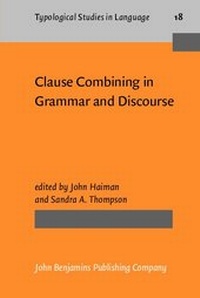
Clause Combining in Grammar and Discourse
1st Edition
Published on 1. January 1988
XIII, 428 pages
978-90-272-7859-3 (ISBN)
Description

Traditionally the study of syntax is restricted to the study of what goes on within the boundaries of the prosodic sentence. Although the nature of clause combining within a prosodic sentence has always been a central concern of traditional syntax (in GG, e.g. it underlies important research on deletion and anaphora), work within a discourse analysis framework has hardly been done. Analyses like this are given in the present volume.
More details
Other editions
Additional editions
John Haiman | Sandra A. Thompson
Clause Combining in Grammar and Discourse
Book
01/1988
John Benjamins Publishing Co
€143.10
Shipment within 10-15 days
Persons
Content
- CLAUSE COMBINING IN GRAMMAR AND DISCOURSE
- Editorial page
- Title page
- Copyright page
- Table of contents
- LIST OF ABBREVIATIONS
- Introduction
- Linkingintonation units in spoken English
- Intonation units and clauses
- Linking with intonation alone
- Linking with 'coordinating' connectives
- Linking with 'subordinating' connectives
- Focusing on a connective
- A comparison with written English
- Conclusion
- NOTES
- REFERENCES
- A syntactic correlate of topicality in Newari narrative
- The problem
- Methodology
- Results and analysis
- Conclusions
- Notes
- References
- Inconsequential clauses in Hua and the typology of clauses
- Morphology
- The functions of the inconsequential
- A. Actions taken in vain
- B. Actions not as yet completed
- C. Signalling a change of speaker
- D. Marking verbs of perception
- Conclusions
- REFERENCES
- Concessive clauses in English and Romance
- ACKNOWLEDGEMENT
- NOTES
- REFERENCES
- Clause integration in German and Dutchconditionals, concessive conditionals,and concessives
- INTRODUCTION
- 1. V-2 AS A SIGNAL OF INCORPORATION IN GERMANIC
- 2. CONDITIONALS, CONCESSIVES, AND CONCESSIVE CONDITIONALS
- 3. HISTORICAL DEVELOPMENT
- 4. CONDITIONS FOR WORD ORDER CHOICE - GENERALCONSIDERATIONS
- 5. CONDITIONALS
- 5.1. Canonical conditionals
- 5.1.1. Conditions allowing non-integration
- 5.1.2. Conditions favoring resumption
- 5.2. Non-canonical conditionals
- 6. CONCESSIVE CONDITIONALS
- 6.1. Canonical concessive conditionals
- 6.1.1. Conditions forcing, favoring, and allowing non- integration
- 6.1.2. Conditions allowing resumption
- 6.2. Non-canonical concessive conditionals
- 7. CONCESSIVES
- 7.1. Canonical concessives
- 7.2. Non-canonical concessives
- 8. CONCLUSIONS
- NOTES
- REFERENCES
- Presentational cleft constructions in spoken French
- 1. Introduction
- 2. Typological considerations
- 3. Pragmatic properties of the avoir-cleft
- 3.1. Concepts and definitions
- 3.2. The presentational construction: a cognitive hypothesis.
- 3.3. The presentational function of the avoir-cleft.
- 3.4. Semantic observations
- 3.5. From presentation to event-reporting
- 3.6. A further extension
- 3.7. Crosslinguistic observations
- NOTES
- REFERENCES
- Towards a typology of clause linkage
- 1. BASIC CONCEPTS
- 2. AUTONOMY VS. INTEGRATION
- 2.1. Hierarchical downgrading
- 2.2. Syntactic level
- 3. EXPANSION VS. REDUCTION
- 3.1. Desententialization of subordinate clause
- 3.2 Grammaticalization of main verb
- 4. ISOLATION VS. LINKAGE
- 4.1. Interlacing
- 4.2 Explicitness of linking
- 5. TOWARDS A TYPOLOGY OF CLAUSE LINKAGE
- 5.1. Correlations among the parameters
- 5.2. A functional account of clause linkage
- 5.3. Types of clause linkage
- NOTES
- REFERENCES
- Subordination in Tauya
- 1. Introduction
- 2. Subordination
- 2.1. Subordinate clauses
- 2.2. Complement clauses
- 2.3. Inconsequential clauses
- 2.4. Complement clauses vs. inconsequential clauses
- 3. Left-dislocated complement clauses
- 4. Inconsequential clauses as independent clauses
- 5. Interpretation
- 6. Summary
- NOTES
- REFERENCES
- Sequential chaining and discourse structure in Godie
- 1. Introduction
- 2. The data base
- 3. Grammatical facts about clauses containing yi
- 4. Function of yi clauses in discourse
- 5. Frequence and distribution of yi sequentials
- 6. Conclusions
- NOTES
- REFERENCES
- The structure of discourse and 'subordination'
- 1. INTRODUCTION
- 2. INTERPRETING THE CLAUSE COMBINATIONS TO BE STUDIED
- 2.1. Characterization by exemplification
- 2.2. General characterization of clause combining
- 2.3. Type of function: embedding vs. clause combining
- 2.3.1. Embedding
- 2.3.2. Combining by coordination
- 2.4. Two degrees of clause combining: hypotaxis and coordination
- 2.5. Type of interdependence in clause combining
- 2.6. The function of clauses in combination vs. the class of a clause
- 2.7. Why not 'subordinate' or 'adverbial' clause?
- 2.8. Towards a discourse characterization
- 3. RELATIONS IN DISCOURSE STRUCTURE
- 3.1. Text relations: an overview
- 3.2. Individual relations
- 3.2.1. Enablement
- 3.2.2. Motivation
- 3.2.3. Background
- 3.2.4. Concession
- 3.2.5. Circumstance, Elaboratio
- 3.2.6. Solutionhood, antithesis, purpose, condition
- 3.2.7. Typology of rhetorical relations
- 3.3. Summary
- 4. TEXT RELATIONS AND ENHANCING HYPOTAXIS
- 4.1. Analogy between clause combining and text relations
- 4.2. Hypothesis
- 4.3. Predictions about the grammar of clause combining based on rhetorical relations
- 4.3.1. Use of a hypotactically enhancing clause
- 4.3.2. Scoping and number of clauses
- 4.3.3. Grammatical marking
- 4.3.4. Sequence of clauses
- 4.3.5. Predominant coding type in text
- 4.3.6. Summary
- 4.4. The grammarian's intuition about hypotaxis
- 4.5. Embedding
- 4.6. Examples of non-necessary alleged properties of hypotaxis
- 4.6.1. Information status: Are hypotactic clauses 'known'?
- 4.6.2. Elocutionary force: Are hypotactic clauses 'unchallengeable'?
- 4.6.3. Another alleged grammatical property: pronominalization
- 5. CONCLUSIO
- NOTES
- REFERENCES
- SOURCES OF DATA
- The grammaticization of coordination
- 1. COORDINATION BY INTONATION
- 1.1. Coordinate noun phrases
- 1.2. Coordinate predicates
- 1.3. Coordinate clauses
- 2. FORMAL MARKERS OF COORDINATION
- 2.1. Sources of noun phrase coordination
- 2.2. Sources of predicate coordination
- 2.3. Sources of clause coordination
- 3. THE GENERALIZATION OF COORDINATION
- 4. THE SUDDEN EMERGENCE OF GRAMMATICIZED CONJUNCTIONS
- 5. CONCLUSION
- ABBREVIATIONS
- REFERENCES
- The discourse function of clause-chaining
- INTRODUCTION
- 1. METHODOLOGY
- 1.1. Definition of clause-chaining
- 1.2. Coding
- 2. SODDO
- 2.1. Factors affecting the use of the m-form
- 2.1.1. The m-form and following foregrounded clauses
- 2.7.2. The m-form and discontinuity with the preceding clause
- 2.1.3. The m-form and position in sentence
- 2.2. The effect of combining factor
- 2.3. The apparent correlation between the m-form and foregrounding
- 3. JAPANESE
- 3.1. The stem and the gerund
- 3.1.1. Marking grounding
- 3.1.2. Positional characteristics
- 3.2. The -to form
- 3.3. Comparison of the -to form and other non-finite forms
- 4. CONCLUSION
- ACKNOWLEDGEMENT
- NOTES
- REFERENCES
- Nominalization and assertion in scientific Russian prose
- 1. INTRODUCTION
- 2. ANALYSIS
- 2.1. English
- 2.2. Russian
- 2.3. Methodological observations
- 3. EXAMPLES
- 3.1. Verbal nouns which presuppose and are definite
- 3.2. Verbal nouns used for first mention in the text
- 3.3. The truth of the presupposition made by the verbal noun is either being established or being questioned
- 3.4. Examples with sr. 'cf.'
- 3.5. Other explicit devices for presupposing.
- 3.6. Similar behavior of nouns which are not deverbal
- 3.7. A formulaic example
- 3.8. Further evidence
- 4. CONCLUSION
- ACKNOWLEDGMENT
- NOTES
- REFERENCES
- INDEX OF LANGUAGES
- INDEX OF NAMES
