
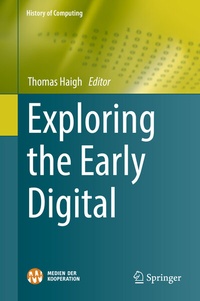
Exploring the Early Digital
Description
Alles über E-Books | Antworten auf Fragen rund um E-Books, Kopierschutz und Dateiformate finden Sie in unserem Info- & Hilfebereich.
More details
Other editions
Additional editions
Person
Thomas Haigh is an Associate Professor of History at the University of Wisconsin-Milwaukee and a visiting Comenius Professor for the History of Computing at Siegen University. He writes the historical reflections column for Communications of the ACM, and from 2005 to 2014 was chair of SIGCIS, the group for historians of information technology.
His publications cover a broad range of topics, from the business history of the World Wide Web, to the gendered labor history of data processing and the intellectual history of computer science. He is the primary author of ENIAC in Action (MIT, 2016), editor of Histories of Computing (Harvard, 2011) and the lead editor of the "Histories of the Internet" special edition of Information & Culture (2015).
Haigh is a Fulbright Award winner and in 2017 received the Wilkins and Scranton prizes from the Business History Conference.Content

System requirements
File format: PDF
Copy protection: Watermark-DRM (Digital Rights Management)
System requirements:
- Computer (Windows; MacOS X; Linux): Use the free software Adobe Reader, Adobe Digital Editions, or any other PDF viewer of your choice (see eBook Help).
- Tablet/Smartphone (Android; iOS): Install the free app Adobe Digital Editions or another reading app for eBooks, e.g., PocketBook (see eBook Help).
- E-reader: Bookeen, Kobo, Pocketbook, Sony, Tolino and many more (only limited: Kindle).
The file format PDF always displays a book page identically on any hardware. This makes PDF suitable for complex layouts such as those used in textbooks and reference books (images, tables, columns, footnotes). Unfortunately, on the small screens of e-readers or smartphones, PDFs are rather annoying, requiring too much scrolling.
This eBook uses Watermark-DRM, a „soft” copy protection. This means that there are no technical restrictions to prevent illegal distribution. However, there is a personalised watermark embedded in the eBook that can be used to identify the purchaser of the eBook in the event of misuse and to provide evidence for legal purposes.
For more information, see our eBook Help page.