

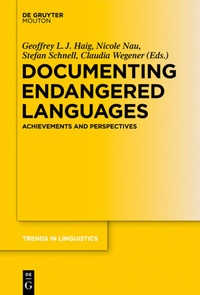
Documenting Endangered Languages
Description

The rapid decline in the world's linguistic diversity has prompted the emergence of documentary linguistics. While documentary linguistics aims primarily at creating a durable, accessible and comprehensive record of languages, it has also been a driving force in developing language annotation and analysis software, archiving architecture, improved fieldwork methodologies, and new standards in data accountability and accessibility.
More recently, researchers have begun to recognize the immense potential available in the archived data as a source for linguistic analysis, so that the field has become of increasing importance for typologists, but also for neighbouring disciplines. The present volume contains contributions by practitioners of language documentation, most of whom have been involved in the Volkswagen Foundation's DoBeS programme ( Dokumentation Bedrohter Sprachen ).
The topics covered in the volume reflect a field that has matured over the last decade and includes both retrospective accounts as well as those that address new challenges: linguistic annotation practice, fieldwork and interaction with speech communities, developments and challenges in archiving digital data, multimedia lexicon applications, corpora from endangered languages as a source for primary-data typology, as well as specific areas of linguistic analysis that are raised in documentary linguistics.
Reviews / Votes
"The lessons in this volume are indispensable contributions to the field that make significant advances in the practice of documentary linguistics as a whole. Any documentary linguist, whether weathered veterans or just entering the field, would be remiss to neglect the lessons from it."Daniel W. Hieber in Linguist List 23.2390More details
Other editions
Additional editions
Persons
Content
- Intro
- Preface. Ulrike Mosel's contribution to documentary linguistics
- Chapter 1. Introduction
- Part I. Theoretical issues in language documentation
- Chapter 2. Competing motivations for documenting endangered languages
- Chapter 3. Evolving challenges in archiving and data infrastructures
- Chapter 4. Comparing corpora from endangered language projects: Explorations in language typology based on original texts
- Part II. Documenting language structure
- Chapter 5. "Words" in Kharia - Phonological, morpho-syntactic, and "orthographical" aspects
- Chapter 6. Aspect in Forest Enets and other Siberian indigenous languages - when grammaticography and lexicography meet different metalanguages
- Chapter 7. Documentary linguistics and prosodic evidence for the syntax of spoken language
- Chapter 8. Diphthongology meets language documentation: The Finnish experience
- Chapter 9. Retelling data: Working on transcription
- Part III. Documenting the lexicon
- Chapter 10. The making of a multimedia encyclopaedic lexicon for and in endangered speech communities
- Chapter 11. What does it take to make an ethnographic dictionary? On the treatment of fish and tree names in dictionaries of Oceanic languages
- Part IV. Interaction with speech communities
- Chapter 12. Language is power: The impact of fieldwork on community politics
- Chapter 13. Sustaining Vurës: Making products of language documentation accessible to multiple audiences
- Chapter 14. Filming with native speaker commentary
- Index
