

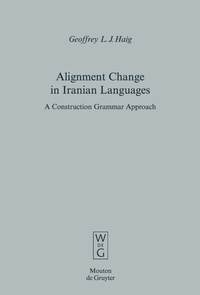
Alignment Change in Iranian Languages
Description

The Iranian languages, due to their exceptional time-depth of attestation, constitute one of the very few instances where a shift from accusative alignment to split-ergativity is actually documented. Yet remarkably, within historical syntax, the Iranian case has received only very superficial coverage. This book provides the first in-depth treatment of alignment change in Iranian, from Old Persian (5 C. BC) to the present. The first part of the book examines the claim that ergativity in Middle Iranian emerged from an Old Iranian agented passive construction. This view is rejected in favour of a theory which links the emergence of ergativity to External Possession. Thus the primary mechanisms involved is not reanalysis, but the extension of a pre-existing construction. The notion of Non-Canonical Subjecthood plays a pivotal role, which in the present account is linked to the semantics of what is termed Indirect Participation. In the second part of the book, a comparative look at contemporary West Iranian is undertaken. It can be shown that throughout the subsequent developments in the morphosyntax, distinct components such as agreement, nominal case marking, or the grammar of cliticisation, in fact developed remarkably independently of one another. It was this de-coupling of sub-systems of the morphosyntax that led to the notorious multiplicity of alignment types in Iranian, a fact that also characterises past-tense alignments in the sister branch of Indo-European, Indo-Aryan. Along with data from more than 20 Iranian languages, presented in a manner that renders them accessible to the non-specialist, there is extensive discussion of more general topics such as the adequacy of functional accounts of changes in case systems, discourse pressure and the role of animacy, the notion of drift, and the question of alignment in early Indo-European.
More details
Other editions
Additional editions
Person
Content
- Frontmatter
- Contents
- Abbreviations
- Chapter 1. Introduction
- Chapter 2. Alignment in Old Iranian
- Chapter 3. Western Middle Iranian
- Chapter 4. Case systems in West Iranian
- Chapter 5. Kurdish (Northern Group)
- Chapter 6. The Central group
- Chapter 7. Conclusions
- Backmatter
