

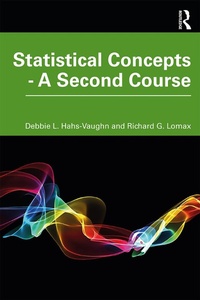
Statistical Concepts - A Second Course
5th Edition
Published on 17. January 2020
782 pages
978-1-000-12443-9 (ISBN)
Description

Statistical Concepts-A Second Course presents the last 10 chapters from An Introduction to Statistical Concepts, Fourth Edition. Designed for second and upper-level statistics courses, this book highlights how statistics work and how best to utilize them to aid students in the analysis of their own data and the interpretation of research results.
In this new edition, Hahs-Vaughn and Lomax discuss sensitivity, specificity, false positive and false negative errors. Coverage of effect sizes has been expanded upon and more organizational features (to summarize key concepts) have been included. A final chapter on mediation and moderation has been added for a more complete presentation of regression models. In addition to instructions and screen shots for using SPSS, new to this edition is annotated script for using R.
This book acts as a clear and accessible instructional tool to help readers fully understand statistical concepts and how to apply them to data. It is an invaluable resource for students undertaking a course in statistics in any number of social science and behavioral science disciplines.
In this new edition, Hahs-Vaughn and Lomax discuss sensitivity, specificity, false positive and false negative errors. Coverage of effect sizes has been expanded upon and more organizational features (to summarize key concepts) have been included. A final chapter on mediation and moderation has been added for a more complete presentation of regression models. In addition to instructions and screen shots for using SPSS, new to this edition is annotated script for using R.
This book acts as a clear and accessible instructional tool to help readers fully understand statistical concepts and how to apply them to data. It is an invaluable resource for students undertaking a course in statistics in any number of social science and behavioral science disciplines.
Reviews / Votes
"This edition delivers on many fronts and sets this book apart from the rest. The clear and conversational style emphasizes the applied and practical without compromising the theoretical and conceptual underpinnings. The parallel use of SPSS and R that walks the reader step-by-step through the procedures coupled with fully annotated interpretation of printouts are very appealing to both novice and more seasoned applied researchers. Rather than treating subjects like power and effect size or verification of assumptions in isolation, the authors do a fantastic job of blending them with the analyses to make the story behind the numbers more compelling and complete. The abundance of visuals and APA style write-ups all contribute to simplify and enhance the learning experience." - Devdass Sunnassee, Assistant Clinical Professor, University of North Carolina, USA."I have relied on previous versions of this textbook to bring to life statistical concepts in my beginning and intermediate level graduate classes. I also share this valuable resource with students who ask questions when working on quantitative projects. This fourth edition brings enhanced materials, explanations, and examples to aid students in gaining basic proficiency in foundational statistical concepts. The detailed and numerous practical examples demonstrate the inner workings of basic statistical methods in the social and behavioural sciences. I look forward to sharing this enhanced edition with our graduate program" -Brian F. French, Washington State University, USA.
"Combining theory and mathematical accessibility with examples in various fields of behavioral sciences, SPSS and R applications, APA style write-ups, after-chapter conceptual and practice problems for students, online pedagogical aids, this is a valuable book for introductory statistical courses in behavioral sciences. It has a broad coverage of topics, and the addition of the new chapter on mediation and moderation adds to its value as a classroom text or as a reference for applied researchers." -Feifei Ye, RAND Corporation, USA.
"Anyone familiar with previous editions of Statistical Concepts from Lomax and Hahs-Vaughn recognize and appreciate the pedigagogically sound treatment of statistical methods comprising introductory and intermediate topics found in many quantitative methods graduate programs. In addition to enhancements found in the past versions such as APA-style write-ups of statistical results and the numerous screen shots depicting both annotated SPSS input commands and output; the fourth edition begins each chapter with a concrete research scenario to motivate the particular statistical method. Another new feature that will resonate with instructors and graduate students are the insightful Stop and Think boxes that offer moments to reflect and to make connections between statistical ideas, data, and the software. Clearly, Lomax and Hahs-Vaughn are committed to preparing the next generation of researchers and practitioners, and the latest edition of Statistical Concepts is a must-have reference for those seeking this type of comprehensive quantitative methods training." - Jeffrey R. Harring, University of Maryland, College Park, USA.
"I have required this textbook for my introductory and intermediate-level students throughout multiple editions, and it has continued to get better and better. This new edition continues to emphasize the development of statistical understanding while also providing readers with valuable information on how to perform a variety of procedures using SPSS and R. The authors have added a terrific new chapter on mediation and moderation that reviews concepts and procedures that are often not a point of emphasis in traditional (textbook) coverage of multiple regression (but that are crucial for more modern data analysis). This is a book that not only is a wonderful learning resource for students, but also one they will want to keep in their personal libraries to reference when carrying out their own future research." - H. Michael Crowson, The University of Oklahoma, USA.
More details
Edition
5th edition
Language
English
Place of publication
London
United Kingdom
Publishing group
Taylor & Francis Ltd
Target group
Professional and scholarly
Illustrations
171 Tables, black and white; 58 Line drawings, black and white; 184 Halftones, black and white
ISBN-13
978-1-000-12443-9 (9781000124439)
Copyright in bibliographic data and cover images is held by Nielsen Book Services Limited or by the publishers or by their respective licensors: all rights reserved.
Schweitzer Classification
Other editions
Additional editions
Book
01/2020
5th Edition
Routledge
€160.94
Shipment within 15-20 days
Book
01/2020
5th Edition
Routledge
€110.70
Shipment within 15-20 days
Persons
Debbie L. Hahs-Vaughn is Professor of Methodology, Measurement, and Analysis at the University of Central Florida, US. Her research primarily relates to methodological issues when analyzing, and applied research using, complex sample data.
Richard G. Lomax is Professor Emeritus of Educational and Human Ecology at The Ohio State University, US, and former Associate Dean for Research and Administration. His research primarily focuses on early literacy and statistics.
Richard G. Lomax is Professor Emeritus of Educational and Human Ecology at The Ohio State University, US, and former Associate Dean for Research and Administration. His research primarily focuses on early literacy and statistics.
Content
Preface
Acknowledgements
1. ONE-FACTOR ANALYSIS OF VARIANCE - FIXED-EFFECTS MODEL
2. MULTIPLE COMPARISON PROCEDURES
3. FACTORIAL ANALYSIS OF VARIANCE - FIXED-EFFECTS MODEL
4. INTRODUCTION TO ANALYSIS OF COVARIANCE: THE ONE-FACTOR FIXED-EFFECTS MODEL WITH A SINGLE COVARIATE
5. RANDOM- AND MIXED-EFFECTS ANALYSIS OF VARIANCE MODELS
6. HIERARCHICAL AND RANDOMIZED BLOCK ANALYSIS OF VARIANCE MODELS
7. SIMPLE LINEAR REGRESSION
8. MULTIPLE LINEAR REGRESSION
9. LOGISTIC REGRESSION
10. MEDIATION AND MODERATION
Appendix: Tables
Acknowledgements
1. ONE-FACTOR ANALYSIS OF VARIANCE - FIXED-EFFECTS MODEL
2. MULTIPLE COMPARISON PROCEDURES
3. FACTORIAL ANALYSIS OF VARIANCE - FIXED-EFFECTS MODEL
4. INTRODUCTION TO ANALYSIS OF COVARIANCE: THE ONE-FACTOR FIXED-EFFECTS MODEL WITH A SINGLE COVARIATE
5. RANDOM- AND MIXED-EFFECTS ANALYSIS OF VARIANCE MODELS
6. HIERARCHICAL AND RANDOMIZED BLOCK ANALYSIS OF VARIANCE MODELS
7. SIMPLE LINEAR REGRESSION
8. MULTIPLE LINEAR REGRESSION
9. LOGISTIC REGRESSION
10. MEDIATION AND MODERATION
Appendix: Tables
