

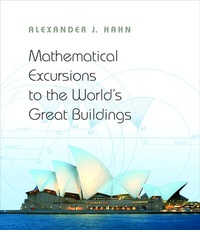
Mathematical Excursions to the World's Great Buildings
1st Edition
Published on 16. June 2015
336 pages
978-1-4008-4199-8 (ISBN)
Description

How mathematics helped build the world's most important buildings from early Egypt to the present
From the pyramids and the Parthenon to the Sydney Opera House and the Bilbao Guggenheim, this book takes readers on an eye-opening tour of the mathematics behind some of the world's most spectacular buildings. Beautifully illustrated, the book explores the milestones in elementary mathematics that enliven the understanding of these buildings and combines this with an in-depth look at their aesthetics, history, and structure. Whether using trigonometry and vectors to explain why Gothic arches are structurally superior to Roman arches, or showing how simple ruler and compass constructions can produce sophisticated architectural details, Alexander Hahn describes the points at which elementary mathematics and architecture intersect.
Beginning in prehistoric times, Hahn proceeds to guide readers through the Greek, Roman, Islamic, Romanesque, Gothic, Renaissance, and modern styles. He explores the unique features of the Pantheon, the Hagia Sophia, the Great Mosque of Cordoba, the Duomo in Florence, Palladio's villas, and Saint Peter's Basilica, as well as the U.S. Capitol Building. Hahn celebrates the forms and structures of architecture made possible by mathematical achievements from Greek geometry, the Hindu-Arabic number system, two- and three-dimensional coordinate geometry, and calculus. Along the way, Hahn introduces groundbreaking architects, including Brunelleschi, Alberti, da Vinci, Bramante, Michelangelo, della Porta, Wren, Gaudí, Saarinen, Utzon, and Gehry.
Rich in detail, this book takes readers on an expedition around the globe, providing a deeper understanding of the mathematical forces at play in the world's most elegant buildings.
From the pyramids and the Parthenon to the Sydney Opera House and the Bilbao Guggenheim, this book takes readers on an eye-opening tour of the mathematics behind some of the world's most spectacular buildings. Beautifully illustrated, the book explores the milestones in elementary mathematics that enliven the understanding of these buildings and combines this with an in-depth look at their aesthetics, history, and structure. Whether using trigonometry and vectors to explain why Gothic arches are structurally superior to Roman arches, or showing how simple ruler and compass constructions can produce sophisticated architectural details, Alexander Hahn describes the points at which elementary mathematics and architecture intersect.
Beginning in prehistoric times, Hahn proceeds to guide readers through the Greek, Roman, Islamic, Romanesque, Gothic, Renaissance, and modern styles. He explores the unique features of the Pantheon, the Hagia Sophia, the Great Mosque of Cordoba, the Duomo in Florence, Palladio's villas, and Saint Peter's Basilica, as well as the U.S. Capitol Building. Hahn celebrates the forms and structures of architecture made possible by mathematical achievements from Greek geometry, the Hindu-Arabic number system, two- and three-dimensional coordinate geometry, and calculus. Along the way, Hahn introduces groundbreaking architects, including Brunelleschi, Alberti, da Vinci, Bramante, Michelangelo, della Porta, Wren, Gaudí, Saarinen, Utzon, and Gehry.
Rich in detail, this book takes readers on an expedition around the globe, providing a deeper understanding of the mathematical forces at play in the world's most elegant buildings.
More details
Edition
Course Book
Language
English
Place of publication
Princeton, NJ
United States
Publishing group
De Gruyter
Target group
Professional and scholarly
Edition type
Digital original
Illustrations
16 color illus. 111 halftones. 233 line illus. 2 tables.
File size
19,46 MB
ISBN-13
978-1-4008-4199-8 (9781400841998)
Schweitzer Classification
Other editions
Additional editions
Alexander J. Hahn
Mathematical Excursions to the World's Great Buildings
Book
07/2012
Princeton University Press
€68.20
Article not available at the moment
Person
Alexander J. Hahn is professor of mathematics at the University of Notre Dame. His books include Basic Calculus: From Archimedes to Newton to Its Role in Science.
Content
Preface vii
Chapter 1 Humanity Awakening: Sensing Form
and Creating Structures 1
Chapter 2 Greek Geometry and Roman Engineering 12
Chapter 3 Architecture Inspired by Faith 53
Chapter 4 Transmission of Mathematics and Transition in Architecture 97
Chapter 5 The Renaissance: Architecture and the Human Spirit 138
Chapter 6 A New Architecture: Materials, Structural Analysis, Computers, and Design 205
Chapter 7 Basic Calculus and Its Application to the Analysis of Structures 265
Glossary of Architectural Terms 301
References 307
Index 311
Photo Sources 318
Chapter 1 Humanity Awakening: Sensing Form
and Creating Structures 1
Chapter 2 Greek Geometry and Roman Engineering 12
Chapter 3 Architecture Inspired by Faith 53
Chapter 4 Transmission of Mathematics and Transition in Architecture 97
Chapter 5 The Renaissance: Architecture and the Human Spirit 138
Chapter 6 A New Architecture: Materials, Structural Analysis, Computers, and Design 205
Chapter 7 Basic Calculus and Its Application to the Analysis of Structures 265
Glossary of Architectural Terms 301
References 307
Index 311
Photo Sources 318
