

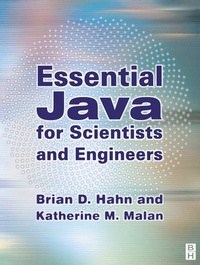
ESSENTIAL JAVA FOR SCIENTISTS AND ENGINEERS
Published on 30. May 2002
338 pages
978-0-08-054572-1 (ISBN)
Description

ESSENTIAL JAVA FOR SCIENTISTS AND ENGINEERS
More details
Other editions
Additional editions
Brian H. Hahn | Katherine M. Malan
ESSENTIAL JAVA FOR SCIENTISTS AND ENGINEERS
Book
05/2002
Butterworth-Heinemann
€29.70
Article exhausted; check different version
Persons
Brian Hahn was a professor in the Department of Mathematics and Applied Mathematics at the University of Cape Town. In his career, Brian wrote more than 10 books for teaching programming languages to beginners.Katherine Malan is a lecturer in Computing Education at CIMSTE (Centre for the Improvement of Mathematics, Science and Technology Education), University of South Africa. Since 1997, she has taught a range of Computer Science undergraduate courses from programming (in Java, C++, Delphi, Visual Basic, Prolog, Pascal) to databases and human computer interaction. She has also taught a number of courses to professionals in industry. From 1997-2002 she ran a Computer Science development programme for students from educationally disadvantaged backgrounds at the University of Cape Town. In 2002, Katherine joined CIMSTE where she is running courses aimed at the professional development of computer science school teachers. To balance her technical work, she is a volunteer Life Line crisis counsellor and loves to cycle and hike in the numerous mountain ranges of South Africa. She can be contacted at malankm@unisa.ac.za.
Content
- Front Cover
- Essential Java for Scientists and Engineers
- Copyright Page
- Contents
- Preface
- Acknowledgements
- Part l: Essentials
- Chapter 1. Getting going
- 1.1 Introduction to programming
- 1.2 Setting up your computer for programming in Java
- 1.3 Writing your first Java program
- 1.4 Input and output
- 1.5 Comments
- 1.6 Using objects
- 1.7 Java on the WWW (optional)
- Chapter 2. Java programming basics
- 2.1 Compound interest again
- 2.2 Primitive data types
- 2.3 Names
- 2.4 Vertical motion under gravity
- 2.5 Operators, expressions and assignments
- 2.6 Repeating with for
- 2.7 Deciding with if
- 2.8 Characters
- 2.9 Math methods
- 2.10 Programming style
- Chapter 3. Solving a problem in Java
- 3.1 Introduction
- 3.2 The class provider, class user and end user
- 3.3 What are objects and classes?
- 3.4 Writing and using a simple class
- 3.5 How memory works
- 3.6 The String class
- 3.7 Understanding methods
- 3.8 Example: simulating a rabbit colony
- 3.9 Access modifiers
- 3.10 Example: simulating the growth of trees
- 3.11 Scope
- 3.12 More on object handles
- 3.13 The static keyword
- 3.14 Naming conventions
- 3.15 Using the Java API
- 3.16 Making your own package (optional)
- Chapter 4. More on loops
- 4.1 Determinate repetition with for
- 4.2 Indeterminate repetition with while
- Chapter 5. Debugging
- 5.1 Compilation errors
- 5.2 Run-time errors
- 5.3 Errors in logic
- 5.4 Rounding errors
- Chapter 6. Arrays and matrices
- 6.1 Introduction
- 6.2 The basics of arrays
- 6.3 Passing arrays to methods
- 6.4 Frequency distributions: a simple bar chart
- 6.5 Multi-dimensional arrays
- 6.6 Arrays of objects
- 6.7 Sorting an array
- Part II: More advanced topics
- Chapter 7. Inheritance
- 7.1 Introduction
- 7.2 Inheritance in Java
- 7.3 Constructors and inheritance
- 7.4 The Object class
- 7.5 Abstract classes and interfaces
- Chapter 8. Graphical user interfaces (GUIs)
- 8.1 Introduction
- 8.2 Building a Swing application
- 8.3 Arranging components
- 8.4 A colour chooser application
- 8.5 Painting
- 8.6 Drawing mathematical graphs
- 8.7 Fractals
- Chapter 9. Input/output
- 9.1 Introduction
- 9.2 Input through command line parameters
- 9.3 Input from the keyboard without the essential package
- 9.4 Streams
- 9.5 File input/output
- 9.6 Manipulating data
- 9.7 Streams and the Internet
- Chapter 10. Exceptions
- 10.1 Introduction
- 10.2 Exceptions in Java
- 10.3 Throwing exceptions
- 10.4 Handling exceptions
- 10.5 Exceptions and file input
- Part III: Some applications
- Chapter 11. Simulation
- 11.1 Random number generation
- 11.2 Spinning coins
- 11.3 Rolling dice
- 11.4 Bacteria division
- 11.5 Radioactive decay
- 11.6 A random walk
- 11.7 Traffic flow
- Chapter 12. Modelling with matrices
- 12.1 Using the Matrix class
- 12.2 Networks
- 12.3 Leslie matrices: population growth
- 12.4 Markov processes
- 12.5 Linear equations
- Chapter 13. Introduction to numerical methods
- 13.1 Equations
- 13.2 Numerical differentiation
- 13.3 Integration
- 13.4 First-order differential equations
- 13.5 Runge-Kutta methods
- 13.6 Driver: a GUI to solve ODEs
- 13.7 A partial differential equation
- Appendix A: Keywords
- Appendix B: Operators
- Appendix C: Syntax quick reference
- C.1 Primitive type declarations
- C.2 Methods
- C.3 Classes
- C.4 Decisions
- C.5 Loops
- Appendix D: Solutions to selected exercises
- Index
