

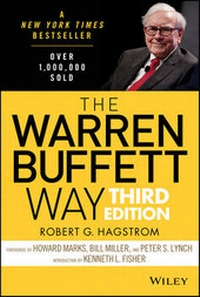
The Warren Buffett Way
Description

More details
Other editions
Additional editions

Person
Content
Foreword: The Exception
What accounts for Warren Buffett's exceptional investment success? That's one of the questions I'm asked most often. It's also the question I want to explore in this foreword.
When I studied for my MBA at the University of Chicago in the late 1960s, I was exposed to a new theory of finance that had been developed, largely there, in the preceding few years. One of the most important components of the "Chicago School" of thought was the Efficient Market Hypothesis. According to that hypothesis, the combined efforts of millions of intelligent, motivated, objective, and informed investors cause information to immediately be reflected in market prices such that assets will provide a fair risk-adjusted return, no more and no less. Prices are never so low or so high that they can be taken advantage of, and thus no investors can be capable of consistently identifying opportunities to benefit. It's this hypothesis that gives rise to the Chicago School's best-known dictum: You can't beat the market.
The Efficient Market Hypothesis supplies the intellectual basis for that conclusion, and there are lots of empirical data showing that, despite all their efforts, most investors don't beat the market. That's a pretty strong case for the inability to outperform.
It's not that no investors beat the market. Every once in a while some do, and just as many underperform; market efficiency isn't so strong a force that it's impossible for individual investors' returns to deviate from the market's return. It's merely asserted that no one can do it to a sufficient degree and consistently enough to disprove the Efficient Market Hypothesis. There are outliers, as in most processes, but their superior returns are described as being based on randomness and thus ephemeral. When I grew up, there was a saying that "If you put enough chimpanzees in a room with typewriters, eventually one of them will write the Bible." That is, when randomness is present, just about anything can happen once in a while. However, as my mother used to say, "It's the exception that proves the rule." A general rule may not hold 100 percent, but the fact that exceptions are so rare attests to its basic truth. Every day, millions of investors, amateur and professional alike, prove you can't beat the market.
And then there's Warren Buffett.
Warren and a few other legendary investors-including Ben Graham, Peter Lynch, Stan Druckenmiller, George Soros, and Julian Robertson-have performance records that fly in the face of the Chicago School. In short, they've outperformed by a big enough margin, for long enough periods of time, with large enough amounts of money, that the advocates of market efficiency are forced onto the defensive. Their records show that exceptional investors can beat the market through skill, not chance.
Especially in Warren's case, it's hard to argue with the evidence. On his office wall, he displays a statement, typed by him, showing that he started The Buffett Partnership in 1956 with $105,000. Since then, he has attracted additional capital and earned returns on it such that Berkshire Hathaway now has investments totaling $143 billion and a net worth of $202 billion. He's kicked the hell out of the indices for many years. And in the process, he's become the second wealthiest man in America. This last achievement wasn't based on dynastic real estate assets or a unique technological invention, as with so many on Forbes's lists, but on applying hard work and skill in investment markets that are open to everyone.
What's responsible for Warren Buffett's singular accomplishments? In my view these are the keys:
- He's super-smart. One of the many bon mots attributed to Warren is the following: "If you have an IQ of 160, sell 30 points. You don't need them." As Malcolm Gladwell pointed out in the book Outliers, you don't have to be a genius to achieve great success, just smart enough. Beyond that, incremental intelligence doesn't necessarily add to your chances. In fact, there are people so smart that they can't get out of their own way, or can't find the path to success (and happiness) in the real world. A high IQ isn't enough to make someone a great investor; if it were, college professors would probably be the richest people in America. It's important to also to be business-oriented and have "savvy" or "street smarts."
- He's guided by an overarching philosophy. Many investors think they're smart enough to master anything, or at least they act that way. Further, they believe the world is constantly changing, and you have to be eclectic and change your approach to adapt, racing to stay up with the latest wonder. The trouble with this is that no one really can know everything, it's hard to constantly retool and learn new tricks, and this mindset prevents the development of specialized expertise and helpful shortcuts.
- He's mentally flexible. The fact that it's important to have a guiding philosophy doesn't mean it's never good to change. It can be desirable to adapt to significantly changed circumstances. It's even possible to come across a better philosophy. The key lies in knowing when to change and when to hold fast.
- He's unemotional. Many of the obstacles to investment success relate to human emotion; the main reason for the failure of the Efficient Market Hypothesis is that investors rarely satisfy the requirement of objectivity. Most become greedy, confident, and euphoric when prices are high, causing them to celebrate their winners and buy more rather than take profits. And they get depressed and fearful when prices are low, causing them to sell assets at bargain prices and invariably discouraging them from buying. And perhaps worst of all, they have a terrible tendency to judge how they're doing based on how others are doing, and to let envy of others' success force them to take additional risk for the simple reason that others are doing so. Envy is enough to make people follow the crowd, even into investments they know nothing about.
