

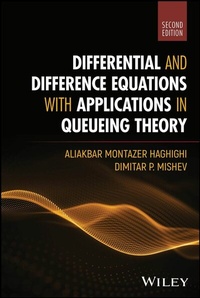
Differential and Difference Equations with Applications in Queueing Theory
Description

A newly updated and authoritative exploration of differential and difference equations used in queueing theory
In the newly revised second edition of Differential and Difference Equations with Applications in Queueing Theory, a team of distinguished researchers delivers an up-to-date discussion of the unique connections between the methods and applications of differential equations, difference equations, and Markovian queues. The authors provide a deep exploration of first principles and a wide variety of examples in applied mathematics and engineering and stochastic processes.
This book demonstrates the wide applicability of queuing theory in a range of fields, including telecommunications, traffic engineering, computing, and facility design. It contains brand-new information on partial differential equations as a prerequisite for solving queueing models, as well as sample MATLAB code for addressing these models.
Readers will also find:
- A large collection of new examples and enhanced end-of-chapter problems with included solutions
- Comprehensive explorations of single-server, multiple-server, parallel, and series queue models
- Practical discussions of splitting, delayed-service, and delayed feedback
- Enhanced treatments of concepts queueing theory, accessible across engineering and mathematics
Perfect for junior and up undergraduate, as well as graduate students in electrical and mechanical engineering, Differential and Difference Equations with Applications in Queueing Theory will also benefit students of computer science, mathematics, and applied mathematics.
More details
Other editions
Additional editions
Persons
Aliakbar Montazer Haghighi, PhD, is Regent Professor, Professor, and former Head of the Department of Mathematics at Prairie View A&M University. He's the Co-founder and Founding Editor-in-Chief of Applications and Applied Mathematics: An International Journal (AAM).
Dimitar P. Mishev, PhD, is Professor in the Department of Mathematics at Prairie View, A&M University. His research is focused on differential and difference equations and queueing theory.
Content
About the Authors xiii
Preface to the Second Edition xv
1 Introduction 1
1.1 Introduction 1
1.2 Functions of a Real Variable 1
1.3 Some Properties of Differentiable Functions 3
1.4 Functions of More Than One Real Variable 3
1.5 Function of a Complex Variable 7
1.6 Differentiation of Functions of Complex Variables 12
1.7 Vectors 15
2 Transforms 31
2.1 Introduction 31
2.2 Fourier Series 32
2.3 Convergence of Fourier Series 39
2.4 Fourier Transform 40
2.5 Laplace Transform 50
2.6 Integral Transform 68
2.7 Z-Transform 69
3 Ordinary Differential Equations 81
3.1 Introduction and History of Ordinary Differential Educations 81
3.2 Basics Concepts and Definitions 81
3.3 Existence and Uniqueness 87
3.4 Separable Equations 89
3.5 Linear Ordinary Differential Equations 98
3.6 Exact Ordinary Differential Equations 102
3.7 Solution of the First ODE by Substitution Method 112
3.8 Applications of the First-Order ODEs 117
3.9 Second-Order Homogeneous Ordinary Differential Equation 122
3.10 The Second-Order Nonhomogeneous Linear Ordinary Differential Equation with Constant Coefficients 138
3.11 Laplace Transform Method 150
3.12 Cauchy-Euler Equation Differential Equation 157
3.13 Elimination Method to Solve Differential Equations 160
3.14 Solution of Linear ODE Using Power Series 163
4 Partial Differential Equations 173
4.1 Introduction 173
4.2 Basic Terminologies for Partial Differential Equations 174
4.3 Some Particular Functions Used in Partial Differential Equations 176
4.4 Types of Boundary Conditions for a Partial Differential Equation 178
4.5 Solution for a Partial Differential Equation 181
4.6 Linear, Semi-linear, and Quasi-linear Partial Differential Equations 184
4.7 Solution of Wave Partial Differential Equation, First and Second Orders, with Different Methods 197
4.8 A One-Dimensional, Second-Order Heat (or Parabolic) Equations 211
5 Differential Difference Equations 223
5.1 Introduction 223
5.2 Basic Terms 225
5.3 Linear Homogeneous Difference Equations with Constant Coefficients 228
5.4 Linear Nonhomogeneous Difference Equations with Constant Coefficients 235
5.5 System of Linear Difference Equations 247
5.6 Differential-Difference Equations 255
5.7 Nonlinear Difference Equations 260
6 Probability and Statistics 269
6.1 Introduction and Basic Definitions and Concepts of Probability 269
6.2 Discrete Random Variables and Probability Distribution Functions 275
6.3 Moments of a Discrete Random Variable 283
6.4 Continuous Random Variables 287
6.5 Moments of a Continuous Random Variable 291
6.6 Continuous Probability Distribution Functions 293
6.7 Random Vector 307
6.8 Continuous Random Vector 312
6.9 Functions of a Random Variable 314
6.10 Basic Elements of Statistics 317
6.11 Inferential Statistics 331
6.12 Hypothesis Testing 338
6.13 Reliability 341
7 Queueing Theory 355
7.1 Introduction 355
7.2 Markov Chain and Markov Process 357
7.3 Birth and Death Process 369
7.4 Introduction to Queueing Theory 371
7.5 Single-Server Markovian Queue, M/M/1 374
7.6 Finite Buffer Single-Server Markovian Queue: M/M/1/N 390
7.7 M/M/1 Queue with Feedback 394
7.8 Single-Server Markovian Queue with State-Dependent Balking 395
7.9 Multiserver Parallel Queue 398
7.10 Many-Server Parallel Queues with Feedback 411
7.11 Many-Server Queues with Balking and Reneging 414
7.12 Single-Server Markovian Queueing System with Splitting and Delayed Feedback 420
Appendix 443
The Poisson Probability Distribution 443
The Chi-Square Distribution 447
The Standard Normal Probability Distribution 449
The (Student) t Probability Distribution 451
Bibliography 453
Answers/Solutions to Selected Exercises 461
Index 469
1
Introduction
The organization of this book is such that by the time reader gets to the last chapter, all necessary terminology and methods of solutions of standard mathematical background have been covered. Thus, we start the book with basic terms of functions of real and complex variables as well as some notations of vectors.
1.1 Introduction
In this section that starts the book, we will discuss basic vocabulary that we will be using throughout the book. Since most of the terms such as complex variables and vectors are subjects of books themselves, we will be very brief and discuss the minimum necessary for this book. Of course, since the book is to be written for a vast reader, as the table of contents of the book shows, not all topics are required for all to know. For example, for undergraduate students using this book as a textbook for their differential equation book, since they are required to have the second calculus, they would jump to Chapter 3 and, when necessary, will refer to Chapter 2. Thus, they will omit this chapter all together.
1.2 Functions of a Real Variable
The most important concept in mathematical analysis is the concept of function. We need not only one function of one variable, but we will need a function of more than one variable, in particular, of two variables. Thus, we will discuss these types of functions below.
By definition, a function, f, of one variable is a relation between two sets, say, A and B, such that for each element of the first set, A, there is a unique element in the second set, B. The first set, A, is called the domain of f, and corresponding elements in the second set, B, is called the range of f. If a typical element of domain of a function f is denoted by x and its corresponding element in the range is denoted by y, then we can write:
The type of elements of domain of a function as discrete or continuous will determine the type of a function as such. Elements of the domain of a function may be discrete or continuous (that is, an interval). Also, a function is linear if it represents a straight line on the coordinate plane, that is, its graph is a straight line, f(x) = ax + b, where a and b are arbitrary constants. For a function of any finite number of variables, a linear function is stated as
where b, a1, a2, . , an are arbitrary constants.
As in calculus, a function is differentiable at a point x if its derivative exists at that point, that is, if
(1.2.1)exists. Thus, a function at a point of discontinuity does not have a derivative at that point. It is easy to see that if a function has a derivative at a point, it is continuous at that point. However, a function may be continuous at point but not differentiable at that point. For example, f(x) = |x| at x = 0. Such a point is referred to as a cusp of the function. It is a point on a curve at which the direction reverses.
If f is a differentiable function of x, then we will have the following:
(1.2.2)The relation (1.2.2) read as the derivative of f with respect to x is sometimes referred to as the rate of change of f with respect to x. It is also referred to as the slope of the tangent line to the graph of f at the point x. If f is a differentiable function of x, then is often written as f´(x).
1.3 Some Properties of Differentiable Functions
- i) Let u(t) and v(t) be differentiable functions of t, and a and b be constants. If there is no confusion, we drop t for the sake of convenience. Then, (1.3.1)
- ii) Let u(t) and v(t) be differentiable functions of t, and c be a constant. If there is no confusion, we drop t for the sake of convenience. Then, (1.3.2)
- iii) Let u(t) and v(t) be differentiable functions of t, and c be a constant. If there is no confusion, we drop t for the sake of convenience. Then, (1.3.3)
- iv) Derivative of composition of two functions: f(t) and g(t). Let y = f(t) and x = g(t). Then, (1.3.4)
provided the derivatives exist.
1.4 Functions of More Than One Real Variable
Details of the functions of several variables are discussed in textbooks for multivariable calculus. In the real world, we have to deal with functions that contain two or more variables. Many real-world phenomena can only be described by functions with several variables. For instance, consider temperature. It can depend on location and the time of day. Or consider the net income of a manufacturer that depends on the number of units sold, cost of materials, cost of advertising, cost of labor, and administrative costs. Therefore, we briefly discuss some of the critical key points about the functions of several variables. We begin here by discussing a function of two variables.
By definition, a function of two variables (or a bivariate function) is a relation, denoted by f, that assigns to each ordered pair of real numbers (x, y) in a set D, called domain, a unique real number, denoted by f(x, y). The set of values that f takes is called the range of f, that is, {f(x, y) : (x, y) ? D}.
1.4.1 The Chain Rule for Real Multivariable Functions
For a single-valued function, we discussed the chain rule, which allows us to find the derivative of the composition of two functions. The same thing is true for multivariable functions. However, due to more than one variable, we should expect more complications. We should also note that for a function of one variable, the function f maps R to R, whereas for a function with n variables, f maps Rn to an m-dimensional space Rm.
Thus, to discuss the chain rule for multivariate functions, we start with a function of two variables, say ? = f(x, y). Hence, let us also suppose x = g(t) and y = h(t).
The question is: what is ?
The answer to this question was in the second example for the function of one variable, logistic function, with one variable, but a bit more complicated. Hence, the answer in this case is to differentiate ? = f(x, y) = f(g(t), h(t)) with respect to each variable and multiply by the derivative of each variable with respect to t, that is,
(1.4.1)Let us begin with a simple example and then we will move to more complicated...
