

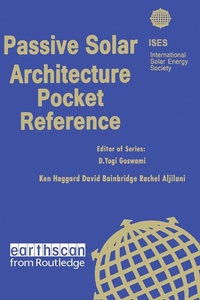
Passive Solar Architecture Pocket Reference
Published on 1. April 2016
94 pages
978-1-317-70517-8 (ISBN)
Description

Our pocket reference books provide a wealth of practical information at your fingertips, whenever you need it. Rich in background detail, at-a-glance tables and diagrams, equations, and more, the Passive Solar Architecture Pocket Reference is a handy resource for architects, engineers and students.
Coverage includes:
definitions
load determinants and Responses (including world wide biomes and climates, building metabolism and response, thermal sources and sinks, passive building responses to sources and sinks, tuning the building to the environment, optimizing insulation & thermal mass for comfort)
contextual aspects (including microclimate and siting, temperatures, humidity, wind, radiation and comfort parameters
passive components (including building envelope, passive solar terminology, orientation, apertures and glazing, thermal storage, thermal control and materials
design tools (including sun path diagrams, sun peg diagrams, air flow relationships, thermal modelling and life cycle design
specific functions (including passive heating, passive cooling and ventilation, natural lighting, passive water heating, resource collection and integrated design).
Coverage includes:
definitions
load determinants and Responses (including world wide biomes and climates, building metabolism and response, thermal sources and sinks, passive building responses to sources and sinks, tuning the building to the environment, optimizing insulation & thermal mass for comfort)
contextual aspects (including microclimate and siting, temperatures, humidity, wind, radiation and comfort parameters
passive components (including building envelope, passive solar terminology, orientation, apertures and glazing, thermal storage, thermal control and materials
design tools (including sun path diagrams, sun peg diagrams, air flow relationships, thermal modelling and life cycle design
specific functions (including passive heating, passive cooling and ventilation, natural lighting, passive water heating, resource collection and integrated design).
Reviews / Votes
'It is pleasing to see so much useful data summarized in a small, convenient and affordable book.' -Architectural Science Review'Contains copious amounts of easily understandable information.' -Building Engineer
'This little book contains all the text, tables and diagrams you'll need to look extremely well informed in any meeting alluding to Part L, energy systems or renewable energy. It explains how we can and should make use of solar energy and apply it to the built environment.' - Celia Burt, Building Engineer
More details
Series
Language
English
Place of publication
London
United Kingdom
Publishing group
Taylor & Francis Ltd
Target group
Professional and scholarly
File size
7,55 MB
ISBN-13
978-1-317-70517-8 (9781317705178)
Copyright in bibliographic data and cover images is held by Nielsen Book Services Limited or by the publishers or by their respective licensors: all rights reserved.
Schweitzer Classification
Other editions
Additional editions
Ken Haggard | David A. Bainbridge | Rachel Aljilani
Passive Solar Architecture Pocket Reference
Book
01/2018
1st Edition
Routledge
€282.25
Shipment within 10-20 days
Ken Haggard | David A. Bainbridge | Rachel Aljilani
Passive Solar Architecture Pocket Reference
Book
02/2010
1st Edition
Earthscan Ltd
€50.00
Shipment within 3-4 weeks
Persons
David A. Bainbridge is Associate Professor of Sustainable Management at the Marshall Goldsmith School of Management, www.sustainabilityleader.org. He is coauthor of the best selling book The Straw Bale House, Village Homes' Solar House Designs, The Water Wall Design Manual, The Integral Passive Solar Water Heater Book and the First and Second Passive Solar Catalogs and contributed to the California Passive Solar Handbook.
Ken Haggard is principle and architect, San Luis Sustainability Group. www.slosustainability.com. He is coauthor of Straw Bale Construction Sourcebook, Fractal Architecture- Design for Sustainability, A Brief Architectural History of San Luis Obispo County, and the California Passive Solar Handbook.
Rachel Aljilani is a LEED AP and associate with San Luis Sustainability Group. She coauthored A Student Guide to Sustainable Living and the San Luis Obispo Guide to the Use of Graywater.
Ken Haggard is principle and architect, San Luis Sustainability Group. www.slosustainability.com. He is coauthor of Straw Bale Construction Sourcebook, Fractal Architecture- Design for Sustainability, A Brief Architectural History of San Luis Obispo County, and the California Passive Solar Handbook.
Rachel Aljilani is a LEED AP and associate with San Luis Sustainability Group. She coauthored A Student Guide to Sustainable Living and the San Luis Obispo Guide to the Use of Graywater.
Content
Preface
1. Definitions
2. Load Determinants and Responses
3. Contextual Aspects
4. Passive Components
5. Design Tools
6. Specific Functions
References
1. Definitions
2. Load Determinants and Responses
3. Contextual Aspects
4. Passive Components
5. Design Tools
6. Specific Functions
References
