

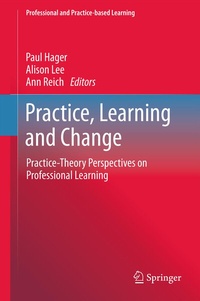
Practice, Learning and Change
Description

The three concepts central to this volume-practice, learning and change-have received very different treatments in the educational literature, an oversight directly confronted here. While learning and change have been extensively theorised, their various contexts articulated and analysed, practice is notably underrepresented. Where much of the literature on learning and change takes the notion of 'practice' as an unexamined given, its co-location as a term with various classifiers, as in 'legal practice' and 'teaching practice', render it curiously devoid of semantic force.
In this book, 'practice' is the super-ordinate organising idea. Drawing on what has been termed the 'practice turn in contemporary theory', the work develops a conceptual framework for researching learning in, and on, practice. It challenges received notions of practice, questioning the assumptions, elisions, conflations and silences on the subject. In so doing, it offers fresh insights into learning and change, and how they relate to practice. In tandem with this conceptual work, the book details site-ontological studies of practice and learning in diverse professional and workplace contexts, examining the work of occupations as various as doctors, chefs and orchestral musicians. It demonstrates the value of theorising practice, learning and change, as well as exploring the connections between them amid our evolving social and institutional structures.
More details
Other editions
Additional editions
Content
Foreword, Theodore Schatzki.- Preface, Paul Hager, Alison Lee & Ann Reich.- Chapter 1. Problematising practice, reconceptualising learning, imagining change, Paul Hager, Alison Lee and Ann Reich.- Theorising practice; rethinking professional learning.- Chapter 2. Theories of Practice and their Connections with Learning: a continuum of more and less inclusive accounts, Paul Hager.- Chapter 3. Ecologies of Practices, Stephen Kemmis, Christine Edwards-Groves, Jane Wilkinson & Ian Hardy.- Chapter 4. Sensing the Tempo-Rhythm of Practice: the dynamics of engagement, Mary C. Johnsson.- Chapter 5. Matter-ings of Knowing and Doing: sociomaterial approaches to understanding practice, Tara Fenwick.- Chapter 6. A Re-turn to Practice. Practice-based studies of education, Paolo Landri.- Investigating learning practices. Chapter 7. Towards Understanding Workplace Learning through Theorising Practice: at work in hospital emergency departments, Marie Manidis and Hermine Scheeres.- Chapter 8. The Complex Systems of Practice, Jeanette Lancaster.- Chapter 9. Practice-as-complexity: encounters with management education in the public sector, Christine Davis.- Chapter 10. Governing LearningPractices: governmentality and practice, Ann Reich and John Girdwood.- Chapter 11. Rhetorical Activation of Workers: a case study in neo-liberal governance,Andreas Fejes and Katherine Nicoll.- Chapter 12. Learning Professional Practice through Education, Madeleine Abrandt Dahlgren, Lars Owe Dahlgren, Johanna Dahlberg.- Chapter 13. Learning to Practise, Practising to Learn: doctors' transitions to new levels of responsibility, Miriam Zukas and Sue Kilminster.- Practice, learning and change.- Chapter 14. Why Do Practices Change and Why Do They Persist? Models of Explanations, Silvia Gherardi.- Chapter 15 Learning Organizational Practices that Persist, Perpetuate and Change: a Schatzkian view, Oriana M. Price, Mary C. Johnsson, Hermine Scheeres, David Boud and Nicky Solomon.- Chapter 16. Collective Learning Practice, Paul Hager and Mary C. Johnsson.- Chapter 17. Seeing is Believing: an embodied pedagogy of 'doing partnership' in child and family health, Alison Lee, Roger Dunston and Cathrine Fowler.
