

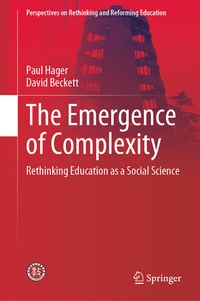
The Emergence of Complexity
Description

".an ambitiously wide-ranging volume, questioning the key tenets of respected approaches ... and offering ... 'novel accounts', which draw on features of complexity thinking.. .But they go further than any of us in their argument that: 'whatever reductive moves are made, they 'flow' from holistic accounts of relationality which have already affectively engaged the purposes of a co-present group.' This is the intellectual contribution that is built consistently and persuasively across the chapters."
Professor Emerita Anne Edwards, Oxford University
"Hager and Beckett have written a book that will challenge more commonly held notions of agency, practice, skills, and learning. Centering their argument on complexity theory or, as they prefer, complexity thinking, Hager and Beckett argue that it is through relations that we raise questions about, gather data from, and make working sense of the complexity that surrounds us. Groups then, particularly small groups, hold and implement agentive power. And what the authors call co-present groups-ones in which holistic relationality occurs socially, and affectively in distinctive places-"draw us closer to each other, and harness our normativity by enabling negotiability and reason-giving." If your field of study involves anything remotely sociocultural in nature or if you are just interested in the complex ways we engage as humans with our worlds, you should find a place for this book in your library."
Bob Fecho, Teachers College, Columbia University, New York NY, USA
Reviews / Votes
"Hager and Beckett's book is a rich, valuable and often successful attempt to shift our understanding of learning, performance and work to a new level. . Perhaps the positivism queried above has a bright side, too, in that people who are unfamiliar with fields like structuralism, or who have conceived an aversion to some of these ways of thinking, may be stimulated by concepts like co-present groups, non-linearity and emergence to reimagine professional and technical education and training." (Steven Hodge, International Journal of Lifelong Education, Vol. 39 (5-6), 2020)
More details
Other editions
Additional editions
Persons
Paul Hager is Emeritus Professor of Education at University of Technology, Sydney. His books include Beckett & Hager (2002) Life, Work and Learning: Practice in Postmodernity (Routledge), Hager & Halliday (2006) Recovering Informal Learning: Wisdom, Judgement and Community (Springer), Hager & Holland (eds.) (2006) Graduate Attributes, Learning and Employability (Springer), and Hager, Lee & Reich (eds.) (2012) Practice, Learning and Change: Practice-theory Perspectives on Professional Learning. Professional and Practice-based Learning book series Vol. 8 (Springer). Paul is a Fellow of the Philosophy of Education Society of Australasia. In 2013 Educational Philosophy and Theory published a special issue celebrating his work.
David Beckett retired at the end of 2017 from The University of Melbourne, where he was most recently a Professor, and Deputy Dean, in the Melbourne Graduate School of Education. As well as the 2002 book with Paul Hager, in 2010, Educational Research: Creative Thinking and Doing (O'Toole and Beckett) was published by Oxford University Press, with a second edition in 2013. He is a Fellow of the Australian Council for Educational Leaders, and a Fellow of the Philosophy of Education Society of Australasia.
