

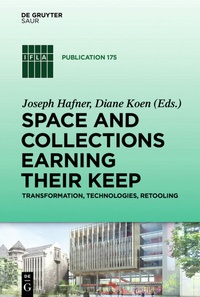
Space and Collections Earning their Keep
Transformation, Technologies, Retooling
1st Edition
Published on 11. July 2016
VII, 209 pages
978-3-11-046420-7 (ISBN)
Description

Traditionally, libraries have served as storage spaces offering access to diverse physical collections. Today, following numerous social and technological changes, libraries are retooling their services, rethinking storage and reimagining their spaces. The transformation in information technology has had an enormous impact on users' research behaviour, which in turn demands new discovery environments. A conference of the IFLA Library Buildings and Equipment and the Acquisition and Collection Development Sections spotlighted libraries from around the world who are providing quality, adaptable and innovative library spaces and services meeting the changing needs of their users, their collections, their staff and their communities.
More details
Series
Language
English
Place of publication
Berlin/Boston
Germany
Target group
Professional and scholarly
US School Grade: College Graduate Student
Illustrations
10 s/w Tabellen, 111 farbige Abbildungen
111 col. ill., 10 b/w tbl.
File size
7,09 MB
ISBN-13
978-3-11-046420-7 (9783110464207)
Schweitzer Classification
Other editions
Additional editions
Joseph Hafner | Diane Koen
Space and Collections Earning their Keep
Transformation, Technologies, Retooling
Book
07/2016
De Gruyter Saur
€139.95
Article exhausted; check different version
Joseph Hafner | Diane Koen
Space and Collections Earning their Keep
Transformation, Technologies, Retooling
Book
07/2016
1st Edition
De Gruyter Saur
€89.95
Shipment within 7-9 days
Joseph Hafner | Diane Koen
Space and Collections Earning their Keep
Transformation, Technologies, Retooling
E-Book
07/2016
1st Edition
De Gruyter Saur
€89.95
Available for download
Persons
Joseph Hafner und Diane Koen, McGill University Library, Montreal, Canada.
Content
- Intro
- Contents
- About IFLA
- Introduction
- Part 1: Journey to Success
- 1. A Three-card Trick. Three New Inspiring Libraries for Melbourne
- 2. The Perfect Storm. Integrating Collections and People in Record Time while Addressing User Needs
- 3. Adapting Library Spaces to Enable Collection Engagement by Diverse Audiences. A Case Study of the State Library of New South Wales
- 4 The Library as a Meeting Place in the City Centre. The Communicative Library
- 5. Transforming Old Spaces into New Functions
- 6. Building Public Libraries for Tomorrow
- Part 2: Innovation and Flexibility
- 7. The Cultural Anchor. The Library as Place-maker, Catalyst and Local Icon
- 8. The Die is not yet Cast. The Value of Keeping an Open Mind and being Agile throughout All Phases of the Renovation Planning Cycle
- 9. Managing Collections and Welcoming Patrons. Building a Map of the Collections in Roubaix Public Library, France
- Part 3: Adaptation of Space
- 10. Renovated Library Space at the University of Botswana. A Reappraisal
- 11. From Room for Books to Room for Users. An Old Infantry Barracks Meets the Challenge
- 12. Re-tooling Library Spaces for Learning
- Part 4: Best Practices for Legacy Collections Storage Initiatives
- 13. Panel Discussion on Collaborative Storage. A Global Perspective
- Contributors
