

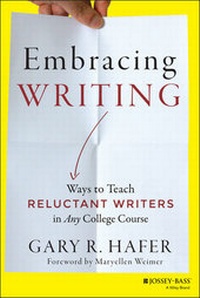
Embracing Writing
Description

More details
Other editions
Additional editions
Persons
Content
Preface
I welcome you to Embracing Writing: Ways to Teach Reluctant Writers in Any College Course, my response to a growing dilemma that many teaching faculty face as they exercise writing for learning in their college courses.
On one hand, I find that the faculty with whom I talk recognize writing as essential to their scholarly and professional responsibilities. They are the first to acknowledge that disciplinary knowledge is closely tied to rhetorical knowledge; that is, they appreciate that they must be able to write prolifically and competently about their discipline in ways that speak clearly to their colleagues and other audiences, such as their students. They know it isn't enough to dump information in the laps of their readers: They must also commune with them in interesting and profound ways. Making a professional finding takes on added significance when such scholarly work culminates in a journal article or a book, bringing its own reward in tenure, promotion, and professional recognition. In short, faculty value not only that they must speak with authority in their discipline but also that they must possess the requisite skills so that their writing accomplishes something. In other words, their writing must invoke readers to effect some change in them: agreements, disagreements, confrontations, denials, connections. Integrating writing and disciplinary knowledge are notions that faculty implicitly acknowledge.
On the other hand, that understanding—as genuine and as real to the discipline as it may be—can seem unreachable when professors try to integrate writing into their courses. In fact, college courses may be the worst place to learn how to do that kind of writing. At those sites, students interpret first efforts as finished products that deserve a grade, no matter how persistently their professors emphasize process. As faculty can testify, writers go through countless drafts, revisions, dumps, and rewrites—let alone feedback of varying helpfulness from colleagues and editors—that all work toward crafting their final products. This context is removed from most student encounters with writing. In its place is what students believe really matters: the transaction that brings about good high-stakes writing, they being unreceptive to final writing as a pastiche assembled from messy processes. Who can blame them for being reluctant to move into the full writing process when the grade is synonymous with the polished final version? Given the exigencies of the modern classroom, it's hard for faculty to create the incentive—let alone supply the time, circumstances, and feedback necessary—for a rich and integrated writing environment in their courses.
That teaching professors feel daunted as they face these intricate problems is understandable. Most teach content courses, not skills-based courses like writing. They don't have the time or the resources to design writing to carry that content. As one professor on a writing-across-the-curriculum committee confessed, “I'll tell you right now: I haven't the foggiest idea of how to teach writing. I know it's important, but I don't feel confident in teaching it.”
It is that dissonance I wish to span with Embracing Writing. Won't you join me in making writing a more meaningful bridge for learning in your classes?
Purpose
I wrote Embracing Writing not only to give teaching faculty the tools to make their students more effective learners and better writers but also to make those tools accessible and manageable to faculty. No matter their successes in using writing in the classroom or at their own writing desk, all instructors can become more compelling when they use writing for learning. To appropriate these tools, readers must recognize several things. First, they need to recognize the significant resources inside the actual writing process that, when embraced, will resolve problems students have with writing. I understand how circular this pronouncement sounds, but writing is powerful enough to solve its own problems when integrated fully into courses. Second, as much as learning is involved in this enterprise, there is an even greater amount of unlearning required. The negative outcomes of much school-sponsored writing—summarized in what I call the Writing Problem—jeopardize students' future success unless they are countered, and countered demonstratively, by an approach rather than just a series of unrelated techniques. Third, faculty who want to honor writing in their courses need to be shown ways to circumvent teaching writing as a second subject. This point may seem counterintuitive until faculty come to know the important (though neglected) epistemic qualities—those qualities that direct writing as learning—within writing itself that facilitate teaching course content to students. Last, faculty themselves can and should practice this approach to writing both in their responses to student writing and in their scholarship.
This book presents writing as the entry point to demonstrate that writers—professors and students—can teach and learn course content effectively and with an insight that gives shape to their learning. Both faculty and students know writing is not only something they must do but also something they must do well. This book gives faculty a method to effect that learning and to produce more self-conscious writers.
Writing Practices
Instead of beginning with sets of rules and regulations that appoint hit-or-miss outcomes, this book starts with typical writing practices. In themselves, these practices are empowering, teaching creative options that open pathways to more powerful writing. For example, this book positions low-stakes writing opportunities for students to give them scaffolded practice with the kinds of writing they will need to produce when the stakes grow higher. It also allows for better teacher intervention while students are shaping their writing rather than professors delaying feedback until the process is completed and the final grade assigned.
Taken individually, these writing practices are not new, since writers instinctively pursue writing as craft. At the same time, writers secure a process that faculty typically ignore or are discouraged from integrating into their courses because they fear the workload involved. This book's approach gathers writerly practices together with what good faculty are already doing expertly: teaching course content.
Shared Understandings
What is available when both you and students write are better opportunities for writing together, ones that you can embrace because this book's approach centers on four understandings.
First, students and faculty must share a similar attitude toward writing. That is, they must be convinced that writing is a uniquely effective way of learning. I remain convinced that the kinds of writing activities I advocate in this book bring about better writing because students are encouraged to take great risks to bring about greater learning. For example, the checksheets in this book emphasize effort in writing, summarizing tasks for students to explore so they can distribute the cognitive workload over several drafts.
A second understanding calls attention to how writing works by encouraging faculty to participate together with their students in its processes and products. For instance, the kind of low-stakes responses I encourage them to make opens up writing as a way to help students and themselves with writing dilemmas.
This book collects writerly habits for cultivation, encouraging faculty to build a routine for writing in their professional life and in classroom routine. The chapter on daily writing, for example, profiles one way to energize the writing of teachers and their students.
Finally, this book investigates a number of writerly practices for the college curriculum by developing a repertoire of strategies that help students gain mastery over their writing. These practices have the added benefit of uniting faculty's professional life with their pedagogy.
Workload
I am particularly aware of many faculty members' reticence about teaching writing, compounded by the prospect of ever-increasing teaching workloads. At teaching workshops I've attended and in others I've led, the most frequently requested workshops all centered on writing in disciplines outside the English department: how to require, grade, and survive it. Within those same workshops are the zealous participants who need to make their sponsorship of classroom writing practical and easily implementable.
I address many of these concerns because they were mine when I began teaching writing twenty-five years ago. For instance, in the first chapter I show what writing activities faculty should privilege in apportioning their time and which ones they should demote. I'm giving fair warning now that I am a huge fan of conferencing and copious feedback. But I'm an even bigger fan of integrating those activities into a course without increasing workload. Such integration makes writing as a tool for learning manageable and enjoyable.
Audience
My primary audience is higher education faculty in any discipline where reluctant writers are among their students, including those
- committed to developing students' writing skills but who may hesitate because of the increased workload.
- who are...
