

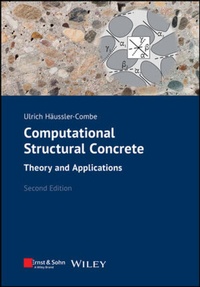
Computational Structural Concrete
Theory and Applications
2nd Edition
Published on 22. September 2022
XVIII, 424 pages
978-3-433-61024-4 (ISBN)
Description

Concrete is by far the most used building material due to its advantages: it is shapeable, cost-effective and available everywhere. Combined with reinforcement it provides an immense bandwidth of properties and may be customized for a huge range of purposes. Thus, concrete is the building material of the 20th century. To be the building material of the 21th century its sustainability has to move into focus. Reinforced concrete structures have to be designed expending less material whereby their load carrying potential has to be fully utilized.
Computational methods such as Finite Element Method (FEM) provide essential tools to reach the goal. In combination with experimental validation, they enable a deeper understanding of load carrying mechanisms. A more realistic estimation of ultimate and serviceability limit states can be reached compared to traditional approaches. This allows for a significantly improved utilization of construction materials and a broader horizon for innovative structural designs opens up.
However, sophisticated computational methods are usually provided as black boxes. Data is fed in, the output is accepted as it is, but an understanding of the steps in between is often rudimentary. This has the risk of misinterpretations, not to say invalid results compared to initial problem definitions. The risk is in particular high for nonlinear problems. As a composite material, reinforced concrete exhibits nonlinear behaviour in its limit states, caused by interaction of concrete and reinforcement via bond and the nonlinear properties of the components. Its cracking is a regular behaviour. The book aims to make the mechanisms of reinforced concrete transparent from the perspective of numerical methods. In this way, black boxes should also become transparent.
Appropriate methods are described for beams, plates, slabs and shells regarding quasi-statics and dynamics. Concrete creeping, temperature effects, prestressing, large displacements are treated as examples. State of the art concrete material models are presented. Both the opportunities and the pitfalls of numerical methods are shown. Theory is illustrated by a variety of examples. Most of them are performed with the ConFem software package implemented in Python and available under open-source conditions.
Computational methods such as Finite Element Method (FEM) provide essential tools to reach the goal. In combination with experimental validation, they enable a deeper understanding of load carrying mechanisms. A more realistic estimation of ultimate and serviceability limit states can be reached compared to traditional approaches. This allows for a significantly improved utilization of construction materials and a broader horizon for innovative structural designs opens up.
However, sophisticated computational methods are usually provided as black boxes. Data is fed in, the output is accepted as it is, but an understanding of the steps in between is often rudimentary. This has the risk of misinterpretations, not to say invalid results compared to initial problem definitions. The risk is in particular high for nonlinear problems. As a composite material, reinforced concrete exhibits nonlinear behaviour in its limit states, caused by interaction of concrete and reinforcement via bond and the nonlinear properties of the components. Its cracking is a regular behaviour. The book aims to make the mechanisms of reinforced concrete transparent from the perspective of numerical methods. In this way, black boxes should also become transparent.
Appropriate methods are described for beams, plates, slabs and shells regarding quasi-statics and dynamics. Concrete creeping, temperature effects, prestressing, large displacements are treated as examples. State of the art concrete material models are presented. Both the opportunities and the pitfalls of numerical methods are shown. Theory is illustrated by a variety of examples. Most of them are performed with the ConFem software package implemented in Python and available under open-source conditions.
More details
Other editions
Additional editions
Book
10/2022
2nd Edition
Ernst & Sohn
€79.00
Available immediately
Ulrich Haeussler-Combe
Computational Structural Concrete 2e - Theory and Applications
Software
09/2022
Ernst & Sohn
€115.85
No shipping information available
Person
Ulrich Häussler-Combe studied structural engineering at the Technical University Dortmund and gained his doctorate from the University Karlsruhe. Following ten years of construction engineering and development in computational engineering, he came back to the University Karlsruhe as a lecturer for computer aided design and structural dynamics. In 2003 he was appointed as professor for special concrete structures at the Technical University Dresden. He retired in 2021 and currently is still active as guest professor at the Technical University Munich.
Content
Preface
List of Examples*
Notation
1 INTRODUCTION
2 FINITE ELEMENTS OVERVIEW
2.1 Modelling Basics
2.2 Discretisation Outline
2.3 Elements
2.4 Material Behavior
2.5 Weak Equilibrium
2.6 Spatial Discretisation
2.7 Numerical Integration
2.8 Equation Solution Methods
2.9 Discretisation Errors
3 UNIAXIAL REINFORCED CONCRETE BEHAVIOUR
3.1 Uniaxial Stress-Strain Behaviour of Concrete
3.2 Long-Term Behaviour - Creep and Imposed Strains
3.3 Reinforcing Steel Stress-Strain Behaviour
3.4 Bond between Concrete and Reinforcement
3.5 Smeared Crack Model
3.6 Reinforced Tension Bar
3.7 Tension Stiffening of Reinforced Bars
4 STRUCTURAL BEAMS AND FRAMES
4.1 Cross-Sectional Behaviour
4.2 Equilibrium of Beams
4.3 Finite Elements for Plane Beams
4.4 System Building and Solution
4.5 Creep of Concrete
4.6 Temperature and Shrinkage
4.7 Tension Stiffening
4.8 Prestressing
4.9 Large Displacements - Second-Order Analysis
4.10 Dynamics
5 STRUT-AND-TIE MODELS
5.1 Elastic Plate Solutions
5.2 Strut-and-Tie Modelling
5.3 Solution Methods for Trusses
5.4 Rigid Plastic Truss Models
5.5 Application Aspects
6 MULTI-AXIAL CONCRETE BEHAVIOUR
6.1 Basics
6.2 Continuum Mechanics
6.3 Isotropy, Linearity, and Orthotropy
6.4 Nonlinear Material Behaviour
6.5 Elasto-Plasticity
6.6 Damage
6.7 Damaged Elasto-Plasticity
6.8 The Microplane Model
6.9 General Requirements for Material Laws
7 CRACK MODELLING AND REGULARISATION
7.1 Basic Concepts of Crack Modelling
7.2 Mesh Dependency
7.3 Regularisation
7.4 Multi-Axial Smeared Crack Model
7.5 Gradient Methods
7.6 Overview of Discrete Crack Modelling
7.7 The Strong Discontinuity Approach
8 PLATES
8.1 Lower Bound Limit State Analysis
8.2 Cracked Concrete Modelling
8.3 Reinforcement and Bond
8.4 Integrated Reinforcement
8.5 Embedded Reinforcement with a Flexible Bond
9 SLABS
9.1 Classification
9.2 Cross-Sectional Behaviour
9.3 Equilibrium of Slabs
9.4 Reinforced Concrete Cross-Sections
9.5 Slab Elements
9.6 System Building and Solution Methods
9.7 Lower Bound Limit State Analysis
9.8 Nonlinear Kirchhoff Slabs
9.9 Upper Bound Limit State Analysis
10 SHELLS
10.1 Geometry and Displacements
10.2 Deformations
10.3 Shell Stresses and Material Laws
10.4 System Building
10.5 Slabs and Beams as a Special Case
10.6 Locking
10.7 Reinforced Concrete Shells
11 RANDOMNESS AND RELIABILITY
11.1 Uncertainty and Randomness
11.2 Failure Probability
11.3 Design and Safety Factors
12 CONCLUDING REMARKS
APPENDIX A SOLUTION METHODS
A.1 Nonlinear Algebraic Equations
A.2 Transient Analysis
A.3 Stiffness for Linear Concrete Compression
A.4 The Arc Length Method
APPENDIX B MATERIAL STABILITY
APPENDIX C CRACK WIDTH ESTIMATION
APPENDIX D TRANSFORMATIONS OF COORDINATE SYSTEMS
APPENDIX E REGRESSION ANALYSIS
References
Index
*LIST OF EXAMPLES
3.1 Tension bar with localisation
3.2 Tension bar with creep and imposed strains
3.3 Simple uniaxial smeared crack model
3.4 Reinforced concrete tension bar
4.1 Moment-curvature relations for given normal forces
4.2 Simple reinforced concrete (RC) beam
4.3 Creep deformations of RC beam
4.4 Effect of temperature actions on an RC beam
4.5 Effect of tension stiffening on an RC beam with external and temperature loading
4.6 Prestressed RC beam
4.7 Stability limit of cantilever column
4.8 Ultimate limit for RC cantilever column
4.9 Beam under impact load
5.1 Continuous interpolation of stress fields with the quad element
5.2 Deep beam with strut-and-tie model
5.3 Corbel with an elasto-plastic strut-and-tie model
6.1 Mises elasto-plasticity for uniaxial behavior
6.2 Uniaxial stress-strain relations with Hsieh-Ting-Chen damage
6.3 Stability of Hsieh-Ting-Chen uniaxial damage
6.4 Microplane uniaxial stress-strain relations with de Vree damage
7.1 Plain concrete plate with notch
7.2 Plain concrete plate with notch and crack band regularisation
7.3 2D smeared crack model with elasticity
7.4 Gradient damage formulation for the uniaxial tension bar
7.5 Phase field formulation for the uniaxial tension bar
7.6 Plain concre
List of Examples*
Notation
1 INTRODUCTION
2 FINITE ELEMENTS OVERVIEW
2.1 Modelling Basics
2.2 Discretisation Outline
2.3 Elements
2.4 Material Behavior
2.5 Weak Equilibrium
2.6 Spatial Discretisation
2.7 Numerical Integration
2.8 Equation Solution Methods
2.9 Discretisation Errors
3 UNIAXIAL REINFORCED CONCRETE BEHAVIOUR
3.1 Uniaxial Stress-Strain Behaviour of Concrete
3.2 Long-Term Behaviour - Creep and Imposed Strains
3.3 Reinforcing Steel Stress-Strain Behaviour
3.4 Bond between Concrete and Reinforcement
3.5 Smeared Crack Model
3.6 Reinforced Tension Bar
3.7 Tension Stiffening of Reinforced Bars
4 STRUCTURAL BEAMS AND FRAMES
4.1 Cross-Sectional Behaviour
4.2 Equilibrium of Beams
4.3 Finite Elements for Plane Beams
4.4 System Building and Solution
4.5 Creep of Concrete
4.6 Temperature and Shrinkage
4.7 Tension Stiffening
4.8 Prestressing
4.9 Large Displacements - Second-Order Analysis
4.10 Dynamics
5 STRUT-AND-TIE MODELS
5.1 Elastic Plate Solutions
5.2 Strut-and-Tie Modelling
5.3 Solution Methods for Trusses
5.4 Rigid Plastic Truss Models
5.5 Application Aspects
6 MULTI-AXIAL CONCRETE BEHAVIOUR
6.1 Basics
6.2 Continuum Mechanics
6.3 Isotropy, Linearity, and Orthotropy
6.4 Nonlinear Material Behaviour
6.5 Elasto-Plasticity
6.6 Damage
6.7 Damaged Elasto-Plasticity
6.8 The Microplane Model
6.9 General Requirements for Material Laws
7 CRACK MODELLING AND REGULARISATION
7.1 Basic Concepts of Crack Modelling
7.2 Mesh Dependency
7.3 Regularisation
7.4 Multi-Axial Smeared Crack Model
7.5 Gradient Methods
7.6 Overview of Discrete Crack Modelling
7.7 The Strong Discontinuity Approach
8 PLATES
8.1 Lower Bound Limit State Analysis
8.2 Cracked Concrete Modelling
8.3 Reinforcement and Bond
8.4 Integrated Reinforcement
8.5 Embedded Reinforcement with a Flexible Bond
9 SLABS
9.1 Classification
9.2 Cross-Sectional Behaviour
9.3 Equilibrium of Slabs
9.4 Reinforced Concrete Cross-Sections
9.5 Slab Elements
9.6 System Building and Solution Methods
9.7 Lower Bound Limit State Analysis
9.8 Nonlinear Kirchhoff Slabs
9.9 Upper Bound Limit State Analysis
10 SHELLS
10.1 Geometry and Displacements
10.2 Deformations
10.3 Shell Stresses and Material Laws
10.4 System Building
10.5 Slabs and Beams as a Special Case
10.6 Locking
10.7 Reinforced Concrete Shells
11 RANDOMNESS AND RELIABILITY
11.1 Uncertainty and Randomness
11.2 Failure Probability
11.3 Design and Safety Factors
12 CONCLUDING REMARKS
APPENDIX A SOLUTION METHODS
A.1 Nonlinear Algebraic Equations
A.2 Transient Analysis
A.3 Stiffness for Linear Concrete Compression
A.4 The Arc Length Method
APPENDIX B MATERIAL STABILITY
APPENDIX C CRACK WIDTH ESTIMATION
APPENDIX D TRANSFORMATIONS OF COORDINATE SYSTEMS
APPENDIX E REGRESSION ANALYSIS
References
Index
*LIST OF EXAMPLES
3.1 Tension bar with localisation
3.2 Tension bar with creep and imposed strains
3.3 Simple uniaxial smeared crack model
3.4 Reinforced concrete tension bar
4.1 Moment-curvature relations for given normal forces
4.2 Simple reinforced concrete (RC) beam
4.3 Creep deformations of RC beam
4.4 Effect of temperature actions on an RC beam
4.5 Effect of tension stiffening on an RC beam with external and temperature loading
4.6 Prestressed RC beam
4.7 Stability limit of cantilever column
4.8 Ultimate limit for RC cantilever column
4.9 Beam under impact load
5.1 Continuous interpolation of stress fields with the quad element
5.2 Deep beam with strut-and-tie model
5.3 Corbel with an elasto-plastic strut-and-tie model
6.1 Mises elasto-plasticity for uniaxial behavior
6.2 Uniaxial stress-strain relations with Hsieh-Ting-Chen damage
6.3 Stability of Hsieh-Ting-Chen uniaxial damage
6.4 Microplane uniaxial stress-strain relations with de Vree damage
7.1 Plain concrete plate with notch
7.2 Plain concrete plate with notch and crack band regularisation
7.3 2D smeared crack model with elasticity
7.4 Gradient damage formulation for the uniaxial tension bar
7.5 Phase field formulation for the uniaxial tension bar
7.6 Plain concre
Notation
The same symbols may have different meanings in some cases. But the different meanings are used in different contexts, and misunderstandings should not arise.
General firstly used T transpose of vector or matrix Eq. (2.5) -1 inverse of quadratic matrix Eq. (2.13) d virtual variation of ,testfunction Eq.(2.5) d solution increment of within iterations Eq. (2.75) transformed in (local) coordinate system Eq. (6.14) time derivative of Eq. (2.4) e related to single finite element Eq. (2.18) Normal lowercase italics as reinforcement cross-section per unit width Eq. (9.61) b cross-section width Eq. (4.9) bw crack band width Eq. (3.6) d cross-section effective height Eq. (9.67) e element index Eq. (2.18) f strength condition Eq. (6.48) fc uniaxial compressive strength of concrete (unsigned) Eq. (3.2) fct uniaxial tensile strength of concrete Eq. (3.4) ft uniaxial failure stress of reinforcement Eq. (3.41) fy uniaxial yield stress of reinforcement Eq. (2.48) fE ,fR probability density functions of random variables E, R Eqs. (11.2), (11.3) gf specific crack energy per unit volume Eq. (3.7) h cross-section geometric height Eq. (4.10) mx,my ,mxy moments per unit width Eq. (9.7) n total number of degrees of freedom in a discretised system Eq. (2.70) nE total number of elements Section 4.3 ni order of Gauss integration Eq. (2.69) nN total number of nodes Section 4.3 nx,ny ,nxy normal forces per unit width Eq. (9.7) p pressure Eq. (6.8) pf failure probability Eq. (11.19) loading distributed along beam Eq. (4.49) r, s, t local spatial coordinates Eq. (2.15) S slip Section 3.4 Sbf slip at residual bond strength Section 3.4 Sb max slip at bond strength Section 3.4 t clock time or loading time Eq. (2.4) tx,ty ,txy couple force resultants per unit width Eq. (9.58) Ui i-th displacement component Eq. (6.1) ?x,?y shear forces per unit width Eq. (9.7) ? deflection Eq. (2.56) ? fictitious crack width Eq. (3.5) ?cr critical crack width Eq. (3.9) x, y, z global spatial coordinates Eq. (2.14) compression zone height Eqs. (4.29), (9.66) internal lever arm Eqs. (4.115), (9.58) Bold lowercase roman b body forces Eq. (2.5) f internal nodal forces Eq. (2.9) p external nodal forces Eq. (2.9) n normal vector Eq. (6.5) s slip Eq. (8.53) t surface tractions Eq. (2.5) tb bond force Eq. (8.54) tcL crack traction in local system Eq. (7.3) tc crack traction in global system Eq. (7.133) u displacement field Eq. (2.1) ? nodal displacement vector Eq. (2.1) ?e nodal displacement vector related to a single element Eq. (2.18) wcL fictitious crack width in local system Eq. (7.2) wc fictitious crack width in global system Eq. (7.133) Normal uppercase italics A cross-sectional area of a bar or beam Eq. (2.54) As cross-sectional area reinforcement Section 3.6 At part of surface with prescribed tractions Eq. (2.5) Au part of surface with prescribed displacements Eq. (2.53) C material stiffness coefficient Eq. (3.35) CT tangential material stiffness coefficient Eq. (3.37) D scalar damage variable Eq. (6.105) E Young's modulus Eq. (2.43) E0 initial Young's modulus Eq. (3.16) Ec initial Young's modulus of concrete Eq. (3.1) Es initial Young's modulus of steel Eq. (3.41) ET tangential hardening material stiffness coefficient Eq. (3.41) F yield function Eq. (6.64) F damage function Eq. (6.108) FE distribution function of random variable E Eq. (11.1) G shear modulus Eq. (4.8) G flow potential Eq. (6.63) Gf specific crack energy per surface Eq. (3.8) I1 first invariant of stress Eq. (6.19) J determinant of Jacobian matrix Eq. (2.37) J2,J3 second, third invariant of stress deviator Eq. (6.19) K slab bending stiffness Eq. (9.12) Lc characteristic length of an element Eq. (7.18) Le length of bar or beam element Eq. (2.23) M bending moment Eq. (4.9) N normal force Eq....