

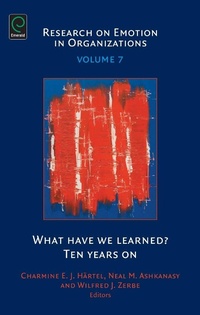
What Have We Learned?
Ten Years on
Published on 29. July 2011
363 pages
978-1-78052-209-8 (ISBN)
Description

The theme of this volume, What Have We Learned? Ten Years On, provides a wonderful tour of the ways in which emotions research has advanced the way in which we conceive of work and its possibilities for adding value to life. The volume is presented in eight parts, so that the reader will can how emotions research has advanced our knowledge and understanding of what comprises work, the experiences and resourcefulness of traditional and non-traditional workers, the drivers of consumer behavior, the dynamics of team behavior, the quality of the leader-member relationship, the demands and skills required of In Extremis work contexts, methods to improve noncognitive assessment, and advances in ways to create and maintain Positive Work Environments. The chapters in this volume leave no doubt in the reader's mind that emotions as energizing and motivating mechanisms demand understanding and attention in order to improve performance and societal value from organizational activities, ensure dignity for workers and consumers, and create workplaces where individuals are engaged and flourishing.
More details
Series
Language
English
Place of publication
Bingley
United Kingdom
Target group
Professional and scholarly
File size
3,46 MB
ISBN-13
978-1-78052-209-8 (9781780522098)
Copyright in bibliographic data and cover images is held by Nielsen Book Services Limited or by the publishers or by their respective licensors: all rights reserved.
Schweitzer Classification
Other editions
Additional editions
Book
07/2011
Emerald Group Publishing Limited
€218.10
Shipment within 10-20 days
Persons
Content
List of Contributors.
Dedication.
About the Editors.
Overview: What Have We Learned? Ten Years On.
Chapter 1 Synthesizing What We Know and Looking Ahead: A Meta-Analytical Review of 30 Years of Emotional Labor Research.
Chapter 2 Understanding the Relationship between Emotional Labor and Effort.
Chapter 3 Tricks of the Trade: Customer Service Employee Strategies in Performing Emotion Work.
Chapter 4 Sales Employee's Emotional Labor: A Question of Image or Support.
Chapter 5 The Role of Emotions in Supporting Independent Professionals.
Chapter 6 Coding Emotions in Complaint Behavior: Comparing the Shaver et al. and Richin's Consumption Emotions Sets.
Chapter 7 Affective Events Theory as a Framework for Understanding Third-Party Consumer Complaints.
Chapter 8 Display Rules and Emotional Labor within Work Teams.
Chapter 9 Emotional Intelligence as a Moderator of the Quality of Leader-Member Exchange and Work-Related Outcomes.
Chapter 10 Managing Negative Emotions in Emergency Call Taking: A Heat-Model of Emotional Management.
Chapter 11 The Measurement of Trait Emotional Intelligence with TEIQue-SF: An Analysis Based on Unfolding Item Response Theory Models.
Chapter 12 Exploring the Antecedent and Consequences of Authenticity of Emotional Expression.
Chapter 13 A Positive Approach to Workplace Bullying: Lessons from the Victorian Public Sector.
Appendix: Conference Reviewers.
What Have We Learned? Ten Years On.
Research on emotion in organizations.
Research on emotion in organizations.
Copyright page.
Dedication.
About the Editors.
Overview: What Have We Learned? Ten Years On.
Chapter 1 Synthesizing What We Know and Looking Ahead: A Meta-Analytical Review of 30 Years of Emotional Labor Research.
Chapter 2 Understanding the Relationship between Emotional Labor and Effort.
Chapter 3 Tricks of the Trade: Customer Service Employee Strategies in Performing Emotion Work.
Chapter 4 Sales Employee's Emotional Labor: A Question of Image or Support.
Chapter 5 The Role of Emotions in Supporting Independent Professionals.
Chapter 6 Coding Emotions in Complaint Behavior: Comparing the Shaver et al. and Richin's Consumption Emotions Sets.
Chapter 7 Affective Events Theory as a Framework for Understanding Third-Party Consumer Complaints.
Chapter 8 Display Rules and Emotional Labor within Work Teams.
Chapter 9 Emotional Intelligence as a Moderator of the Quality of Leader-Member Exchange and Work-Related Outcomes.
Chapter 10 Managing Negative Emotions in Emergency Call Taking: A Heat-Model of Emotional Management.
Chapter 11 The Measurement of Trait Emotional Intelligence with TEIQue-SF: An Analysis Based on Unfolding Item Response Theory Models.
Chapter 12 Exploring the Antecedent and Consequences of Authenticity of Emotional Expression.
Chapter 13 A Positive Approach to Workplace Bullying: Lessons from the Victorian Public Sector.
Appendix: Conference Reviewers.
What Have We Learned? Ten Years On.
Research on emotion in organizations.
Research on emotion in organizations.
Copyright page.
