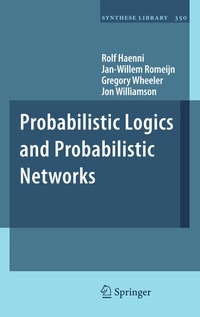
Probabilistic Logics and Probabilistic Networks
Description

Reviews / Votes
"The authors have a wide range of experience in this field and, with this book, they aim at the ambitious and meaningful goal of showing how several distinct approaches to probabilistic logic can be incorporated into a general framework. . It will be particularly appreciated by researchers who would like a unifying view of the several approaches to probabilistic logic." (Renato Pelessoni, Mathematical Reviews, June, 2015)
"The authors of this book come from different academic backgrounds and disciplines (evidential probability [Wheeler, computer science]; probabilistic argumentation [Haenni, computer science]; objective Bayesianism [Williamson, philosophy]; and statistical inference [Romeijn, philosophy and psychology]). Their common interest is to investigate different logical and probabilistic inferential systems and to produce an unified view of inference in probabilistic logic. The group also has an eye toward computational feasibility, leading them to investigate applications of probabilistic networks to the inferential systems they try to unify. This book is the result of research began in 2005 as part of a program called Progic funded by the Leverhulme Trust. The project sponsored a series of excellent conferences centering on the problem of integrating logic and probability. While the focus of the book is probabilistic
and statistical inference, it could perfectly well serve as an introduction to the different inferential systems the authors consider. The book represents a valuable step towards a solution of the difficult and interesting problems which arise when trying to combine probability and logic."Horacio Arlo-Costa, Carnegie Mellon University, Pittsburgh, U.S.A.
'Rolf Haenni, Jan-Willem Romeijn, Gregory Wheeler and Jon Williamson make a heroic tour de force through these theories of probabilistic reasoning, with the aim of identifying a unifying overarching framework.'
Jan Sprenger, Tilburg Center for Logic and Philosophy of Science in Metascience, The Netherlands
Read the complete review: http://www.springerlink.com/content/pr7j017516052304/
More details
Other editions
Additional editions