

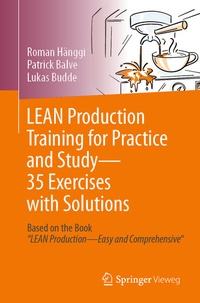
LEAN Production Training for Practice and Study - 35 Exercises with Solutions
Description

No production is perfect. Waste creeps into every process. It makes it slow and expensive. Goods lie around in the warehouse, production takes place in unnecessarily large batches or employees wait unproductively to produce the next part. The result is high production costs and disappointed customers.
Lean Production tackles this waste in all processes. But how do you actually implement the various Lean principles and methods? The success of Lean Production lies in doing, and this is precisely where the book comes in.
The 35 practical exercises show in detail how the Lean approaches can be applied and successfully implemented. The solutions are supplemented with practical tips for implementation from the authors' extensive experience. The exercises are implemented in the LeanClean Inc. with many pictures and diagrams - concrete, simple and comprehensively explained.
More details
Other editions
Additional editions
Persons
Prof. Dr. Roman Hänggi is a Professor of Production Management. He has gained his rich experience in Lean at various hierarchical levels over the course of 25 years in industry. His research focuses on to the ongoing evolution of Lean in the context of digitalization. He provides guidance to numerous industrial companies on their journeys towards becoming operational champions through the integration of Lean and digitalization.
Prof. Dr. Patrick Balve is a Professor of Logistics Planning and Organization. He is particularly interested in the practical implementation of Lean in teaching and practice. His extensive experience of Lean, gained over eight years in the automotive industry and a further five years in applied research, makes him an expert in the field of Lean implementation.
Dr. Lukas Budde is a postdoctoral researcher at the University of St. Gallen. His research interests include the smart factory, complexity management, and service management in industrial companies. He provides guidance to companies on their digitalization journeys, with Lean Production as a fundamental approach.
Content
Preface.- Introduction.- List of abbreviations.- Basics of lean production.- Exercise 1: Process map.- Exercise 2: Value stream analysis + OBC.- Exercise 3: OEE.- Exercise 4: Handling level analysis.- Exercise 5: Operator balance chart (OBC).- Exercise 6: Spaghetti diagram.- Exercise 7: Pareto chart + cp /cpk + first pass yield / yield Exercise 5: Operator Balance Chart (OBC).- Exercise 6: Spaghetti Diagram.- Exercise 7: Pareto Chart + cp /cpk + First Pass Yield / Yield.- Exercise 8: Inventory Analysis.- Exercise 9: 5 S + Waste Walk.- Exercise 10: Zoning + Rank Order Clustering Algorithm.- Exercise 11: SMED + Andler Lot Size.- Exercise 12: Lean Shelf.- Exercise 13: Milkrun + Material Flow Matrix.- Exercise 14: Kanban + Kanban Formula.- Exercise 15: Clocking Out + EPEI.- Exercise 16: Set Formation.- Exercise 17: Sequencing + Johnsson Algorithm.- Exercise 18: Complementary Push Methods (MRP, BoA, BB).- Exercise 19: A3 + Ishikawa Diagram.- Exercise 20: Poka-Yoke.- Exercise 21: Andon.- Exercise 22: KPI.- Exercise 23: Shopfloor Management.- Exercise 24: Change + 8-Step Method.
