

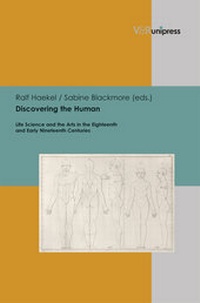
Discovering the Human
Life Science and the Arts in the Eighteenth and Early Nineteenth Centuries
1st Edition
Published on 14. August 2013
204 pages
978-3-8470-0137-9 (ISBN)
Description

'Discovering the Human' investigates the emergence of the modern human sciences and their impact on literature, art and other media in the 18th and 19th centuries. Up until the 1830s, science and culture were part of a joint endeavour to discover and explore the secret of life. The question 'What is life?' unites science and the arts during the Ages of Enlightenment and Romanticism, and at the end of the Romantic period, a shift of focus from the human as an organic whole to the specialized disciplines signals the dawning of modernity. The emphasis of the edited collection is threefold: the first part sheds light on the human in art and science in the Age of Enlightenment, the second part is concerned with the transitions taking place at the turn of the 19th century. The chapters forming the third part investigate the impact of different media on the concept of the human in science, literature and film.
'Discovering the Human' investigates the emergence of the modern human sciences and their impact on literature, art and other media in the 18th and the 19th centuries. Up until the 1830s, science and culture were part of a joint endeavour to discover and explore the secret of life. The question 'What is life?' unites science and the arts during the Ages of Enlightenment and Romanticism, and at the end of the Romantic period, a shift of focus from the human as an organic whole to the specialized disciplines signals the dawning of modernity. The emphasis of the edited collection is threefold: the first part sheds light on the human in art and science in the Age of Enlightenment, the second part is concerned with the transitions taking place at the turn of the 19th century. The chapters forming the third part investigate the impact of different media on the concept of the human in science, literature and film.
'Discovering the Human' investigates the emergence of the modern human sciences and their impact on literature, art and other media in the 18th and the 19th centuries. Up until the 1830s, science and culture were part of a joint endeavour to discover and explore the secret of life. The question 'What is life?' unites science and the arts during the Ages of Enlightenment and Romanticism, and at the end of the Romantic period, a shift of focus from the human as an organic whole to the specialized disciplines signals the dawning of modernity. The emphasis of the edited collection is threefold: the first part sheds light on the human in art and science in the Age of Enlightenment, the second part is concerned with the transitions taking place at the turn of the 19th century. The chapters forming the third part investigate the impact of different media on the concept of the human in science, literature and film.
More details
Other editions
Additional editions
Ralf Haekel | Sabine Blackmore
Discovering the Human
Life Science and the Arts in the Eighteenth and Early Nineteenth Centuries
Book
08/2013
1st Edition
Brill Deutschland
€59.00
Shipment within 7-9 days
Persons
Editor
Dr. Ralf Haekel is Juniorprofessor of English Literature and Culture at Göttingen University. His research interests include Early Modern drama, science in British Romanticism and literature and media studies. His new book 'The Soul in British Romanticism' will be published later this year.
Sabine Blackmore is junior lecturer and research assistant at the English department of Humboldt-Universität, where she is completing her PhD thesis on female melancholy in early eighteenth century poems. Her research interests focus on melancholy and gender before 1800, medicine and literature, as well as crime fiction, topics on which she has published journal articles.
Contributions
Content
- Intro
- Title Page
- Copyright
- Table of Contents
- Body
- Ralf Haekel & Sabine Blackmore: Discovering the Human - An Introduction
- 1. Historical Transitions
- 2. Life
- 3. Language
- 4. Classification
- 5. Science and Art
- 6. Discovering the Human
- References
- I. Eighteenth-Century Science and the Arts
- Christoph Heyl: William Hogarth, Science and Human Nature
- References
- Mascha Hansen: Scientifick Wives - Eighteenth-Century Women Between Self, Society and Science
- References
- Primary Literature
- Secondary Literature
- Sladja Blazan: Immanuel Kant's "One Great Republic" - From Spirit Theory to Moral Philosophy
- The Immaterial World
- Secret Power
- One Great Republic
- The Applicability of Dysfunctional Methodology
- References
- Primary Literature
- Secondary Literature
- II. Romantic Science and the Arts
- Catherine Clinger: Speleological Interiority - The Mindfulness of a Spelunking Anatomist
- References
- Primary Literature
- Secondary Literature
- Ulrike Kristina Köhler: Ann Radcliffe's Gothic - A Subtle Plea for Female Education in the Arts and in the Sciences
- References
- Primary Literature
- Secondary Literature
- Felix C.H. Sprang: The Rise of the "Life Sciences" and the Dismissal of Plant Life in the Late Eighteenth and Early Nineteenth Centuries
- References
- Primary Literature
- Secondary Literature
- III. The Human and Media Change
- Hania Siebenpfeiffer: (Imagining) First Contact - Literary Encounters of the Extraterrestrial Other in Seventeenth- and Eighteenth-Century Novels
- 1. Transforming the Universe - the `pluralité des mondes' and the Question of Life in Outer Space
- 2. First Contact - Francis Godwin's Voyage to the Moon
- 3. Satirical Counterparts - Cyrano de Bergerac meets Domingo Gonzales
- 4. Martian prophecies - Kindermann's Exploration of the Future of Humankind
- 5. Discovering the Human in Outer Space
- References
- Helga Schwalm: Lives of the Physicians - Samuel Johnson, Medicine and Biography
- References
- Primary Literature
- Secondary Literature
- Birgit Mara Kaiser: Electrified Humans - Of Inhuman Affects in Heinrich von Kleist
- The Striking Life of Humans, Between Electricity and Organisms
- Electrified Humans and Inhuman Affects in Kleist
- References
- Primary Literature
- Secondary Literature
- Ute Berns: Artificial Life, Science and Reflexivity in James Whale's Frankenstein
- 1.
- 2.
- 3.
- 4.
- References
