

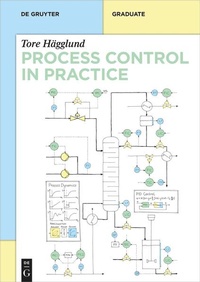
Process Control in Practice
Description

This book covers the most important topics that people working as process control engineers and plant operators will encounter. It focuses on PID control, explains when to use P-, PI-, PD- or PID control as well as PID tuning and includes difficult to control process nonlinearities such as valve stiction or sensor problems. The book also explains advanced control strategies that are necessary when single loop control gives insufficient results.
The key features of the text in front of you are:
- This book is a result of teaching the material to industrial practitioners over three decades and four previous editions in Swedish, each of which was a refi nement of the previous one.
- A key contribution of this book is the careful selection of what is required when you are at a plant and have to make sense of what you see.
- The book is written in such a way that it does not assume mathematical knowledge above the compulsory school level. Process control sits between control engineering and process or chemical engineering and often there is a distinct gap between the two. By explaining both the fundamentals of control and the processes the book is written to appeal to control engineers and process engineers alike.
- The book includes exercises and solutions and thus lends itself for teaching in the classroom.
More details
Other editions
Additional editions
Persons
Tore Hägglund received his M.Sc degree in Engineering Physics in 1978 and his Ph.D degree in Automatic Control in 1984, both from Lund Institute of Technology, Lund, Sweden, where he currently is professor. Between 1985 and 1989 he worked for Alfa Laval Automation (now ABB) with development and implementation of industrial adaptive controllers.
Tore Hägglund has written several books, e.g. PID Controllers: Theory, Design, and Tuning (coauthor K. J. Åström), and Process Control in Practice. His current research interests are in the areas of process control, tuning and adaptation, and supervision and detection, with applications mainly in the pulp and paper industry.
Content
- Intro
- Preface
- A Note on the Translation
- Contents
- 1 Introduction
- 2 Process Types and Step Response Analysis
- 3 PID-Controllers
- 4 PID-Controller Tuning
- 5 Nonlinear Processes
- 6 Control Strategies
- Exercise
- Solutions to the Exercises
- Bibliography
- Index
