

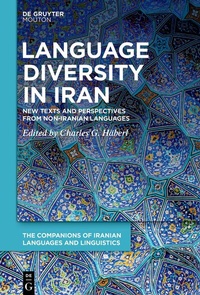
Language Diversity in Iran
New Texts and Perspectives from Non-Iranian Languages
1st Edition
Published on 3. September 2024
XIII, 363 pages
978-3-11-064157-8 (ISBN)
Description

The current companion will offer a survey of the Afroasiatic, Dravidian, Indo-Aryan, and Turkic languages in contact with Iranian languages. Comparatively few of Iran's minority languages are well-documented or even widely known outside of a small cadre of specialists. A volume that organizes sketches of the non-Iranian languages of Iran offers a unique perspective on the history and structure of the Iranian language.
More details
Series
Language
English
Place of publication
Berlin/Boston
Germany
Publishing group
de Gruyter Mouton
Target group
Professional and scholarly
US School Grade: College Graduate Student
Illustrations
3 b/w and 5 col. ill., 130 b/w tbl.
File size
10,75 MB
ISBN-13
978-3-11-064157-8 (9783110641578)
Schweitzer Classification
Other editions
Additional editions
Book
09/2024
1st Edition
De Gruyter Mouton
€139.95
Shipment within 5-7 days
E-Book
09/2024
1st Edition
De Gruyter Mouton
€139.95
Available for download
Person
Charles G. Häberl, Rutgers University, New Brunswick, NJ, USA.
Content
- Intro
- Contents
- List of contributors
- Index of tables
- Index of figures
- Introduction
- 1 A South Azeri variety
- 2 Syriac and Middle Iranian
- 3 Northern Domari
- 4 Kholosi
- 5 Khuzestani Arabic
- 6 Mandaic
- 7 Khalaj
- 8 ?uroyo
- Index
