

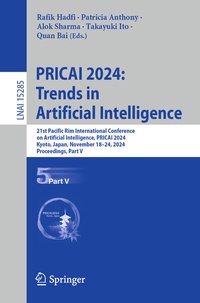
PRICAI 2024: Trends in Artificial Intelligence
Description

The five-volume proceedings set LNAI 15281-15285, constitutes the refereed proceedings of the 21st Pacific Rim International Conference on Artificial Intelligence, PRICAI 2024, held in Kyoto, Japan, in November 18-24, 2024.
The 145 full papers and 35 short papers included in this book were carefully reviewed and selected from 543 submissions.
The papers are organized in the following topical sections:
Part I: Machine Learning, Deep Learning
Part II: Deep Learning, Federated Learning, Generative AI, Natural Language Processing, Large Language Models,
Part III: Large Language Models, Computer Vision
Part IV: Computer Vision, Autonomous Driving, Agents and Multiagent Systems, Knowledge Graphs, Speech Processing, Optimization
Part V: Optimization, General Applications, Medical Applications, Theoretical Foundations of AI
More details
Other editions
Additional editions
Content
.- Optimization.
.- Unmixing Detrital Zircon U-Pb Age Distribution Based on Multi-Objective Optimization.
.- Top-k Rule List Learning via Integer Linear Programming.
.- General Applications.
.- A Robust Airport Detection Method Based on Environment-Insensitive Saliency Analysis .
.- Ethical Alignment in Citizen-Centric AI.
.- An Attention Model based Approach for Leakage Detection in Water Distribution Networks using Normal Pressure Data.
.- VisiDroid: An Approach for Generating Test Scripts from Task Descriptions for Mobile.
.- Fine-grained Modalities Interaction for Cross-Modal Recipe Retrieval .
.- Real-Time Energy Pricing in New Zealand: An Evolving Stream Analysis.
.- Recognition of Hand-drawn Hydrocarbon Structure Formulas Using Anchor Free Detector.
.- A Hybrid Model for Electric Vehicle Charging Infrastructure Planning.
.- Transformers Fusing Wavelet with High-Frequency Enhancement for SAR Ship Detection.
.- Contextual Bandit with Herding Effects: Algorithms and Recommendation Applications.
.- Medical Applications.
.- NETrack: A Lightweight Attention-based Network for Real-time Pose Tracking of Nasal Endoscope Based on Endoscopic Image.
.- Robotic Control of Endoscope Assistance in Skull Base Surgery Based on Adaptive RCM Point.
.- IRL for Restless Multi-Armed Bandits with Applications in Maternal and Child Health.
.- 3D Deformable Convolution for Medical Image Registration.
.- HDF-SegNet: Dynamic Integration of Hierarchical Information for Cardiac Magnetic Resonance Image Segmentation.
.- Theoretical Foundations of AI.
.- Fast solution to the fair ranking problem using the Sinkhorn algorithm.
.- An in-label Prioritizing Variable Branching Strategy of SAT Solvers for Solving a Preferred Extension of Argumentation Frameworks.
.- From First-Order to Second-Order Rationality: Advancing Game Convergence with Dynamic Weighted Fictitious Play.
.- Block Argumentation: Characterising Acceptability Semantics with Two Types of Semantic Constraints.
.- Rapid Cooperative Guidance with Finite Time Convergence.
.- Relative Change-Reluctance in Iterated Belief Revision.
