

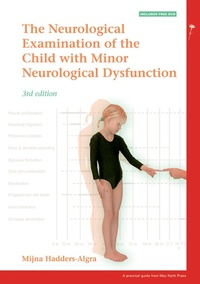
The Neurological Examination of the Child with Minor Neurological Dysfunction
Description

This highly practical book brings the examination of minor neurological dysfunction developed by Bert Touwen and his colleagues in Groningen right up to date, which is timely in view of the increasing interest in and use of this approach. The approach is a detailed and extensive neurological examination with the aim of detecting a possible neurobiological basis for learning, behavioural and motor coordination problems in a child and thus informing decision-making and management. It provides a refined, sensitive and age-appropriate technique, designed to take into account the developmental aspects of the child's rapidly changing nervous system. This third edition of Bert Touwen's classic handbook has been updated by Mijna Hadders-Algra to reflect contemporary clinical practice. A new chapter assesses the reliability and validity of the methodology, and the book now includes norms for comparison, as well as practical management guidelines based on current clinical practice. Entirely new photographs and diagrams illustrate the assessment techniques clearly.
More details
Other editions
Additional editions
Person
Content
- Intro
- Contents
- Foreword Touwen
- Foreword Forsyth
- Acknowledgements
- Chapter 1 Introduction
- Introduction
- Chapter 2 Assessment of minorneurological dysfunction
- History: minimal brain dysfunction and minor neurological dysfunction
- Current application of the assessment of MND
- Chapter 3 Assessment techniqueand psychometric properties
- Development of the Groningen Assessment
- Theoretical and technical aspects of the assessment
- Psychometric properties
- Chapter 4 Assessment of thechild sitting: part I
- Ability to sit
- Posture during sitting (PT)
- Posture with arms extended (PT)
- Involuntary movements during sitting with and without extended arms (I)
- Mouth-opening and finger-spreading phenomenon (A)
- Kicking (Co)
- Reaction to push against the shoulder while sitting (Co)
- Examination of reflexes
- Chapter 5 Assessment of the child standing
- Ability to stand
- Posture during standing, including inspection of the trunk (PT)
- Abdominal skin reflex (R)
- Romberg test (Co)
- Test for involuntary movements (I)
- Reaction to push against the shoulder during standing (Co)
- Diadochokinesis (Co)
- Finger-nose test (Co)
- Fingertip-touching test (Co)
- Finger opposition test (F)
- Follow-a-finger test (F)
- Circle test (F)
- Chapter 6 Assessment ofthe child walking
- Ability to walk
- Posture during walking (PT)
- Walking along a straight line (Co)
- Walking on tiptoe
- Walking on heels
- Standing on one leg (Co)
- Hopping (Co)
- Chapter 7 Assessment of the child lying
- Knee-heel test (Co)
- Chapter 8 Assessment of thechild sitting: part II
- Assessment of processing of sensory information
- Eyes
- EARS
- MOUTH
- Chapter 9 General data
- Quantity of spontaneous motor activity
- Quality of spontaneous motor activity
- Somatognosis - knowledge of body schema
- Hand preference
- Chapter 10 Interpretation of findings
- Introduction: MND in the framework of the International Classification ofFunctioning, Disability and Health: Children and Youth version
- Interpretation of neurological findings
- Specific types of MND
- Application of the assessment in research
- Value in clinical practice
- Concluding remarks
- References
- Index
