

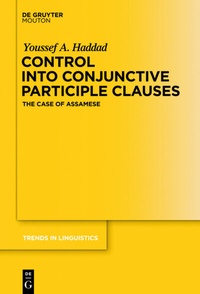
Control into Conjunctive Participle Clauses
Description

The book explores Adjunct Control in Assamese, an Indo-Aryan language spoken in North India by about 15 million people. The author works within the Minimalist Program of syntactic theory. Adjunct Control is a relation of co-referentiality between two subjects, one in the matrix clause and one in the adjunct clause of the same structure. The relevant adjuncts in Assamese are non-finite clauses commonly known as Conjunctive Participle (CNP) clauses.
Four types of Adjunct Control are examined: (i) Forward Control, in which only the matrix subject is pronounced; (ii) Backward Control, in which only the subordinate subject is pronounced; (iii) Copy Control, in which both subjects are pronounced; and (iv) Expletive Control, in which case the two control elements are expletives. While Forward Control is a cross-linguistically common control pattern, Assamese also allows the other three less common structures.
The author analyzes Adjunct Control as movement and provides a detailed account of the conditions that drive and constrain each of the four types of control. The theoretical implications are highlighted.
The book is unique both empirically and theoretically. It is the first monograph which deals with Assamese generative syntax. It is also the first book to explore control structures in a single understudied language in such detail. In addition to Assamese, the book provides data from Telugu, Bengali, Konkani, Marathi, Tamil, and Hindi.
More details
Other editions
Additional editions
Person
Content
- Intro
- Acknowledgments
- Contents
- List of Abbreviations
- Chapter 1 Introduction
- 1. Research questions
- 2. Domain of investigation
- 3. Analytic approach
- 3.1. From Government and Binding to Minimalism: An overview
- 3.1.1. The architecture of the grammar in Government and Binding
- 3.1.2. The architecture of the grammar in the Minimalist Program
- 3.2. Control in Government and Binding
- 3.3. Control in the Minimalist Program
- 3.3.1. The PRO Theory of Control
- 3.3.2. The Movement Theory of Control
- 3.4. Multiple copy spell-out and the realization vs. deletion of copies
- 3.4.1. Deletion of copies
- 3.4.2. Realization of multiple copies
- 4. Structure of the study
- Chapter 2 Assamese Adjunct Control: A descriptive overview
- 1. Introduction
- 2. Linguistic overview
- 3. Case in Assamese: A descriptive overview
- 4. Finite clauses in Assamese
- 5. Nonfinite clauses in Assamese
- 5.1. Infinitive clauses in Assamese
- 5.2. Conjunctive participle clauses in Assamese
- 5.3. The subordinate nature of CNP clauses
- 6. CNP clauses and Adjunct Control
- 6.1. Forward Control in Assamese
- 6.2. Backward Control in Assamese
- 6.3 Copy Control
- 6.4. Exceptions
- 7. Conclusion
- Chapter 3 Forward/Backward Adjunct Control: The analysis
- 1. Introduction
- 2. Forward/Backward Control: The facts
- 2.1. Forward Control
- 2.2. Backward Control
- 3. Assamese Adjunct Control as Obligatory Control
- 4. Assamese Adjunct Control as sideward movement
- 4.1. Forward Control
- 4.1.1. Forward Control as sideward movement
- 4.1.2. Forward Control as sideward plus remnant movement
- 4.2. Backward Control in Assamese
- 5. Multiple Case checking and Copy Control
- 6. Case in raising vs. control
- 6.1. Landau's analysis
- 6.2. Raising vs. control in Assamese
- 6.3. Case in raising vs. control: The counterargument
- 6.3.1. Boeckx and Hornstein's analysis
- 6.3.2. Beyond Assamese: Case and Theta-Role Visibility
- 7. Conclusion
- Chapter 4 Copy Adjunct Control: The analysis
- 1. Introduction
- 2. Copy Control as movement
- 3. Copy Control: The derivational history
- 4. Copy Control and linearization
- 4.1. Multiple copy spell-out
- 4.1.1. Nunes's analysis
- 4.1.2. Fujii's analysis
- 4.2. Multiple copy spell-out and Multiple Spell-Out
- 4.2.1. Multiple Spell-Out and copy raising
- 4.2.2. Multiple Spell-Out and Copy Control
- 5. Adjunction to CP and unwanted sideward movement
- 6. Phonological realization of copies
- 6.1. Movement and the PF realization of copies
- 6.2. Lack of cataphoricity and the nature of the CNP subject
- 7. Conclusion
- Chapter 5 Adjunct Control violations as Expletive Control
- 1. Introduction
- 2. Nonvolitional as unaccusative
- 3. Unaccusative predicates and Expletive Control
- 3.1. Adjunct Control and the target of sideward movement
- 3.2. Expletive Control and cyclic merge
- 4. English Expletive Control
- 5. Conclusion
- Chapter 6 Trigger: Why movement in control?
- 1. Introduction
- 2. Enlightened Self-Interest and control
- 3. Event and control
- 4. CP vs. IP and control
- 4.1. IP as defective for [Person]
- 4.2. IP as defective for [Tense]
- 5. Movement and predication
- 5.1. Theoretical assumptions
- 5.1.1. The merge of adjuncts
- 5.1.2. Predication
- 5.2. CNP clauses as predicative
- 5.3. Sinhala CNP clauses as nonpredicative
- 6. Conclusion
- Chapter 7 Summary and conclusion
- 1. Summary
- 2. Theoretical implications
- 2.1. Multiple Case checking
- 2.2. R-expressions vs. pronominals in Copy Control
- 2.3. Why movement
- 3. Concluding remarks
- Notes
- References
- Index
