

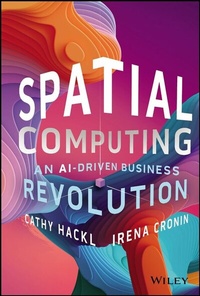
Spatial Computing
Description

The next phase of the internet-multimodal, vision-enabled AI that will transform society
Written by Irena Cronin, renowned consultant in the immersive space, and Cathy Hackl, globally recognized tech & gaming executive, futurist, and speaker, Spatial Computing: An AI-Driven Business Revolution reveals exclusive insider knowledge of what's happening today in the convergence of AI and spatial computing. Spatial Computing is an evolving 3D-centric form of computing that uses AI, Computer Vision, and extended reality to blend virtual experiences into the physical world, breaking free from screens into everything you can see, experience, and know.
Spatial Computing: An AI-Driven Business Revolution includes coverage of:
- The new paradigm of human-to-human and human-computer interaction, enhancing how we visualize, simulate, and interact with data in physical and virtual locations
- Navigating the world alongside robots, drones, cars, virtual assistants, and beyond-without the limitation of just one technology or device
- Insights, tools and illustrative use cases that enable businesses to harness the convergence of AI and spatial computing today and in the decade to come via both hardware and software
The impact of spatial computing is just starting to be felt. Spatial Computing: An AI-Driven Business Revolution is a must-have resource for business leaders who wish to fully understand this new form of revolutionary, evolutionary technology that is expected to be even more impactful than personal computing and mobile computing.
More details
Other editions
Additional editions
Persons
CATHY HACKL is a tech and gaming executive, futurist, podcast host and keynote speaker. She's the CEO of Spatial Dynamics, a spatial computing & AI solutions company, and an expert in augmented reality, spatial computing, AI hardware, wearables, gaming, virtual world strategies, Generation Alpha and strategic foresight. Known in tech circles as the Godmother of the Metaverse, Hackl has been a fixture in the emerging tech industry for almost a decade.
IRENA CRONIN, MBA, is SVP of Product at DADOS Technology and CEO of Infinite Retina. She is an expert in immersive technologies-including augmented reality, virtual reality, and artificial intelligence-and the lead author of The Infinite Retina: Spatial Computing, Augmented Reality, and How a Collision of New Technologies Are Bringing About the Next Tech Revolution.
Content
Foreword: the Inception of Our New Spatial Reality: Immerse Or Die! xi
Introduction: the Converging Frontiers of Ai And Spatial Computing xiii
Setting the Stage xiv
An AI Moment Unlike Any Other xv
The Unforgettable Past: 1st Photo, 1st Movie, 1st Television xvi
The Dawn of VR and AR xvii
The Promise of Spatial Computing xviii
The Imperative for Leaders xix
What Is Spatial Computing? xxi
Other Key Technologies Tied to Spatial Computing xxix
Real- World Use Case Examples xxxi
Who Are the Beneficiaries? xxxiii
Why Good for Business? xxxv
Part 1 The Business Relevance of AI- Driven Spatial Computing 1
1 The AI Revolution: Transforming Today's Business 3
From Aristotle to Today 3
Evolution of AI Applications and Technologies 5
Categories and Types of AI Software 5
NLP and Its Applications 6
CV and Its Role in AI 8
ML and dl and Their Relevance 10
GenAI and Its Creative Potential 12
CV and Spatial Computing 14
Understanding the Intersection of ML/DL and Spatial Computing 15
GenAI's Role in Spatial Computing 17
Hardware Companies Leveraging AI 18
Software Companies with AI-Driven Solutions 20
AI-Driven Decision-Making in Spatial Computing 22
Business Benefits of AI in Spatial Computing 24
Enhanced Decision-Making with AI and Spatial Computing 28
A Look at the Regulatory Environment 29
Future Prospects and Preparation 30
Conclusions: Looking Ahead 30
2 The Evolution of a New Era of Spatial Computing 33
Understanding the Foundations 33
From Science Fiction to Business Reality 34
How Spatial Computing Works 35
Beyond Conversation 38
Current Applications 42
Challenges and Opportunities 49
Conclusions 49
3 The Symbiosis: Spatial Computing and AI 51
Overview of AI-Driven Spatial Applications 52
Business Benefits and Other Human Benefits 64
Future Trends in AI and Spatial Computing 69
Conclusions 72
Part 2 Leadership in the AI-Driven Era of Spatial Computing 75
4 Pioneering Case Studies: Meet the Leaders at the Intersection 77
Big Tech at the Intersection of Spatial Computing and AI 77
Companies Using AR and AI 80
Autonomous Robots and Vehicles 82
AI for Design 84
Future Leaders of Spatial Computing 86
5 Decision- Making and Leadership in the New Era 89
Futures Thinking and Strategic Foresight as Key Skills 92
Spatial Computing Today 94
1. Reassess 3D Needs and Accelerate Innovation 95
2. Integrate AI with an Eye toward Spatial Computing 97
3. Shift Your Focus from Web 2.0 Metrics 98
4. Start to Plan for Sensory Design 99
5. Reimage for a Spatial Context and Format 100
6 The User Experience Revolution 101
A Brief History of User Experience Revolutions 101
How AI and Spatial Computing Redefine Customer Engagement 102
AI as Virtualization 103
Spatial Computing Is the Gateway to New Experiences 104
Customer Experience, User Experience, Employee Experience 106
AI-Driven Spatial Computing in CX, UX, and EX 108
Brand Experience 110
Part 3 Strategy, Implementation, and the Future 113
7 Risks, Challenges, and Ethical Considerations 115
Risks 116
Challenges 119
Ethical Considerations 124
8 Your Spatial Computing and AI Roadmap: From Strategy to Implementation and Beyond 131
Strategic Planning 132
Technology Selection and Integration 134
Implementation 135
Monitoring and Optimization 137
Compliance and Ethics 138
Risk Management 140
Reporting and Communication 142
Future Trends and Adaptation 143
Sustainability and Responsible AI 145
9 Tomorrow and the Next Decade: Looking Ahead at What the Future Holds 147
Continued Integration with Daily Life 148
Enhanced UXs 150
Transformative Applications 151
Ethical and Regulatory Developments 153
Collaboration and Connectivity 154
Cultural and Social Impacts 156
Sustainability and Environmental Considerations 158
Conclusions: Embracing AI-Driven Spatial Computing 159
Notes 161
About the Authors 167
Acknowledgments 169
Index 171
CHAPTER 1
The AI Revolution: Transforming Today's Business
From Aristotle to Today
AI has undergone a remarkable transformation from a mere concept in the annals of science fiction to a pivotal force in contemporary technology and industry. This evolution is a testament to human ingenuity and a reflection of our enduring quest to create intelligent machines.
The conception and evolution of AI have been significantly influenced by philosophical thought, stretching back centuries before the advent of contemporary technology. The inquiries and speculations of ancient, medieval, and early modern philosophers laid a conceptual groundwork that subtly prefigured the development of AI.
In ancient and medieval times, myths and storytelling often featured elements of artificial life and mechanical beings. For example, ancient Greek myths recounted tales of Hephaestus, the god of blacksmiths, who created mechanical servants. These stories reflect an early human fascination with the idea of artificial beings and the possibility of mimicking life or human intelligence.
The contributions of Aristotle, the ancient Greek philosopher, were foundational, particularly in the realm of logic. His work on syllogisms, a form of logical reasoning, and his ideas about categorizing knowledge and deductive reasoning can be seen as early steps toward algorithmic thinking, a cornerstone of modern AI.
During the Renaissance, there was a surge of interest in automata-mechanical devices designed to imitate human or animal actions. These devices, often powered by intricate clockwork mechanisms, were the precursors to modern robotics. The Renaissance marked a period where the intersection of art, science, and technology began to blur, setting a precedent for today's AI innovations.
René Descartes, an Enlightenment philosopher, proposed the concept of mind-body dualism, which separated the mind from the physical world. While his views were more metaphysical than technological, they initiated discussions about the nature of consciousness and intelligence. These debates are central to the philosophical underpinnings of AI, especially when considering the possibility of machine consciousness or sentience.
In the 19th century, figures like Charles Babbage and Ada Lovelace, though not philosophers in the traditional sense, made significant contributions that bridged philosophy and early computing. Babbage's design of the Analytical Engine and Lovelace's recognition of its potential to go beyond mere calculation laid foundational ideas for computational machines and AI.
George Boole, a mathematician and logician of the same era, developed a system of logical algebra that formed the basis for digital circuit design and computer programming. Boolean algebra, with its binary variables, became a critical element in the development of computing and AI.
The early 20th century saw the rise of logical positivism and the Vienna Circle, a group of philosophers and scientists advocating a scientific approach to philosophy grounded in logic and empirical data. This movement influenced later thinking in AI, particularly in the development of algorithms that mimic human reasoning.
Alan Turing, known for his contributions to computer science, also engaged with philosophical questions about machine intelligence. His Turing Test, while a technical proposition, was equally a philosophical one, prompting considerations about when a machine might be regarded as truly "intelligent."
Despite these promising beginnings, AI's journey was not without its challenges. The field experienced periods of high optimism, followed by disappointment and reduced funding, known as "AI winters." These winters were largely due to the limitations of technology at the time, which could not keep pace with the theoretical aspirations of AI researchers.
However, the resurgence of AI in the late 20th and early 21st centuries was fueled by significant advancements in computational power and the availability of large datasets. These developments enabled the creation of more sophisticated ML models and Neural Networks, which could learn and improve from vast amounts of data. DL, a subset of ML involving layered Neural Networks, became a driving force behind many of AI's most impressive feats, from mastering complex games to driving advancements in NLP and image recognition.
The impact of AI has been profound and far-reaching, infiltrating a multitude of industries and aspects of daily life. In manufacturing, AI-driven automation and predictive maintenance have revolutionized production lines. In finance, AI algorithms are used for tasks ranging from fraud detection to algorithmic trading. The healthcare sector has seen significant benefits from AI in areas like diagnostic imaging, drug discovery, and personalized medicine.
AI's influence extends beyond industry to touch the lives of individuals through consumer technologies. Smart assistants, personalized recommendations on streaming platforms, and sophisticated algorithms that moderate content on social media are all examples of AI in action. And more to the point, AI has enhanced the capabilities of Spatial Computing technologies, making them more interactive and immersive.
AI, serving as a foundational component of Spatial Computing, enables the integration of digital and physical spaces in ways that were once the domain of science fiction. To understand the full scope of AI's role in Spatial Computing, it's essential to explore the evolution of AI technologies and applications, the various categories of AI software, and specific fields like NLP, CV, ML, DL, and GenAI.
Evolution of AI Applications and Technologies
Before the advent of Spatial Computing, AI had already begun its transformative journey. Early AI applications were primarily focused on solving specific, well-defined problems, such as playing chess or simple natural language understanding. These applications utilized rule-based systems, where the AI operated within a pre-determined set of guidelines.
As technology advanced, AI applications expanded to more complex tasks. This evolution was supported by the growth in computational power and the availability of large datasets, allowing for more sophisticated AI models. AI started to permeate various sectors as we have stated, from healthcare, where it assisted in diagnostic processes, to finance, where it was used for predictive analytics and risk assessment.
Categories and Types of AI Software
AI software can be broadly categorized into several types:
- Rule-based systems: These are early forms of AI that operate on a set of predefined rules. They are effective for structured, predictable tasks but lack the flexibility to handle complex, unstructured data.
- ML-based systems: ML systems learn from data, identifying patterns and making decisions with minimal human intervention. They are more adaptable than rule-based systems and can improve over time as they are exposed to more data.
- DL-based systems: A subset of ML, DL utilizes Neural Networks with multiple layers (hence "deep") to process data. These systems are particularly effective at handling large volumes of unstructured data, such as images and speech.
- Hybrid systems: These combine various AI techniques, often integrating rule-based components with ML and DL models to leverage the strengths of each approach.
NLP and Its Applications
NLP, a branch of AI, focuses on the interaction between computers and human language. It involves teaching machines to understand, interpret, and generate human language in a meaningful way. Applications of NLP are widespread, including in digital assistants (like Siri and Alexa), machine translation services (like Google Translate), and customer service chatbots.
Core Aspects of NLP
- Language understanding: NLP involves teaching computers to comprehend the nuances of human language, including syntax (sentence structure), semantics (meaning), and pragmatics (contextual use).
- Language generation: Beyond understanding, NLP also enables computers to generate coherent and contextually relevant language responses. This aspect is crucial in applications like chatbots and digital assistants.
- Speech recognition: NLP is not limited to text but also encompasses spoken language, enabling voice-activated systems to understand and respond to verbal commands.
Diverse Applications of NLP
- Digital assistants: Digital assistants like Siri, Alexa, and Google Assistant are quintessential examples of NLP in action. They interpret voice commands, understand queries, and provide responses or perform actions. The sophistication of these assistants has grown significantly, allowing for more natural and contextually aware interactions.
- Machine translation: Services like Google Translate exemplify NLP's application in breaking down language barriers. These services translate text or speech from one language to another, continually improving in accuracy and fluency. While not perfect, they have become remarkably adept at providing quick and generally reliable translations.
- Customer service chatbots: Many businesses now employ chatbots to handle customer inquiries and provide support. These...
