

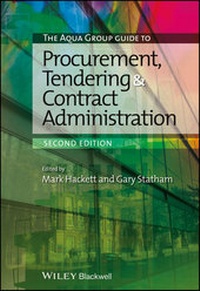
The Aqua Group Guide to Procurement, Tendering and Contract Administration
Description

More details
Other editions
Additional editions
Persons
Mark Hackett, Senior Partner, Mark Hackett Associates, LLP.
Gary Statham, Partner, Mark Hackett Associates, LLP.
Content
Part I Briefing The Project Team 1
1 The Project Team 3
Introduction 3
Parties to a building contract and their supporting teams 3
Rights, duties and responsibilities 4
The employer 5
The architect/contract administrator 5
The quantity surveyor 5
The principal designer 5
The clerk of works 6
The status of named consultants 6
Unnamed consultants with delegated powers 7
The project manager 7
The principal contractor 7
Sub-contractors 9
Statutory requirements 9
The CDM regulations 10
Avoiding disputes 12
Communications 12
2 Assessing the Needs 14
The structure 14
The strategic definition 14
Contribution to the initial project brief 16
The initial programme 17
The appointment 17
Appointment documents 19
Collateral warranties 20
3 Buildings as Assets 21
Buildings as assets as well as buildings 21
Single building or programme? 22
Buildings as solutions to business challenges? 23
Everyday solutions-based thinking 24
Summary 25
Part II Available Procurement Methods 27
4 Principles of Procurement 29
Simple theory - complex practice 29
The eternal triangle 29
Other considerations 32
The Construction (Design and Management) Regulations 2015 32
Risk 33
Accountability 33
Entering into the contract 33
Type of contract 34
Selection of the contractor - the tendering procedure 35
Establishing price and time 35
The dynamics of tendering 36
5 Basic Concepts 37
Economic use of resources 38
Labour 38
Materials 39
Plant 39
Capital 39
Contractor's contribution to design and contract programme 40
Production cost savings 40
Continuity 41
Risk and accountability 41
Accountability 43
Summary 43
6 Accountability 45
Background 45
The modern concept of public accountability 46
Contract documentation 46
Proper price 47
Dispensing with competition 47
Inflation 47
Value for money 48
Summary 49
Contents vii
7 Value and Risk Management 50
Value management 50
Value articulation and project definition 52
Optimisation of benefits and costs 52
Learning lessons and performance optimisation 53
Risk management 54
Risk must be managed 54
Nothing ventured, nothing gained 55
Understanding the project 56
Risk management strategies 57
Allocating management actions 58
Value and risk are complementary 59
Similarities in the processes 63
The integrated process 63
8 Fixed Price and Cost Reimbursement 64
Fixed price 64
Cost reimbursement 65
Application to contract elements 65
Fluctuations 66
Target cost contracts 66
Use 67
The employer's position 67
The contractor's position 67
Programme 68
Summary 69
9 Fixed Price Contracts 70
JCT fixed price contracts 70
The standard building contract 71
Design and build contract 71
Major project construction contract 73
Intermediate building contract 74
Minor works building contract 75
Other fixed price contracts available 75
Advantages and disadvantages of fixed price contracts 76
Advantages 76
Disadvantages 76
10 Cost Reimbursement Contracts 77
The fee 77
The prime cost building contract 78
Characteristics of the form 78
Advantages and disadvantages of cost reimbursement contracts 79
Advantages 79
Disadvantages 80
Budget and cost control 80
Administering the contract 80
Procedure for keeping prime costs 81
Contractor's site staff and direct workforce 81
Materials 82
Plant 82
Credits 82
Sub-letting 83
Defective work 83
Cost control 83
Final account 84
11 Target Cost Contracts 85
Guaranteed maximum price contracts 87
Competition 88
Contract 88
Advantages and disadvantages 89
Use 89
12 Management and Construction Management Contracts 90
Payment and cost control 90
Selection and appointment of the contractor 92
Contract conditions 93
Contract administration 94
Professional advisers 94
Advantages and disadvantages 95
Advantages 95
Disadvantages 95
Construction management 96
Use 97
Programme 97
13 Design and Build Contracts 99
The contract 100
Where to use DB (and when not to do so) 101
Managing the design process 102
Novation 103
Evaluation of submissions 104
Post-contract administration 104
Financial administration 104
Programme 105
Advantages and disadvantages 106
Advantages 106
Disadvantages 106
14 Continuity Contracts 107
Serial contracting 108
Purpose and use 109
Operation 109
Continuation contracts 110
Purpose and use 110
Operation 111
Term contracts 112
Purpose and use 112
JCT Measured Term Contract 113
Operation 113
15 Partnering 115
A definition 115
When to adopt a partnering approach 117
The agreement 117
JCT Partnering Charter 118
JCT Framework Agreement 118
JCT constructing excellence 119
The partnering workshop 119
The benefits 119
The risks 120
Future of partnering 121
16 EU Procurement 122
Introduction 122
The scope of procurement law 123
The general principles 123
Procedures 124
Key principles 124
Evaluating tenderers 124
Evaluating tenders 125
Framework agreements 126
Contract change 127
Cancellation of the process 127
Information obligations debrief and disclosure 127
Commencing proceedings 128
Remedies 128
Complaints to the EU commission and other challenge procedures 129
Tendering contracts 130
Notes 130
Part III Preparing For And Inviting Tenders 131
17 Procedure from Brief to Tender 133
Initial brief 133
Developing the brief 133
Feasibility stage 134
Sketch scheme 134
Costs 135
Procurement 135
Detailed design 136
Programming 137
Design team meetings 138
Drawings 138
Specifications 139
Bills of quantities 140
Specialist sub-contractors and suppliers 140
Quality assurance 140
Obtaining tenders 141
18 Pre-Contract Cost Control 142
Introduction 142
The purpose of pre-contract cost control 142
Framework for pre-contract estimating 143
Order of cost estimate 145
Information used to prepare an order of cost estimate 146
Treatment of on-costs and other costs in order of cost estimates 147
Presenting an order of cost estimate 148
Cost plans 149
Treatment of on-costs and other costs in cost plans 151
Presenting a cost plan 153
Challenges associated with the production of cost plans 155
Cash flow 155
Whole life costs 156
Summary 158
Notes 158
19 Drawings and Schedules 159
The language of drawing 159
The changing role of drawings and documents 159
Quality 162
Standards 162
Quality manuals 162
Quality procedure codes 163
Quality review 164
Types, sizes and layout of drawings 164
Size 165
Layout and revision 165
Scale 166
Nature and sequence of drawing production 167
RIBA Plan of Work 2013 167
Drawings for SBC contracts 167
Drawings for design and build or management contracts 168
Design intent information 169
Computer aided design 170
Drawing file formats and translation 171
Project extranets 171
Contents of drawings 174
Survey plan 174
Site plan, layout and drainage 175
General arrangement 175
Elevations of all parts of the building 177
Descriptive sections 177
Ceiling plans at all floor levels 177
Construction details (scale 1 : 20 and 1 : 10) 177
Large-scale details (scale 1 : 10 and 1 : 15) 178
Schedules 178
Drawings and schedules for records 179
Notes 184
20 Specifications 185
The use of specifications 185
Specifying by prescription 187
Specifying by performance 187
Specifying by description 187
Specification writing 188
Decide on format 188
Collect information 194
Input information 194
Check and test 195
Deliver 195
BIM 196
21 Building Information Modelling 197
The BIM revolution - what is BIM, and who/what is it for? 197
The role of government and its BIM strategy 199
The levels of BIM adoption 202
The BIM journey 203
Plan of work, deliverables and work stages 203
Loading the model: language and libraries 205
Bringing different software programmes together - the search for interoperability 206
Operation and maintenance 207
Terms of appointment and changes to other business practices 208
Level 3 and the future 209
Epilogue 209
Notes 210
22 Bills of Quantities 211
Tender and contract document 211
The wider role 211
Basic information 212
Preliminaries 212
Preambles 213
Measured works 213
Formats 214
23 Sub-contractors 220
Introduction 220
Specialist sub-contractors 221
Design by the sub-contractor 221
The SBC and sub-contract agreements 222
SBC provisions under the main contract 223
24 Obtaining Tenders 224
Introduction 224
Tender list 225
Preliminary enquiry 226
Tender documents and invitation 226
Tender period 227
Tender compliance 227
Late tenders 228
Opening tenders 228
Examination and adjustment of the priced document 228
Negotiated reduction of a tender 229
Notification of results 229
Tender analysis 230
E-Tendering 230
Part IV Contract Administration 231
25 Placing the Contract 233
Preparing and signing the contract documents 233
Sectional completion 234
Contractor's designed portion 234
Executing the contract 235
Performance bonds and parent company guarantees 236
Collateral warranties 236
Third party rights 240
Issue of documents 241
Insurances 242
26 Meetings 245
Initial meeting 245
Introductions 246
Factors affecting the carrying out of the works 246
Programme 247
Sub-contractors and suppliers 248
Lines of communication 248
Financial matters 248
Procedure to be followed at subsequent meetings 250
Contractor's meetings 251
Employer's meetings 251
27 Site Duties 256
The architect on site 256
The architect's duty of inspection and supervision 258
Supervision and Inspection duties 258
Routine site visits 259
Consultants' site visits 260
Inspections by statutory officials 260
Records and reports 261
Samples and testing 262
Considerate constructors scheme 263
Site safety 264
Health and Safety Policy 264
Fire precautions on site 267
Regulatory control 268
The Joint Fire Code 268
Means of escape 269
Fire-fighting equipment 270
Emergency plans 270
Providing information 270
28 Instructions 277
Architect/contract administrator's instructions 277
Clerk of works' directions 279
Format and distribution of instructions 279
29 Variations and Post-Contract Cost Control 281
Variations 281
Valuing variations 282
Dayworks 286
Cost control 287
30 Interim Payments 290
Introduction 290
Payments of pre-determined amounts at regular intervals 292
Pre-determined payments at pre-determined stages 293
Regular payments by detailed valuation 293
Certificates and payments under the SBC 293
The architect/contract administrator 293
The quantity surveyor 294
The employer 294
The contractor 295
Interim certificates under the SBC 296
Unfixed materials and goods on site 298
Unfixed materials and goods off site 298
Retention under the SBC 299
Payments to sub-contractors under the SBC 299
Value added tax 299
Valuation and certificate forms 300
31 Completion, Defects and the Final Account 304
Practical completion 304
Partial possession 307
Possession of the building 307
Defects and making good 308
Final account 309
Adjustment of the contract sum 309
Practical considerations 311
Final certificate 312
32 Delays and Disputes 316
Introduction 316
Delays caused by the contractor 317
Delays caused by the employer or his representatives 317
Delays caused by events outside the control of either party 318
Force majeure 319
Exceptionally adverse weather conditions 319
SBC procedure in the event of delay 320
Best endeavours 320
Notification of delay 321
New completion dates 321
Final adjustment 322
Duties and decisions 322
Reimbursement of loss and/or expense under the SBC 323
Liquidated damages 324
Disputes and dispute resolution 325
Mediation 326
Adjudication 326
Arbitration 330
Litigation 332
33 An Introduction to Sustainability in Construction 335
Sustainable development 335
Key concepts 335
The importance of the environment and the importance of energy 336
Sustainability in the built environment 336
The regulatory framework for construction 337
European Union developments 337
UK regulatory and policy developments 338
Assessing the sustainability of construction and buildings 340
UK building environmental assessment schemes and standards 341
International building environmental assessment schemes and standards 342
Author's comment 343
Sustainable procurement 344
Key concepts 344
Guidance and standards 345
Other important issues 346
References 346
34 Future Trends 349
Global -v- local 349
Industry and corporate trends 351
Opportunities and challenges 352
BIM 352
Lean process and procedures 353
Knowledge management 353
Behaviours 354
Index 357
Chapter 1
The Project Team
Introduction
Since the first editions of the Aqua Group's books, the process of constructing and running a built asset has become increasingly complicated. From inception to completion, through site acquisition, design, tender, contract and construction, each stage of the process is time-consuming and can be considerably expensive. The need to optimise the process is of paramount importance and the best base from which to achieve this is proper and efficient team work. It is therefore vital that all members of the project team are fully conversant, not only with their own role but also with the roles of others and with the inter-relationships at each stage of the project. All members of the project team can then play their part fully and effectively, contributing their particular expertise whenever required.
The make-up of any particular project team will depend upon the scope and complexity of the project, the procurement route and the contractual arrangements selected. There are already many different methods of managing a project and, no doubt, others will be developed in the future. This chapter is set in the context of traditional procurement and, although not exhaustive, provides an indication of the principles involved and the criteria by which other situations can be evaluated.
Parties to a building contract and their supporting teams
The parties to a building contract are the employer and the contractor. Those appointed by these two will complete the project team which can include:
The design team
- *employer
- *architect
- *quantity surveyor
- *principal designer
- project manager
- structural engineer
- building services engineers
- sub-contractors
In addition, the employer may appoint:
- *clerk of works
The construction team
- *contractor and/or principal contractor
- *site agent (or foreman, described in the contract as the person-in-charge)
- sub-contractors
It should be noted, however, that only those marked with an asterisk are mentioned in the Joint Contract Tribunal (JCT) Standard Building Contract With Quantities 2011 Edition (hereinafter referred to as the 'SBC'). This list is not exhaustive and to it could be added planners, landscape consultants, process engineers, programmers and the like. Furthermore, some roles may be combined and roles such as the project manager or principal designer may be fulfilled by individuals, firms or companies from varying technical backgrounds.
Rights, duties and responsibilities
The SBC is comprehensive on the subject of the rights, duties and responsibilities of the employer, the contractor and the other members of the project team mentioned in it. Not all the members of the project team are mentioned in the SBC and those not mentioned will usually be given responsibility by way of delegation from those who are mentioned. The delegation of any duties and/or responsibilities must be spelt out elsewhere in the contract documents and this will usually comprise part of the bills of quantities.
Whatever the size of the project team, all members should be familiar with the contract as a whole and, in particular, with those clauses directly concerning their own work, so that the project can be run smoothly and efficiently. It should be noted that the duties comprise (i) discretionary duties; (ii) mandatory duties; and (iii) statutory duties.
The employer
The employer is referred to throughout the contract and is expressly required to perform specific duties. The vast majority of these duties are codified and are carried out by the architect/contract administrator on behalf of the employer. However, the employer, as one would expect, retains the important duty of payment to the contractor for works which are completed in accordance with the contract. Such is the importance of the payment provisions in the SBC, and indeed in all construction contracts, that failure to adhere to the provisions may lead to statutory repercussions against the employer.
The architect/contract administrator
The architect/contract administrator is named in the contract and, as the designation contract administrator suggests, is not only responsible for carrying out the design of the works but also for the vast majority of the administrative duties under the contract on behalf of the employer. The architect/contract administrator is also the only channel of communication for any un-named consultants with delegated powers. Historically, the architect was recognised as being the person responsible for administering the contract. However, since the designation 'architect' is a protected title under section 20 of the Architects Act 1997, it can be used in business or practice by only those with the requisite education, training and experience. In this regard, if a person happened to carry out the duties of administering the contract and that person was not entitled to practice as an 'architect', then he could be held to be in breach of the Act. The title 'contract administrator' was added in order that other professionals could administer the contract without fear of breaching the Act.
The quantity surveyor
Quantity surveyors are named in the contract and their principal duties are in relation to the payment provisions, value of the works including the value of variations and, if so instructed, ascertainment of any loss and/or expense suffered by the contractor as the consequence of a specified matter.
The principal designer
The Construction (Design and Management) Regulations 2015 (hereinafter referred to as 'CDM 2005'), which came into effect on 6 April 2015, introduced the 'Principal Designer' to the project team (having been previously referred to as the planning CDM co-ordinator in the Construction (Design and Management) Regulations 2007). When a project is notifiable, the principal designer is appointed by the employer, pursuant to regulation 5(1)a of the CDM Regulations. Standard contracts such as the SBC make provision for the appointment of a Principal designer. For instance, Article 5 of the SBC identifies that the Principal designer is the architect/contract administrator unless such other person is appointed.
The Principal designer is required to:
- plan, mange, monitor and co-ordinate matters relating to health and safety during the pre-construction phase to ensure the project is carried out without risks to health and safety;
- liaise with the principal contractor regarding the contents of the health and safety file, the information which the principal contractor needs for preparation of the construction phase plan, and any design development which may affect planning and management of the construction work;
- assist the client in the provision of the pre-construction information required by regulation 4(4) and to provide such of that information as is relevant to designers and contractors as is necessary;
- ensure that designers comply with their duties under Regulation 9 and ensure that all persons working in relation to the pre-construction phase cooperate with the client, the principal designer and each other; and
- prepare and update as necessary the project 'health and safety file' and, at the end of the construction phase, pass that file to the client; and
The clerk of works
The clerk of works may be appointed by the employer to act as an inspector of the works, solely under the direction of the architect/contract administrator. Traditionally, the role would have been taken by an experienced tradesman such as a carpenter, joiner or bricklayer. However, with today's highly complex and high-tech buildings, the architect/contract administrator, who will normally recommend the appointment, may need someone technically experienced or qualified and here the Institute of Clerks of Works will be able to assist in finding the right person. The clerk of works should be ready to take up the duties before the date of possession (how early will depend on the size and complexity of the project) and that person will either be resident on site or will visit the site on a regular basis during the period of the works.
The status of named consultants
While the architect/contract administrator and the quantity surveyor are expressly referred to in the contract and are expressly required to perform specific duties (many clauses include the phrase 'the architect/contract administrator shall'), they are not parties to the contract. Should the contractor have a grievance regarding the named consultants failing to carry out their duties prescribed in the contract, the only contractual recourse is to seek redress from the employer.
Unnamed consultants with delegated powers
The project manager, the structural or any other consulting engineers are not referred to in the contract and nor do they have any express powers under the contract. They do, however, have a duty, as the employer's persons, not to impede the progress of the contractor. Their position within the project team depends on the agreement they have with the employer or the architect. Where they have been given responsibility by way of delegation, perhaps for design or site inspection, they should be named in the contract documents and the extent of their delegated responsibility should be defined so that they have...
