

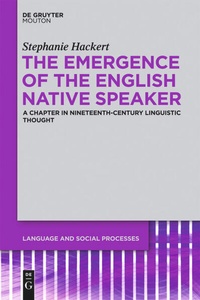
The Emergence of the English Native Speaker
Description

The native speaker is one of the central but at the same time most controversial concepts of modern linguistics. With regard to English, it became especially controversial with the rise of the so-called "New Englishes," where reality is much more complex than the neat distinction into native and non-native speakers would make us believe. This volume reconstructs the coming-into-being of the English native speaker in the second half of the nineteenth century in order to probe into the origins of the problems surrounding the concept today. A corpus of texts which includes not only the classics of the nineteenth-century linguistic literature but also numerous lesser-known articles from periodical journals of the time is investigated by means of historical discourse analysis in order to retrace the production and reproduction of this particularly important linguistic ideology.
Reviews / Votes
"In sum, this book provides a new angle on a key concept, that of the English native speaker, and will provide both information and historical insight to researchers in any of the several fields where this concept has prominence and impact."Kimberly Renée Chopin in: Linguist List 24.2731More details
Other editions
Additional editions
Person
Content
2 - 1 Introduction [Seite 11]
3 - Part I: A discourse-historical approach to the English native speaker [Seite 17]
3.1 - 2 The native speaker in contemporary linguistics [Seite 19]
3.1.1 - 2.1 So what is the problem with the native speaker? [Seite 20]
3.1.2 - 2.2 Defining the native speaker [Seite 22]
3.1.3 - 2.3 The native speaker in the World Englishes context [Seite 24]
3.1.3.1 - 2.3.1 Modeling World Englishes [Seite 25]
3.1.3.2 - 2.3.2 The ownership question: Whose English is it? [Seite 31]
3.1.4 - 2.4 Approaches to the native speaker: Features or historical construct? [Seite 36]
3.1.5 - 2.5 The birth of the English native speaker [Seite 41]
3.2 - 3 Identities, ideologies, and discourse: Toward a theoretical and methodological framework [Seite 43]
3.2.1 - 3.1 Linguistic identities and ideologies [Seite 43]
3.2.2 - 3.2 Discourse as a scientific object [Seite 45]
3.2.3 - 3.3 Discourse as a linguistic object [Seite 47]
3.2.3.1 - 3.3.1 Linguistic approaches to discourse I: Historical discourse analysis [Seite 47]
3.2.3.2 - 3.3.2 Digression: Late-nineteenth century intertextuality and the notion of the discourse community [Seite 50]
3.2.3.3 - 3.3.3 Linguistic approaches to discourse II: Critical Discourse Analysis [Seite 55]
3.2.4 - 3.4 The corpus [Seite 60]
3.2.4.1 - 3.4.1 Socio- and linguistic-historical background [Seite 61]
3.2.4.2 - 3.4.2 Constitution of the corpus [Seite 67]
3.2.4.3 - 3.4.3 A note on quoted material [Seite 70]
3.3 - 4 The ideologies of Marsh (1859): A close reading [Seite 73]
3.3.1 - 4.1 The introduction [Seite 74]
3.3.2 - 4.2 Of native speakers, native languages, and native philology [Seite 82]
3.3.3 - 4.3 Names for English and its speakers [Seite 87]
3.3.4 - 4.4 Summary [Seite 98]
4 - Part II : "Good" English and the "best" speakers: The native speaker and standards of language, speech, and writing [Seite 99]
4.1 - 5 Defining and delimiting "English" and "standard English" [Seite 101]
4.1.1 - 5.1 The native speaker and the standard language in the World Englishes context [Seite 104]
4.1.2 - 5.2 Defining a language: Stability and staticity as theoretical and methodological necessities of nineteenth- and twentieth-century linguistics [Seite 113]
4.1.2.1 - 5.2.1 Nineteenth-century attempts at solving the problem of linguistic heterogeneity [Seite 115]
4.1.2.2 - 5.2.2 The "imagination" of standard English through the OED [Seite 118]
4.2 - 6 The question of standard spoken English and the dialects [Seite 123]
4.2.1 - 6.1 From written to spoken standards for English [Seite 123]
4.2.1.1 - 6.1.1 Standard spoken English: Where is it to be found? [Seite 127]
4.2.1.2 - 6.1.2 English = standard English [Seite 128]
4.2.1.3 - 6.1.3 Standard English = educated English [Seite 129]
4.2.1.4 - 6.1.4 Educated speakers are the "best" speakers [Seite 130]
4.2.1.5 - 6.1.5 Can we not define the standard linguistically? [Seite 134]
4.2.1.6 - 6.1.6 "Educated" = public-school educated [Seite 136]
4.2.1.7 - 6.1.7 Of "natural" educated speakers "to the language born" [Seite 137]
4.2.1.8 - 6.1.8 Educated English = a level of excellence which need not be homogenous in reality [Seite 139]
4.2.1.9 - 6.1.9 Colloquial English and the naturalness problem [Seite 142]
4.2.2 - 6.2 The standard and the dialects [Seite 146]
4.2.2.1 - 6.2.1 Whence the new interest in the dialects? [Seite 146]
4.2.2.2 - 6.2.2 The status of the dialects vis-à-vis the standard language [Seite 147]
4.2.2.3 - 6.2.3 The dialects' contribution to the historicization of the standard language: "Primitive" forms and "Anglo-Saxon" words [Seite 148]
4.2.2.4 - 6.2.4 Preservation of the dialects: "Antique curiosities" or actual means of communication? [Seite 150]
4.2.2.5 - 6.2.5 "Genuine" dialect and "authentic" speakers: The emergence of the NORM [Seite 153]
4.2.2.6 - 6.2.6 Rural, traditional dialects vs. new, urban forms of speech [Seite 157]
4.3 - 7 Spoken vs. written language and the native speaker [Seite 163]
4.3.1 - 7.1 Why are there no native writers? [Seite 163]
4.3.1.1 - 7.1.1 The spoken language, the native speaker, and linguistic theory [Seite 164]
4.3.1.2 - 7.1.2 The relationship of speech and writing before the mid-nineteenth century [Seite 168]
4.3.1.2.1 - 7.1.2.1 The Herderian notion of "Volksstimme" [Seite 170]
4.3.1.2.2 - 7.1.2.2 Coleridge vs. Wordsworth: "Lingua communis" vs. authentic folk speech [Seite 171]
4.3.1.3 - 7.1.3 The ascendancy of spoken language [Seite 174]
4.3.1.3.1 - 7.1.3.1 The significance of spoken language in the second half of the nineteenth century: Max Muller's influential Lectures on the Science of Language [Seite 176]
4.3.1.3.2 - 7.1.3.2 Late nineteenth-century thought on speech and writing [Seite 180]
4.3.1.3.3 - 7.1.3.3 The late-nineteenth century concern with spelling reform and what it implies for the native speaker [Seite 186]
4.3.2 - 7.2 Summary of Part II [Seite 189]
5 - Part III : Language, nation, and race: Of Anglo-Saxons and English speakers conquering the world [Seite 193]
5.1 - 8 Nationalism, racism, and the native speaker [Seite 195]
5.1.1 - 8.1 Nineteenth-century linguistic nationalism [Seite 199]
5.1.2 - 8.2 Language and race [Seite 203]
5.1.3 - 8.3 Language, nation, and race and the writings of Edward A. Freeman [Seite 208]
5.1.4 - 8.4 Language and nation historically: The development of English and its speakers [Seite 215]
5.1.4.1 - 8.4.1 The historical perspective on language, nation, and race: Constructing a venerable history for English [Seite 215]
5.1.4.2 - 8.4.2 R. C. Trench on language as a nation's "moral barometer" [Seite 218]
5.2 - 9 Anglo-Saxonism and the English native speaker [Seite 223]
5.2.1 - 9.1 The rise of Anglo-Saxonism in philology [Seite 224]
5.2.2 - 9.2 Anglo-Saxonism in nineteenth- and early twentieth-century Britain and the U.S.A. [Seite 225]
5.2.2.1 - 9.2.1 The origins myth: Anglo-Saxons and their religious and political heritage [Seite 227]
5.2.2.2 - 9.2.2 Framing Anglo-Saxonism racially: Of superior and inferior peoples [Seite 228]
5.2.2.3 - 9.2.3 Anglo-Saxonism in America [Seite 231]
5.2.2.4 - 9.2.4 Closing the lines: British and U.S. Anglo-Saxons unite [Seite 233]
5.2.3 - 9.3 The development of nationalism in Britain and the U.S. [Seite 241]
5.2.3.1 - 9.3.1 British national identity in the eighteenth and early nineteenth centuries [Seite 242]
5.2.3.2 - 9.3.2 The "moment of Englishness" [Seite 244]
5.2.3.3 - 9.3.3 Language and nationalism in the late nineteenth-century U.S.A. [Seite 246]
5.3 - 10 The language of the world: In praise of English [Seite 251]
5.3.1 - 10.1 English as the greatest language linguistically [Seite 252]
5.3.1.1 - 10.1.1 Vocabulary: Mixed origins [Seite 254]
5.3.1.2 - 10.1.2 English as the great borrowing language [Seite 256]
5.3.1.3 - 10.1.3 English against French [Seite 259]
5.3.2 - 10.2 The English-speaking community [Seite 261]
5.3.2.1 - 10.2.1 The numerological tradition: Pride in the number of English speakers worldwide [Seite 261]
5.3.2.2 - 10.2.2 The three C's: Civilization, commerce, and Christianity [Seite 264]
5.3.2.3 - 10.2.3 Of superior and inferior races and the "great law of contact" [Seite 267]
5.3.3 - 10.3 Threats to the language [Seite 272]
5.3.4 - 10.4 Summary of Part III [Seite 281]
5.4 - 11 Conclusion [Seite 283]
6 - References [Seite 293]
6.1 - Historical sources [Seite 293]
6.2 - Other references [Seite 300]
7 - Author index [Seite 311]
8 - Subject index [Seite 313]
