

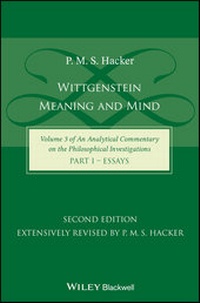
Wittgenstein
Description

More details
Other editions
Additional editions
Person
P. M. S. Hacker is the leading authority on the philosophy of Wittgenstein. He is author of the four-volume Analytical Commentary on the Philosophical Investigations (1980-96), the first two volumes co-authored with G.P. Baker, and of the epilogue Wittgenstein's Place in Twentieth Century Analytic Philosophy (Blackwell, 1996). He has written extensively on philosophy and neuroscience-Philosophical Foundations of Neuroscience (Blackwell, 2003) and History of Cognitive Neuroscience (Wiley Blackwell, 2008), both co-authored with M.R. Bennett. He has published three volumes of a tetralogy on human nature: Human Nature: The Categorial Framework (Blackwell, 2007), The Intellectual Powers: A Study of Human Nature (Wiley Blackwell, 2013), and The Passions: A Study of Human Nature (Wiley Blackwell, 2018). He is currently completing the final volume - The Moral Powers: A Study of Human Nature (forthcoming). Together with Joachim Schulte, he has produced the fourth edition and extensively revised translation of Wittgenstein's Philosophical Investigations (Wiley Blackwell, 2009). They are currently working on a new edition and translation of Wittgenstein's On Certainty.
Content
Introduction to Part I: Essays
Volume 1 of this Analytical Commentary: Wittgenstein: Understanding and Meaning (1st edition 1980, 2nd edition 2005) laid the groundwork for understanding the trajectory of Wittgenstein's thought in his second great masterwork. It explained and gave due prominence to the Augustinian conception of language as informing a multitude of philosophical theories about the nature of language, all of which Wittgenstein aimed to undermine. Conceiving of the essential function of words as naming and of the essential function of sentences as describing stands in the way of an unprejudiced view of the manifold techniques of using words and of the diverse functions of sentences in the stream of human life. These misconceptions give rise to philosophical mythologies of the so called name-relation, logically proper names, sentence-radicals and semantic mood operators, of the idea of a truth-conditional theory of meaning for a natural language, of the notions of determinacy of sense and of the general propositional form. The Augustinian conception of language generates misguided pictures of the relation between language and reality, sentence and fact, proposition and truth-maker, and of ostensive definition as forging a connection between word and world. This in turn contributes to the pervasive illusion that grammar is answerable to reality, or that it reflects, and must reflect, the essential structure of the world. Against this backdrop of Wittgenstein's demythologizing, his radical conception of the nature, scope and limits of philosophy was displayed. He held philosophy to be therapeutic and descriptive, not theoretical and hypothetico-deductive. It destroys idols, but does not replace them. It is a quest for an overview of a segment of logical grammar - of the conceptual network of our language - that gives rise to conceptual questions. The purpose of that quest is the solution or dissolution of the questions. Achievement in philosophy consists in the resolution of philosophical questions, not in the acquisition of new empirical or putatively metaphysical information that provides answers to them. Understanding is indeed attained; but it consists in arriving at a clear vision of what is known and familiar, namely the common grammatical, conceptual, connections of our language. Philosophy contains no theories on the model of the sciences. In its questions, methods and results, philosophy is wholly distinct from science. No scientific discovery can resolve the a priori questions of philosophy, any more than a discovery in physics can resolve an a priori question in mathematics.
Once this had been explained and clarified, it was possible to put Wittgenstein's discussion of understanding into the right perspective. Meaning, explanation of what a word or utterance means, and understanding constitute a triad of key concepts in philosophical investigations into language and the nature of linguistic representation. Reversing the direction of fit between these concepts that was (and still is) presupposed by the prevailing philosophical tradition, Wittgenstein elaborated the consequences of the grammatical propositions that meaning is what is given by an explanation of meaning, and that it is what is understood when the meaning of an utterance is understood. Understanding (which is akin to an ability, rather than being a mental state) and the criteria of understanding assume a dominant role in his description of the network of grammar in this domain. Clarification of the internal relations between meaning, understanding and explanation also illuminates their complex connections with truth, evidence, justification, definition, rules of use, grammatical propositions and so forth. This network of conceptual connections is put to use in elaborating an anthropological, ethnocentric conception of language as opposed to the calculus conception of language that Wittgenstein had embraced in the Tractatus.
Wittgenstein: Rules, Grammar and Necessity, Volume 2 of the Analytical Commentary (1st edition 1985, 2nd edition 2009) examined the complexities and problematic interpretation of Investigations §§185 - 242. Wittgenstein's conception of a rule needed much clarification, especially against the backdrop of the ideas of syntactic and semantic rules advanced by logicians, theoretical linguists and philosophers throughout the twentieth century, and especially in the last thirty years of the century. His animadversion to hidden rules of depth-grammar (prominent in the Tractatus and among contemporary linguistic theorists) needed explaining. His insistence that one cannot follow a rule without knowing and understanding the rule one is following, that a rule is a reason for doing something and not a mere regularity, that rules do not compel but justify, needed elucidation. His insight that, in order for one to be following a rule, the rule and its consideration need not enter into one's action, required clarification: all that is necessary is that one cite it, or would cite it if challenged, ex post actu, as a reason for acting in accordance with the rule. Wittgenstein's elucidation of following a rule and of the connection between rules and practices had to be made clear in order to explain how an internal relation between rule and what accords with it is forged. This led naturally to an examination of Wittgenstein investigations into the internal relations in general, into the nature of logical, mathematical and grammatical internal relations, as well as to his demystification of necessity and demolition of metaphysics.
Volume 3, Wittgenstein: Meaning and Mind (1st edition 1990) is here presented in an extensively revised 2nd edition, which brings it to the same level as that of the previous two revised volumes. It takes the Commentary forward from §243 to §427. These sections are no less controversial than the preceding ones. To be sure, the rocky ground already traversed should have taught one much. But, as one plunges into the tropical undergrowth of the private language arguments, it is all too easy to lose one's bearings. The path is overgrown with prevalent misinterpretations and misunderstandings, and dark distorting shadows are cast across it by the disposition to extract theories from Wittgenstein's descriptions and grammatical statements. Following in his footsteps is not made easier by his ever increasing tendency to dart down a side-path in order to show one a bog here and quicksands there.
The first task is to clarify the position of these arguments in the overall structure of the book. Why is the question of the possibility of a private language raised at this point? In what ways and to what extent do the private language arguments presuppose Wittgenstein's previous arguments and conclusions? In particular, how is the discussion of the possibility of a private language related to the antecedent investigation of rules and following rules?
No less pressing is the need to clarify exactly what a private language is supposed to be, and how that misconceived idea relates to the tradition of Western philosophy and reflection on the nature of public language. More specifically, given that all human languages are public languages, why should anyone be interested in a language that is of necessity intelligible only to its speaker? Wittgenstein's purpose in examining the idea of a private language has itself occasioned much dispute. Was he trying to demonstrate the essential social nature of language, to show that it is not merely an empirical truth that only a social creature can speak a language but that it is an a priori truth? Or was he trying to refute a bizarre form of scepticism about knowing what one means by one's words and whether words have any meaning? Or is his purpose much deeper?
If the subject is disputed, so too is the conclusion. Is he arguing that there can be no private ostensive definitions, or rather that there can be private ostensive definitions but only in the context of a shared public language? How can he argue that there can be no 'private' language, given that the form of words 'a "private" language' is as meaningless as 'a square circle'? Moreover, how can a philosopher who repudiates theses and proofs in philosophy go on to try to prove that there cannot be a private language?
The tactical moves in Wittgenstein's argument are equally subject to divergent interpretation. The mistaken idea that he relies on some version of the verification principle continues to be advanced by critics. The equally misguided idea that he was advancing a form of logical behaviourism is still common. And the supposition that he was defending a form of anti-realist, assertion-conditions semantics as opposed to realist, truth-conditional semantics is still being advanced. These misinterpretations need to be eradicated.
As one moves beyond the private language arguments of §§243 - 315, further, quite different problems arise. How could anyone suggest that 'thinking' is not an activity verb? Is thinking not a paradigm of a mental activity? How can anyone assert that thinking is not an incorporeal process? And how can Wittgenstein say that although I can say what I think, I cannot know what I think? This seems absurd. Similar alarm is raised by his discussion of the imagination. Does one really not see one's mental images with one's mind's eye? Is a mental image of red not a red mental image?...
