

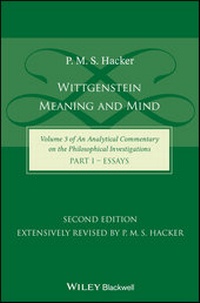
Wittgenstein
Meaning and Mind (Volume 3 of an Analytical Commentary on the Philosophical Investigations), Part 1: Essays
2nd Edition
Published on 4. April 2019
376 pages
978-1-118-95181-1 (ISBN)
Description

Wittgenstein: Meaning and Mind is the third volume of a four-volume analytical commentary on Wittgenstein's Philosophical Investigations, consisting of two parts. Part 1 is a sequence of fifteen essays that examine in detail all the major topics discussed in Philosophical Investigations §§243-427. These include the private language arguments, privacy, private ostensive definition, the nature of the mind, the inner and the outer, behaviour and behaviourism, thought, imagination, the self, consciousness, and criteria. Published in 1990 to widespread acclaim as a scholarly tour de force, the first edition of this volume of essays provides a comprehensive survey of these themes, the history of their treatment in early modern and modern philosophy, the development of Wittgenstein's ideas on these subjects from 1929 onwards, and an elaborate analysis of his definitive arguments in the Investigations.
The new second edition has been thoroughly revised by the author and features four new essays. These include a survey of the evolution of the private language arguments in Wittgenstein's oeuvre and their role within the developing argument of the Investigations, a comprehensive essay on private ownership of experience and its pitfalls, a detailed examination and defence of Wittgenstein's repudiation of subjective knowledge of one's experience, and an overview of the achievement and importance of the private language arguments. Revised essays examine new objections to Wittgenstein's arguments - which are found wanting- and incorporate new materials from the Nachlass that were not known to exist in 1990. All references have been adjusted to the revised fourth edition of the Investigations, but previous pagination in the first and second editions has been retained in parentheses.
These revisions bring the book up to the high standard of the extensively revised editions of Wittgenstein: Understanding and Meaning (Blackwell, 2005) and Wittgenstein: Rules, Grammar and Necessity (Wiley Blackwell, 2009). They ensure that this survey of Wittgenstein's private language arguments and of his accounts of thought, imagination, consciousness, the self, and criteria will remain the essential reference work on the Investigations for the foreseeable future.
More details
Other editions
Additional editions
P. M. S. Hacker
Wittgenstein
Meaning and Mind (Volume 3 of an Analytical Commentary on the Philosophical Investigations), Part 1: Essays
Book
approx. 06/2030
2nd Edition
Wiley-Blackwell
€36.75
The article will not be published
P. M. S. Hacker
Wittgenstein
Meaning and Mind (Volume 3 of an Analytical Commentary on the Philosophical Investigations), Part 1: Essays
Book
04/2019
2nd Edition
Wiley
€109.50
Shipment within 15-20 days
Software
04/2019
Wiley
€120.53
No shipping information available
Previous edition

Content
- Intro
- Title Page
- Copyright Page
- Contents
- Note to the second edition: Part I: Essays
- Acknowledgements to the first edition
- Acknowledgements to the second edition
- Introduction to Part I: Essays
- Abbreviations
- The Essays
- Chapter I Introduction to the private language arguments
- 1. The Augustinian conception of language and Wittgenstein's early commitments
- 2. The place of the private language arguments in the Philosophical Investigations
- 3. The Great Tradition and its long shadow
- 4. From grammatical trivialities to metaphysical mysteries
- (A) Misconceptions about the mental realm
- (B) Misconceptions about names of the mental
- (C) Misconceptions about knowledge of the subjective realm
- (D) Misconceptions about knowledge of the mental states of others
- 5. The dialectic of the mental
- Chapter II Only I can have
- 1. The traditional picture and its predicaments
- 2. Private ownership
- 3. Dispelling conceptual illusions and confusions
- Chapter III Only I can know
- 1. The roots of the problem
- 2. Wittgenstein's response to the classical conception
- 3. Wittgenstein's sketchy account of knowledge
- 4. The cognitive network: connective analysis
- 5. A different route: the functions of the verb 'to know'
- 6. The temptations of the received view resisted
- 7. Further objections rebutted
- Chapter IV Private ostensive definition
- 1. A 'private' language
- 2. Names, ostensive definitions and samples - a reminder
- 3. The vocabulary of a private language
- 4. Idle wheels
- Chapter V Men, minds and machines
- 1. Human beings, their parts and their bodies
- 2. The mind
- 3. Only in the stream of life .
- 4. Homunculi and brains
- 5. Can machines think?
- Chapter VI Avowals and descriptions
- 1. Descriptions of subjective experience
- 2. Descriptions
- 3. Natural expression
- 4. A spectrum of cases
- Chapter VII Behaviour and behaviourism
- 1. Behaviourism in psychology and philosophy
- 2. Wittgenstein: first reactions
- 3. Crypto-behaviourism?
- 4. Body and behaviour
- Chapter VIII Knowledge of other minds: the inner and the outer
- 1. Semi-solipsism
- 2. Inside and outside
- 3. The indeterminacy of the mental
- Chapter IX An overview of the achievement of the private language arguments
- 1. An overview
- 2. Fundamental insights
- 3. Fidelity to philosophical methodology
- 4. Consequences and confusions
- Chapter X Thinking: methodological muddles and categorial confusions
- 1. Thinking: a muddle elevated to a mystery
- 2. Methodological clarifications
- 3. Activities of the mind
- 4. Processes in the mind
- Chapter XI Thinking: the soul of language
- 1. The strategic role of the argument
- 2. The dual-process conception
- 3. Thought, language and the mastery of linguistic skills
- 4. Making a radical break
- Chapter XII Images and the imagination
- 1. Landmarks
- 2. Seeing, imagining and mental images
- 3. Images and pictures
- 4. Visual images and visual impressions
- 5. Imagination, intention and the will
- Chapter XIII I and my self
- 1. Historical antecedents
- 2. 'The I, the I is what is deeply mysterious'
- 3. The eliminability of the word 'I'
- 4. '"I" does not refer to a person'
- Chapter XIV The world of consciousness
- 1. The world as consciousness
- 2. The gulf between consciousness and body
- 3. The certainty of consciousness
- Chapter XV Criteria
- 1. Symptoms and hypotheses
- 2. Symptoms and criteria
- 3. Further problems about criteria
- 4. Evidence, knowledge and certainty
- Index
- EULA
