

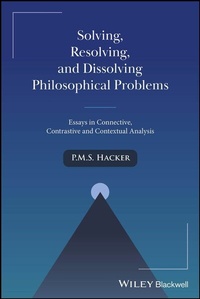
Solving, Resolving, and Dissolving Philosophical Problems
Description

Equips readers with the intellectual tools required to tackle perennial philosophical problems
Solving, Resolving, and Dissolving Philosophical Problems is addressed to all who are interested in philosophical questions. It presupposes little philosophical knowledge, only curiosity and an open mind. It demands a willingness to learn not doctrine but method, and the courage to suspend judgement and to challenge received ideas.
Advocating the method of the 3 C-s: Connective, Contrastive, and Contextual Analysis, the book demonstrates the method by putting it to work - examining fifteen salient philosophical questions that concern all thinking people. It is organized thematically into four parts. Part I introduces questions in philosophy of psychology (the nature of the mind; the mind/body problem; the nature of consciousness and its demystification; knowledge of other minds). Part II deals with epistemological questions (knowledge, belief; memory; imagination, thinking; dreaming). Part III deals with value (the roots of morality; the nature of good and evil; the need for a secular conception of the soul; happiness). The application of the method in the essays produces striking, original and unanticipated results that will give readers pause. The final part of the book articulates in detail the methodology of the 3 C-s exemplified by the fifteen essays and defends it against objections.
Solving, Resolving, and Dissolving Philosophical Problems: On the Methodology of Connective, Contrastive, and Contextual Analysis is an excellent textbook for undergraduate students in introductory philosophy courses alongside more advanced scholars, as well as an invaluable resource for educated general readers with an interest in philosophical methodology.
More details
Other editions
Additional editions
Person
P.M.S. HACKER is an Emeritus Fellow at St John's College, Oxford. He is a leading authority on the philosophy of Wittgenstein. He has also written extensively on philosophy of mind, philosophy and neuroscience, and philosophy of language. He is author of 25 books and 175 papers. His most recent works are the 2nd edition of Philosophical Foundations of Neuroscience (co-authored with the great neuroscientist M. R. Bennett), his human nature tetralogy: Human Nature: the Categorial Framework; The Intellectual Powers; The Passions; The Moral Powers; and A Beginner's Guide to the Later Philosophy of Wittgenstein.
Content
Introduction ix
Acknowledgements xvi
Part I Philosophical Psychology 1
Essay 1 The Nature of the Mind 3
Essay 2 The Nature of Our Body and the Mind/Body Relation 14
Essay 3 What Is Consciousness? 25
Essay 4 Consciousness and Experience or 'What It Is Like to Be a Bat' Revisited 37
Essay 5 Other Minds and Other People 49
Part II Epistemology 61
Essay 6 Knowledge 63
Essay 7 Belief 75
Essay 8 Memory 88
Essay 9 Imagination 101
Essay 10 Thinking 117
Essay 11 On Dreams and Dreaming 131
Part III Axiology 143
Essay 12 The Place of Value in a World of Facts 145
Essay 13 Morality and the Analysis of Moral Goodness 160
Essay 14 Badness, Wickedness, Evil and the Death of the Soul 175
Essay 15 Happiness 190
Part IV Methodology 203
Essay 16 On Method: Connective, Contrastive, and Contextual Analysis 205
Further Reading 224
Index 228
