

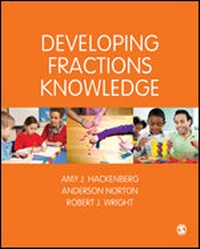
Developing Fractions Knowledge
1st Edition
Published on 21. July 2016
224 pages
978-1-4739-8685-5 (ISBN)
Description

Supporting and understanding your students' fractional knowledge is crucial to their overall grasp of numbers and mathematics. By centralizing around three key stages of development, this effective guide will help you to assess your students' understanding of fractions and modify your teaching accordingly.
These key stages are identified as:
Stage 1a: Fair Sharing
Stage 1b: Part-Whole
Stage 2a: Disembedding and IteratingStage 2b: Measuring with Unit Fractions
Stage 2c: Reversing Fractions
Stage 3a: Fractions as Numbers
Stage 3b: Operating with Fractions
As the newest addition to the bestselling Maths Recovery Series, this book will be a useful guide for all primary classroom teachers and assistants, including experienced Mathematics Recovery instructors.
These key stages are identified as:
Stage 1a: Fair Sharing
Stage 1b: Part-Whole
Stage 2a: Disembedding and IteratingStage 2b: Measuring with Unit Fractions
Stage 2c: Reversing Fractions
Stage 3a: Fractions as Numbers
Stage 3b: Operating with Fractions
As the newest addition to the bestselling Maths Recovery Series, this book will be a useful guide for all primary classroom teachers and assistants, including experienced Mathematics Recovery instructors.
Reviews / Votes
With its beginnings in whole-number arithmetic understanding, Developing Fractions Knowledge is the most comprehensive look at fractions learning to date. It journeys with the practitioner and learner to view fractions as part-whole concepts, measures, and ultimately as numbers with meaning. The assessment and instructional tasks and practical connections to research and Math Recovery principles make it a must-have resource for educators to use again and again! -- Carolyn Olijnek Developing Fractions Knowledge skilfully combines cutting-edge research with practical knowledge of the classroom to provide an essential resource for everyone interested in developing students' understanding of fractions. I can't wait to try some of the tasks and activities with students! -- Dr Janette Bobis, Professor in Mathematics Education, All in, it was an enjoyable book (I have to admit thinking a book on fractions is not one I would choose) and I think would be a worthwhile investment for a department. -- N. G. Macleod The book includes many example assessment tasks and instructional activities to use with pupils who are learning about fractions for the first time, as well as pupils who are struggling and working to relearn concepts.This book provides a comprehensive look at fraction knowledge and understanding. It is a great book for anyone teaching primary maths at any age, but would also be appropriate for a longer-term, on-going departmental professional development. -- Matthew Reames
More details
Series
Edition
First Edition
Language
English
Place of publication
London
United Kingdom
Target group
Professional and scholarly
ISBN-13
978-1-4739-8685-5 (9781473986855)
Copyright in bibliographic data and cover images is held by Nielsen Book Services Limited or by the publishers or by their respective licensors: all rights reserved.
Schweitzer Classification
Other editions
Additional editions
Amy J. Hackenberg | Anderson Norton | Robert J. Wright
Developing Fractions Knowledge
Book
08/2016
1st Edition
SAGE Publications Inc
€172.33
Shipment within 10-20 days
Amy J. Hackenberg | Anderson Norton | Robert J. Wright
Developing Fractions Knowledge
Book
08/2016
1st Edition
SAGE Publications Inc
€106.40
Shipment within 10-20 days
Persons
Dr. Amy J. Hackenberg taught mathematics to middle and high school students for 9 years in L.A. and Chicago, prior to earning a Ph.D. in mathematics education from the University of Georgia. Amy is currently an associate professor of mathematics education at Indiana University-Bloomington. She conducts research on how middle school students construct fractions knowledge and algebraic reasoning and on how teachers can learn to develop productive student-teacher relationships. In her current project she is investigating how to differentiate instruction for diverse middle school students (see https://idream.sitehost.iu.edu/), studying her own teaching as well as working with practicing teachers. She is the proud co-author of the Math Recovery series book, Developing Fractions Knowledge.
Dr. Anderson Norton is a professor in the Department of Mathematics at Virginia Tech. His research focuses on building models of students' mathematical development. This work has generated interdisciplinary collaborations with psychologists and neuroscientists. Prior to this volume, Norton served as chair of the steering committee for the North American Chapter of the International Group for the Psychology of Mathematics Education, co-editor on a pair of publications bridging psychology and mathematics education, and co-author of the Math Recovery series book, Developing Fractions Knowledge.
Dr Robert J. (Bob) Wright holds Bachelor's and Master's degrees in mathematics from the University of Queensland (Australia) and a doctoral degree in mathematics education from the University of Georgia. He is an adjunct professor in mathematics education at Southern Cross University in New South Wales. Bob is an inter-nationally recognized leader in assessment and instruction relating to children's early arithmetical knowledge and strategies, publishing six books, and many articles and papers in this field. His work over the last 25 years has included the development of the Mathematics Recovery Program, which focuses on providing specialist training for teachers to advance the numeracy levels of young children assessed as low-attainers. In Australia and New Zealand, Ireland, the UK, the USA, Canada, Mexico, South Africa and elsewhere, this programme has been implemented widely, and applied extensively to classroom teaching and to average and able learners as well as low-attainers. Bob has conducted several research projects funded by the Australian Research Council including the most recent project focusing on assessment and intervention in the early arithmetical learning of low-attaining 8- to 10-year-olds.
Dr. Anderson Norton is a professor in the Department of Mathematics at Virginia Tech. His research focuses on building models of students' mathematical development. This work has generated interdisciplinary collaborations with psychologists and neuroscientists. Prior to this volume, Norton served as chair of the steering committee for the North American Chapter of the International Group for the Psychology of Mathematics Education, co-editor on a pair of publications bridging psychology and mathematics education, and co-author of the Math Recovery series book, Developing Fractions Knowledge.
Dr Robert J. (Bob) Wright holds Bachelor's and Master's degrees in mathematics from the University of Queensland (Australia) and a doctoral degree in mathematics education from the University of Georgia. He is an adjunct professor in mathematics education at Southern Cross University in New South Wales. Bob is an inter-nationally recognized leader in assessment and instruction relating to children's early arithmetical knowledge and strategies, publishing six books, and many articles and papers in this field. His work over the last 25 years has included the development of the Mathematics Recovery Program, which focuses on providing specialist training for teachers to advance the numeracy levels of young children assessed as low-attainers. In Australia and New Zealand, Ireland, the UK, the USA, Canada, Mexico, South Africa and elsewhere, this programme has been implemented widely, and applied extensively to classroom teaching and to average and able learners as well as low-attainers. Bob has conducted several research projects funded by the Australian Research Council including the most recent project focusing on assessment and intervention in the early arithmetical learning of low-attaining 8- to 10-year-olds.
Content
Introduction
Professional Learning and Three Grand Organizers for Arithmetic Instruction
From Whole Numbers to Fractions
Assessing Stages of Units Coordination
Teaching Students at Stage 1: Fragmenting
Transitioning to Stage 2: Part-Whole Reasoning
Teaching Students at Stage 2: Measuring with Unit Fractions
Teaching Students at Stage 2: Reversible Reasoning
Teaching Students at Stage 3: Fractions as Numbers
Teaching Students at Stages 2 and 3: Equal Sharing of Multiple Items
Teaching Students at Stages 2 and 3: Multiplying Fractions
Teaching Students at Stages 2 and 3: Adding and Subtracting Fractions
Teaching Students at Stages 2 and 3: Dividing Fractions
From Fractions to Algebra
Professional Learning and Three Grand Organizers for Arithmetic Instruction
From Whole Numbers to Fractions
Assessing Stages of Units Coordination
Teaching Students at Stage 1: Fragmenting
Transitioning to Stage 2: Part-Whole Reasoning
Teaching Students at Stage 2: Measuring with Unit Fractions
Teaching Students at Stage 2: Reversible Reasoning
Teaching Students at Stage 3: Fractions as Numbers
Teaching Students at Stages 2 and 3: Equal Sharing of Multiple Items
Teaching Students at Stages 2 and 3: Multiplying Fractions
Teaching Students at Stages 2 and 3: Adding and Subtracting Fractions
Teaching Students at Stages 2 and 3: Dividing Fractions
From Fractions to Algebra
