

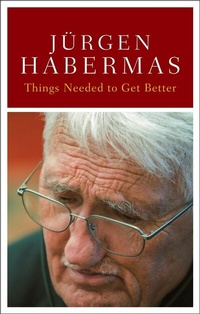
Things Needed to Get Better
Description

In this book Jürgen Habermas offers a wide-ranging reflection on his life and work and on the factors that shaped the development of his thought. He discusses the motives behind his work, the circumstances under which it emerged and the changes it has undergone over the course of his long and productive career. He speaks about the events and the texts that played a decisive role in his thinking and he recounts key encounters with colleagues. The image that emerges is that of a richly intertwined network of relationships which covers large swathes of the intellectual map of the twentieth century and reaches through to the present day.
Looking back at the development of his thought, Habermas discusses the specific historical circumstances that shaped his generation, identifies key experiences with his intellectual mentors, explores recent historical tendencies and political beliefs and talks about his own scholarly works and their reception. Time and again we see the normative impulse that lies behind so much of Habermas's work: 'I view the attempt to make the world even the tiniest bit better, or even just to be part of the effort to stave off the constant threats of regression that we face, as an utterly admirable motive.'
This autobiographical self-reflection by one of the greatest philosophers of our time will be of interest to a wide readership.
More details
Other editions
Additional editions
Persons
Content
2 Frankfurt, a New World and the Old Heidelberg
3 From the Critique of Positivism to the Critique of Functionalist Reason
4 Postmetaphysical Thinking and Detranscendentalized Reason
5 Looking Back on Also a History of Philosophy
6 In Philosophical Discourse with Friends and Colleagues
Editor's Note
Notes
Index
2
FRANKFURT, A NEW WORLD AND THE OLD HEIDELBERG
Mr Habermas, your move from Bonn to Frankfurt, to Adorno at the Institute of Social Research, was no doubt a turning point in your life. How do you look back on that phase of your career today?
The political and, in a sense, also theoretical 'connection' of the Bonn period to the Frankfurt one was made smoother by the fact that I didn't arrive in Frankfurt entirely unprepared. I don't mean my reading of the Dialectic of Enlightenment - I had already bought the first edition by the Amsterdam émigré publisher Querido in Bonn - because that dark literature didn't resonate with my conviction that we had to turn the conditions in Germany inside out. If I recall my first reading of the book correctly, I found Horkheimer's chapter on Juliette bizarre, and as a student writing serious theatre reviews for the FAZ and Frankfurter Hefte, I couldn't yet fully understand Adorno's American experiences with the culture industry. What was far more important with regard to Frankfurt were the intellectual traces of my diligent visits to said communist bookshop in Gummersbach during my school days, and especially the studies I had undertaken since my doctorate to prepare for the aforementioned ideology project. For two years I spent many hours at the library in Bonn studying the economic and democratic theory of the Austro-Marxists, as well as their neo-Kantian literature, the journals of the Second and Third International and works by authors such as Karl Korsch and George Lukács. It was especially when I read those that I had a feeling of regret because 'we can't think like that any more'. And then, literally on the train to Frankfurt, I happened to get my hands on Prisms, which had just been published, in which Adorno no longer applied the legacy of Marxian concepts to modern phenomena in the faded jargon of the tens and twenties, but in a contemporary way, innocently and systematically. And that was in the middle of the political darkness of the anti-communist Adenauer era! This sudden experience of reading a completely unexpected - and literarily brilliant - transposition of familiar, but hitherto obviously only historically interpreted formulations to the present, this updating and recoding of Marxian terminology, provided the momentum with which I travelled to Frankfurt. So the shift to Frankfurt was more than simply another step in my academic training; it was also motivated by particular ideas.
So the transition from Bonn to Frankfurt was also a profound intellectual caesura?
In terms of my intellectual formation, it was as significant as studying again, doing a second degree. My decision to go to Frankfurt wasn't simply a given, by the way. Although Adorno had a very inviting manner in that first conversation when I followed the invitation passed on by Adolf Frisé, I initially went there on my DFG scholarship, without any guarantee of employment at the Institute. I only found out later that Adorno depended on the consent of Horkheimer, who had granted him his first 'own' assistant, as it were, from the Institute's budget. But what I hadn't expected, and overwhelmed me, was something quite different: the Institute was a world unto itself, unique in the early days of the Federal Republic - and by no means just because of its Marxist past and its still left-wing, indeed radical reformist orientation in the midst of a reactionary, post-fascist environment. This opened up a completely new milieu that I wasn't prepared for. My daily contact with 'Teddie' and Gretel Adorno surprised me with the completely natural presence of literary figures and intellectual constellations, intellectual relationships between historic persons whom I saw as belonging to a significant, but essentially bygone period. Suddenly the long-vanished intellectual epoch of the Weimar years, from which we had been cut off by the Nazi period, was part of the everyday present thanks to a circle of significant émigrés. Because now people were referring by first name to figures like Walter Benjamin and Bertolt Brecht, Siegfried Kracauer, Gershom Scholem and Ernst Bloch, Thomas and Erika Mann . an entire cosmos of distant names and persons - most of whom were still alive! It was the presence of an exciting intellectual climate that was completely plausible given Adorno's biography, but which had at most literary significance for me, if that. After all, who in the Germany of 1956 still knew someone like Walter Benjamin, whose newly published first two volumes of collected writings, the brown Suhrkamp volumes, we - in fact it was Ute, with Tilmann in the pram - had just picked up on the Zeil.1 Because Gretel Adorno had asked me to review this first posthumous publication of works by Benjamin. But these texts, with their fascinatingly glittering images and their concepts drawn from a religiously connoted philosophy of history, were so foreign and simultaneously so captivating for me that it took me years to articulate a public response. Daily life at the Institute also felt different from everything I knew: the palpable political and social isolation of returned émigrés; then Horkheimer's manoeuvring, which seemed overcautious from our political perspective, or his genuinely privileged connection to the state premier Zinn and the culture minister, which made him and his circles a great number of enemies at the university; but above all, the presence of Adorno's brilliant intellectual physiognomy - his razor-sharp language, his over-alert intelligence, his inability not to think. All of that just underlined the aloofness - and for us, the young staff, the aura - of this milieu with its unfamiliar mannerisms, its sometimes off-puttingly authoritarian behavioural expectations and its intellectual treasures, which I often sensed more than I really knew them. I should at least mention this fascinating background, which was often embodied ambivalently in the figure of Horkheimer, to explain my identification not only with a school of which I had very limited knowledge, but also with an intellectual and political formation that was quite alien in the Germany of the time.
What was the prevailing intellectual climate at the university back then, and perhaps generally in the city?
The Institute, which was after all a research institute, only opened itself up to tuition during my time there with the introduction of one of the first diploma courses in sociology. I therefore had no close contact with university life. I myself didn't attend any courses, and only occasionally acted as the assistant for one of Adorno's sociological seminars. As far as I could tell, the lines of conflict, not only in the humanities but also in the department of economic and social sciences, still followed the political biographies of the 'established' colleagues and the returning émigrés. But your question about the intellectual climate in the city is interesting. You see, Frankfurt was still the centre of the American occupying power. Its banks and economic significance, its airport and generally its central position on the north-south axis of the 'old' Federal Republic, made the trade fair city one of the country's economic and social hubs. During our studies in Bonn, we had already gone to watch plays in Frankfurt, where Harry Buckwitz was bold enough to stage Brecht in Adenauer's anti-communist Germany. But that this still painfully devastated city would develop not long afterwards into something like the intellectual capital of the 'old' republic - with its concentration of major newspapers and publishers, the not only geographically, but also socially short routes between Westend and St Paul's Church, between the different milieus of the theatres, the publishers, the university and the newspaper desks, and with the book fairs, which were especially turbulent in the sixties and seventies, as an international focus - was something that Ute and I didn't suspect back then, when we moved into a thirty-seven-square-metre attic flat on the corner of Feldbergstrasse and Liebigstrasse with our newborn son. I would say that the spirit of the university fed off the spirit of the city during the fifties. Alexander Kluge, whom we met at the Adornos', wasn't yet the Alexander Kluge. And even Adorno was only just becoming the Adorno whose intellectual presence contributed substantially to the association between the name of the city and the 'Frankfurt School'. I still drew sustenance from that during my third and final Frankfurt period in the eighties and early nineties.
How do you assess your first experiences in Frankfurt today, your relationship with Adorno and his variant of a critical theory? Were you able to reconcile any of his basic philosophical intentions with your own theoretical ambitions in 1956, when you first came to the Institute, and again in 1964, when you returned to Frankfurt from Heidelberg?
To answer that, let me remind you that the teaching of the 'old' critical theory of society, if you will, was only practised in a convincing form by Adorno, not by Horkheimer. Between 1956 and 1969, Adorno was not yet the philosopher he posthumously became through his two major late works.2 In public he was the...
