

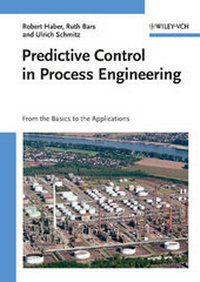
Predictive Control in Process Engineering
From the Basics to the Applications
1st Edition
Published on 19. September 2012
XXIX, 600 pages
978-3-527-63625-9 (ISBN)
Description

Describing the principles and applications of single input, single output and multivariable predictive control in a simple and lively manner, this practical book discusses topics such as the handling of on-off control, nonlinearities and numerical problems. It gives guidelines and methods for reducing the computational demand for real-time applications. With its many examples and several case studies (incl. injection molding machine and waste water treatment) and industrial applications (stripping column, distillation column, furnace) this is invaluable reading for students and engineers who would wish to understand and apply predictive control in a wide variety of process engineering application areas.
More details
Other editions
Additional editions
Software
09/2011
Wiley-VCH
€223.05
No shipping information available
Robert Haber | Ruth Bars | Ulrich Schmitz
Predictive Control in Process Engineering
From the Basics to the Applications
Book
09/2011
1st Edition
Wiley-VCH
€172.00
Article exhausted; check different version
Persons
Robert Haber had studied electrical engineering at the Budapest University of Technology, where he also has received the Ph.D. in control theory. He is currently head of the Laboratory for Process Automation in the Faculty of Process Engineering, Energy and Mechanical Systems at the Cologne University of Applied Sciences. His research interests include process automation, experimental identification, model based control and intelligent process data analysis.
Ruth Bars graduated at the Electrical Engineering Faculty of the Budapest University of Technology, Hungary, where she has gained also her Ph.D. degree. Currently she is associate professor at the Department of Automation and Applied Informatics at the Budapest University of Technology and Economics. Her research interests are in predictive control and in developing new ways of control education. He was involved in IFAC International Federation of Automatic Control as Technical and Coordinating Committee chair.
Ulrich Schmitz studied chemical engineering and plant design at the Cologne University of Applied Sciences. Prior to this he was working as an operator in a petrochemical plant. From 2001 till 2005 he was a scientific assistant at the Cologne University of Applied Sciences and took part in a cooperative doctoral project between the Universities in Cologne and Budapest. In 2007 he received his Ph.D. from the Budapest University of Technology and Economics. Since 2005 he has been working as an APC technologist for Shell Deutschland Oil at the Rhineland Refinery in Germany.
Ruth Bars graduated at the Electrical Engineering Faculty of the Budapest University of Technology, Hungary, where she has gained also her Ph.D. degree. Currently she is associate professor at the Department of Automation and Applied Informatics at the Budapest University of Technology and Economics. Her research interests are in predictive control and in developing new ways of control education. He was involved in IFAC International Federation of Automatic Control as Technical and Coordinating Committee chair.
Ulrich Schmitz studied chemical engineering and plant design at the Cologne University of Applied Sciences. Prior to this he was working as an operator in a petrochemical plant. From 2001 till 2005 he was a scientific assistant at the Cologne University of Applied Sciences and took part in a cooperative doctoral project between the Universities in Cologne and Budapest. In 2007 he received his Ph.D. from the Budapest University of Technology and Economics. Since 2005 he has been working as an APC technologist for Shell Deutschland Oil at the Rhineland Refinery in Germany.
Content
Preface
Notation and Abbreviations
INTRODUCTION TO PREDICTIVE CONTROL
Preview of Predictive Control
Manipulated, Reference, and Controlled Signals
Cost Function of Predictive Control
Reference Signal and Disturbance Preview, Receding Horizon, One-Step-Ahead, and Long-Range Optimal Control
Free and Forced Responses of the Predicted Controlled Variable
Minimization of the Cost Function
Simple Tuning Rules of Predictive Control
Control of Different Linear SISO Processes
Control of Different Linear MIMO Processes
Control of Nonlinear Processes
Control under Constraints
Robustness
Summary
LINEAR SISO MODEL DESCRIPTIONS
Nonparametric System Description
Pulse-Transfer Function Model
Discrete-Time State Space Model
Summary
PREDICTIVE ON-OFF CONTROL
Classical On-Off Control by Means of Relay Characteristics
Predictive Set Point Control
Predictive Start-Up Control at a Reference Signal Change
Predictive Gap Control
Case Study: Temperature Control of an Electrical Heat Exchanger
Summary
GENERALIZED PREDICTIVE CONTROL OF LINEAR SISO PROCESSES
Control Algorithm without Constraints
Linear Polynomial Form of Unconstrained GPC
Tuning the Controller Parameters
Blocking and Coincidence Points Techniques
Measured Disturbance Feed-Forward Compensation
Control Algorithm with Constraints
Extended GPC with Terminal Methods
Summary
PREDICTIVE PID CONTROL ALGORITHMS
Predictive PI(D) Control Structure
Predictive PI Control Algorithm
Predictive PID Control Algorithm
Equivalence between the Predictive PI(D) Algorithm and the Generalized Predictive Control Algorithm
Tuning of Predictive PI(D) Algorithms
Robustifying Effects Applied for Predictive PI(D) Control Algorithms
Summary
PREDICTIVE CONTROL OF MULTIVARIABLE PROCESSES
Model Descriptions
Predictive Equations
The Control Algorithm
Polynomial Form of the Controller (without Matrix Inversion)
Pairing of the Controlled and the Manipulated Variables
Scaling of the Controlled and the Manipulated Variables
Tuning
Decoupling Control
Case Study: Control of a Distillation Column
Summary
ESTIMATION OF THE PREDICTIVE EQUATIONS
LS Parameter Estimation
More-Steps-Ahead Prediction Based on the Estimated Process Model
Long-Range Optimal Single-Process Model Identification
Multi-Step-Ahead Predictive Equation Identification
Comparison of the Long-Range Optimal Identification Algorithms
Case Study: Level Control in a Two-Tank Plant
Summary
MULTIMODEL AND MULTICONTROLLER APPROACHES
Nonlinear Process Models
Predictive Equations
The Control Algorithm
Case Study
Summary
GPC OF NONLINEAR SISO PROCESSES
Nonlinear Process Models
Predictive Equations for the Nonparametric and Parametric Hammerstein and Volterra Models
Control Based on Nonparametric and Parametric Hammerstein and Volterra Models
Control Based on Linearized Models
Control Based on Nonlinear Free and Linearized Forced Responses
Case Study: Level Control of a Two-Tank Plant
Summary
PREDICTIVE FUNCTIONAL CONTROL
Control Strategy and Controller Parameters for a Constant Set Point
PFC for Aperiodic Processes
PFC with Disturbance Feed-Forward
PFC with Constraints
Nonlinear PFC for Processes with Signal-Dependent Parameters
Case Study: Temperature Control of a Hot Air Blower
Summary
CASE STUDIES
Predictive Temperature Control of an Injection Molding Machine
Wastewater Quality Control of an Intermittently Operated Plant
Wastewater Quality Control with Pre-Denitrification
INDUSTRIAL APPLICATIONS
Concentration Control and Pressure Minimization of a Petrochemical Distillation Column
Concentration Control and Reducing Steam Consumption in a Stripping Column
Temperature and Combustion Control of a Gas-Heated Furnace for Chemical Gasoline
PRACTICAL ASPECTS AND FUTURE TRENDS
Classification of a Predictive Control Project
Project Implementation
Implementation of a Predictive Controller
Future Trends
Summary
Notation and Abbreviations
INTRODUCTION TO PREDICTIVE CONTROL
Preview of Predictive Control
Manipulated, Reference, and Controlled Signals
Cost Function of Predictive Control
Reference Signal and Disturbance Preview, Receding Horizon, One-Step-Ahead, and Long-Range Optimal Control
Free and Forced Responses of the Predicted Controlled Variable
Minimization of the Cost Function
Simple Tuning Rules of Predictive Control
Control of Different Linear SISO Processes
Control of Different Linear MIMO Processes
Control of Nonlinear Processes
Control under Constraints
Robustness
Summary
LINEAR SISO MODEL DESCRIPTIONS
Nonparametric System Description
Pulse-Transfer Function Model
Discrete-Time State Space Model
Summary
PREDICTIVE ON-OFF CONTROL
Classical On-Off Control by Means of Relay Characteristics
Predictive Set Point Control
Predictive Start-Up Control at a Reference Signal Change
Predictive Gap Control
Case Study: Temperature Control of an Electrical Heat Exchanger
Summary
GENERALIZED PREDICTIVE CONTROL OF LINEAR SISO PROCESSES
Control Algorithm without Constraints
Linear Polynomial Form of Unconstrained GPC
Tuning the Controller Parameters
Blocking and Coincidence Points Techniques
Measured Disturbance Feed-Forward Compensation
Control Algorithm with Constraints
Extended GPC with Terminal Methods
Summary
PREDICTIVE PID CONTROL ALGORITHMS
Predictive PI(D) Control Structure
Predictive PI Control Algorithm
Predictive PID Control Algorithm
Equivalence between the Predictive PI(D) Algorithm and the Generalized Predictive Control Algorithm
Tuning of Predictive PI(D) Algorithms
Robustifying Effects Applied for Predictive PI(D) Control Algorithms
Summary
PREDICTIVE CONTROL OF MULTIVARIABLE PROCESSES
Model Descriptions
Predictive Equations
The Control Algorithm
Polynomial Form of the Controller (without Matrix Inversion)
Pairing of the Controlled and the Manipulated Variables
Scaling of the Controlled and the Manipulated Variables
Tuning
Decoupling Control
Case Study: Control of a Distillation Column
Summary
ESTIMATION OF THE PREDICTIVE EQUATIONS
LS Parameter Estimation
More-Steps-Ahead Prediction Based on the Estimated Process Model
Long-Range Optimal Single-Process Model Identification
Multi-Step-Ahead Predictive Equation Identification
Comparison of the Long-Range Optimal Identification Algorithms
Case Study: Level Control in a Two-Tank Plant
Summary
MULTIMODEL AND MULTICONTROLLER APPROACHES
Nonlinear Process Models
Predictive Equations
The Control Algorithm
Case Study
Summary
GPC OF NONLINEAR SISO PROCESSES
Nonlinear Process Models
Predictive Equations for the Nonparametric and Parametric Hammerstein and Volterra Models
Control Based on Nonparametric and Parametric Hammerstein and Volterra Models
Control Based on Linearized Models
Control Based on Nonlinear Free and Linearized Forced Responses
Case Study: Level Control of a Two-Tank Plant
Summary
PREDICTIVE FUNCTIONAL CONTROL
Control Strategy and Controller Parameters for a Constant Set Point
PFC for Aperiodic Processes
PFC with Disturbance Feed-Forward
PFC with Constraints
Nonlinear PFC for Processes with Signal-Dependent Parameters
Case Study: Temperature Control of a Hot Air Blower
Summary
CASE STUDIES
Predictive Temperature Control of an Injection Molding Machine
Wastewater Quality Control of an Intermittently Operated Plant
Wastewater Quality Control with Pre-Denitrification
INDUSTRIAL APPLICATIONS
Concentration Control and Pressure Minimization of a Petrochemical Distillation Column
Concentration Control and Reducing Steam Consumption in a Stripping Column
Temperature and Combustion Control of a Gas-Heated Furnace for Chemical Gasoline
PRACTICAL ASPECTS AND FUTURE TRENDS
Classification of a Predictive Control Project
Project Implementation
Implementation of a Predictive Controller
Future Trends
Summary
